
Galahad
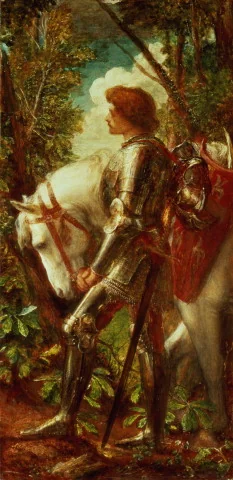
Image from Wikipedia
Image from Wikipedia
Sir Galahad: the brightest knight of the Round Table and the Grail figure of the Arthurian legend
An ideal of purity, faith, and perfection in medieval literature
Sir Galahad, also known as Galaad, is one of the most important figures in the Arthurian legend and is regarded as the central Grail figure of medieval literature. In the transmitted versions, he is the son of Lancelot and Elaine of Corbenic, the daughter of King Pelles, and embodies the rare case of a knight whose destiny is oriented from the very beginning towards perfection, trial, and transcendence. ([de.wikipedia.org](https://de.wikipedia.org/wiki/Galahad?utm_source=openai))
Biography of the legendary figure
Galahad's position within the Round Table is defined by his extraordinary origin and moral exceptionalism. The tradition emphasizes that he is allowed to sit in a chair that is taboo for all other knights; this motif already marks him as the chosen one and as a character beyond the ordinary courtly standard. His story is closely connected to the Grail myth and unfolds mainly in the prose romance The Quest for the Grail. ([de.wikipedia.org](https://de.wikipedia.org/wiki/Galahad?utm_source=openai))
The figure is not just another knight among many, but a literary condensation of the Christian ideal image. In the sources, Galahad is described as the one who not only overcomes adventures but ultimately reaches the Grail, thereby fulfilling the highest goal of chivalric and spiritual pursuit. This is precisely where his uniqueness lies: He is not a combatant of vanity but the executor of a predetermined, exalted calling. ([pantheon.org](https://pantheon.org/articles/g/galahad.html?utm_source=openai))
The central role in the Grail quest
The narrative tradition presents Galahad as the true Grail knight. According to the transmitted depictions, his story is primarily anchored in the Queste del Saint Graal; there he passes the decisive trials and achieves his vision in Sarras at the end, before he dies. This connects his figure with a motif that is rarely developed so consistently in Arthurian literature: victory and transcendence coincide, the goal is achieved, and for this reason, the hero disappears from the world of action. ([pantheon.org](https://pantheon.org/articles/g/galahad.html?utm_source=openai))
This literary trait has made Galahad one of the most striking figures of medieval storytelling. He symbolizes purity, dedication, and the notion that the highest chivalric achievement lies not in possession but in reaching a spiritual state. The sources emphasize this symbolism so strongly that Galahad is still regarded today as the epitome of the pure Grail knight. ([pantheon.org](https://pantheon.org/articles/g/galahad.html?utm_source=openai))
Descent, symbolism, and literary function
Galahad's lineage is central to his significance: As the son of Lancelot and Elaine of Corbenic, he is genealogically connected to two important lines of the Arthurian legend. In later depictions, this condenses into an idealized image that renders his descent as a foreshadowing of his destiny. Thus, even the genealogical construction serves the narrative economy of the myth and sets him apart from the other knights. ([de.wikipedia.org](https://de.wikipedia.org/wiki/Galahad?utm_source=openai))
Research and later reception also often read Galahad as a figure that operates less through dynamism than through prefiguration. The older encyclopedia tradition describes him as being "predestined for the Grail quest" through his lineage and condemned to the obliteration of his own appearance after fulfilling his task. This very mixture of chosen-ness and self-consumption constitutes his literary power. ([en.wikisource.org](https://en.wikisource.org/wiki/1911_Encyclop%C3%A6dia_Britannica/Grail%2C_The_Holy?utm_source=openai))
Reception in literature and cultural history
Galahad's afterlife extends far beyond the medieval romance. Later adaptations and accompanying figures in Arthurian literature repeatedly revisit his origin, his purity, and his quest for the Grail, making him a cultural key figure of the European chivalric ideal. Modern mentions and reinterpretations also show how firmly his name remains anchored in cultural memory. ([de.wikipedia.org](https://de.wikipedia.org/wiki/Galahad?utm_source=openai))
The enduring fascination is based on the tension between human origin and superhuman claim. While Galahad is the son of a famous knight, his true significance lies in overcoming worldly standards. This transforms him into a figure whose essence thrives less on action than on radiance — an ideal of purity that shapes the Arthurian world to this day. ([pantheon.org](https://pantheon.org/articles/g/galahad.html?utm_source=openai))
What makes Galahad intriguing to this day
Galahad remains fascinating because he radically sharpens the ideal of the perfect knight. In him, origin, trial, faith, and fulfillment converge into one of the most memorable figures of the Arthurian legend. Those interested in literature, myth, and medieval symbolism encounter in Galahad a figure that not only accompanies the Grail myth but decisively defines it. ([pantheon.org](https://pantheon.org/articles/g/galahad.html?utm_source=openai))
His story illustrates how powerful a figure can be that lives less through external conflicts than through inner determination. This very mix of heroic form and spiritual asceticism makes Galahad one of the lasting icons of European narrative tradition. Anyone who wishes to experience the depth of the Arthurian legend cannot overlook him. ([pantheon.org](https://pantheon.org/articles/g/galahad.html?utm_source=openai))
Official channels of Galahad:
- Instagram: no official profile found
- Facebook: no official profile found
- YouTube: no official profile found
- Spotify: no official profile found
- TikTok: no official profile found
Sources:
- Wikipedia – Galahad
- Encyclopedia.com – Sir Galahad
- Pantheon.org – Galahad
- Encyclopedia.com – Galahad
- Wikipedia: Image and text source