
Duisburg
Forsthausweg 2, 47057 Duisburg, Deutschland
University of Duisburg-Essen, Duisburg Campus | Address & Parking
The Duisburg campus of the University of Duisburg-Essen is a location that stands out for visitors, students, and staff primarily due to its clear structure and its good integration into the Ruhr area. Upon arrival, one quickly realizes that it is not a single compact area, but rather a campus with several distinct sections, understandable maps, and an infrastructure designed for orientation, short distances, and practical accessibility. This combination makes the location particularly interesting for anyone looking for the Duisburg campus, wanting to gather information in advance, or needing a reliable overview of the address, directions, parking, and buildings. The official UDE communication clearly shows that Duisburg is one of the central university locations and that orientation is best achieved through specific area designations, official maps, and building finders. For everyday life at a large university, this is an advantage, as one not only knows the postal address but also understands how the campus functions internally, which paths lead to which buildings, and where the most important points of contact are. ([uni-due.de](https://www.uni-due.de/en/university/addresses.shtml))
Address and Directions to Duisburg Campus
The official postal address of Duisburg Campus is University of Duisburg-Essen, Forsthausweg 2, 47057 Duisburg. This clearly locates the site and can be easily found in navigation systems, map applications, and on the university's pages. It is particularly important for visitors that UDE describes the campus not only through this central address but also through a network of stops, building sections, and access routes. This facilitates planning for both spontaneous visits and appointments, lectures, exams, or meetings in the faculties. The university also emphasizes that it is represented with two large campus locations and the University Hospital Essen in the Ruhr metropolis. Duisburg is therefore not an isolated single location but part of a larger university system organized across two cities, which also brings different travel options. Those coming from Duisburg Central Station can use various lines depending on their destination area. For areas L, M, and SG, UDE mentions tram 901 towards Duisburg Zoo/Uni and bus 933 towards Duisburg University. For area M, bus 926 towards Duisburg Uni Nord-Lotharstraße is also relevant. For area ST, the university refers to tram 901 to Thyssen Tor 30 and the subsequent signage. Area B is even reachable on foot from the main train station. For arrival by car, UDE specifies concrete routes via A2, A3, and A40 with the exit Duisburg-Kaiserberg, as well as via A59 with the exit Duisburg-Mitte, Koloniestraße. This combination of postal address, stops, and access logic makes travel planning manageable for various target groups. ([uni-due.de](https://www.uni-due.de/en/university/addresses.shtml))
Parking Garage at Duisburg Campus: Opening Hours, Access, and E-Charging Stations
A significant advantage for anyone driving to Duisburg Campus is the new parking garage at the site. Since November 2024, it has been available to staff, students, and guests, making it a relevant component for the practical accessibility of the campus. UDE describes the parking garage as a modern solution that not only creates parking space but also organizes usage clearly. The facility is open Monday to Friday from 6 AM to 10 PM. These time slots are intentionally chosen and serve both safety and regulated operation within the approved daytime hours, according to the university. Different access forms are provided for entry: staff are to enter via access transponders, while students and guests gain access through license plate recognition. Additionally, a signpost at the entrance indicates the number of free spaces, making arrival on site much more pleasant. There is also concrete information regarding electric mobility: Currently, there is one e-charging station installed, located on level 0 near the exit. According to UDE, it would even be structurally possible to equip up to one-third of the parking spaces with charging options, but the currently usable station is initially intended only for university vehicles. It is also important for cyclists to know that there are no bicycle parking spaces in the parking garage itself, but several covered bicycle parking spaces are planned at Duisburg Campus. This shows how strongly UDE focuses on organized mobility, safety, and a gradual development of infrastructure. ([uni-due.de](https://www.uni-due.de/verwaltung/gebaeudemanagement/faq_parkhaus_du.php))
Campus Areas L, M, B, SG, and ST
The Duisburg campus is not organized as a contiguous block but is divided into several clearly defined areas. This structure helps with orientation when searching for specific institutes, lecture halls, or service points. UDE provides an overview of the areas L, M, B, SG, and ST. L includes Lotharstraße 55 to 65, M includes Lotharstraße 1 to 21 as well as Mülheimer Straße, B includes Bismarckstraße 69 to 90, SG includes Geibelstraße 41, and ST includes Friedrich-Ebert-Straße 12. This division is very helpful for first-time visits because the designations reappear on official maps, in building finders, and on signposts. Once the structure is understood, one can navigate much more quickly than if the entire campus were described as a single area. Additionally, UDE names different travel options for the individual areas. For L, M, and SG, tram 901 and bus 933 are important, area M is also accessible via bus line 926, and area ST is accessed via tram 901 and the paths through Thyssen Tor. Area B is even reachable on foot from the main train station, and there is a bus connection between area B and the L/M area via the stops Oststraße, Duisburg Schweizer Straße, and Duisburg University. This further supports the idea of viewing the campus not just as an address but as a small urban orientation system. Those working with these designations can plan meetings, events, and directions more precisely and save a lot of time on site. Especially for a campus that includes several groups of buildings, this internal readability is one of the greatest advantages. ([uni-due.de](https://www.uni-due.de/scies/campusmaps.shtml))
Lecture Hall Center, Libraries, and Virtual Orientation
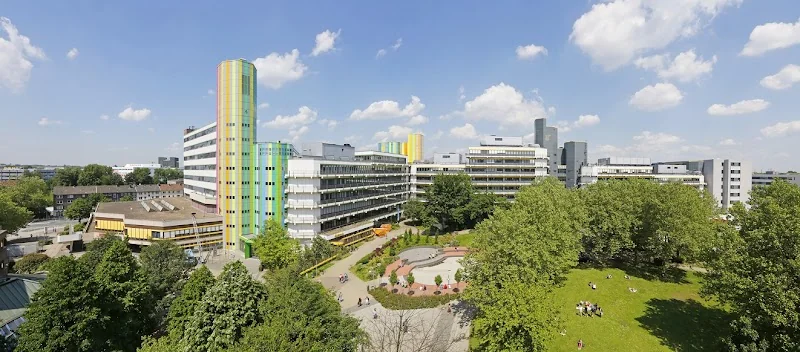
The practical strength of Duisburg Campus includes not only the paths and access routes but also the buildings where teaching, research, and services are bundled. The official building overview of the university lists, among other things, the lecture hall center LA at Lotharstraße 65, buildings LB, LC, LD, LE, LF, and LH, building LK, the Audimax LX, the Gerhard-Mercator-Haus LR, building LM at Forsthausweg 11, and building LN, referred to as NETZ, located at Carl-Benz-Straße 199. Additional areas include LG at Forsthausweg 2, which is exactly at the official campus address, as well as the M area at Lotharstraße 1, the parking garage PH1-D at Carl-Benz-Straße, and several buildings in B, SG, SI, SK, and other locations. For visitors, this variety may seem large at first glance, but it actually forms a very functional network of lecture halls, workspaces, and service buildings. The library information from UDE is particularly helpful: At Duisburg Campus, there is the specialized library LK in building LK, the specialized library BA in area B at BA 149, and the specialized library MC in area M at MC 272. The official page provides location maps and virtual orientations, so one is guided through the campus not only textually but also visually. At this point, the keyword photos or image material becomes relevant, as UDE works with maps, building views, and orientation aids that make the location tangible. Therefore, anyone wanting to understand Duisburg Campus before an appointment will find not only addresses on the official pages but a whole orientation system that significantly eases the way to lecture halls, libraries, and entrances. ([uni-due.de](https://www.uni-due.de/de/universitaet/gebaeudefinder))
History of the University of Duisburg-Essen
The Duisburg campus is also historically interesting because it belongs to a university whose current form is relatively young, but whose roots go back much further. The University of Duisburg-Essen was established on January 1, 2003, through the merger of the former universities or comprehensive universities of Duisburg and Essen. The official chronicle of UDE documents that the founding decision was made in late 2002 in the state parliament, the actual merger took place in early 2003, and a multi-year founding and establishment phase followed, which was officially completed in 2006. For the development of the campus, this means: the current location is part of a modern, newly structured university but stands in a longer educational and urban historical tradition. The chronicle also points out that the founding of the former comprehensive universities in Duisburg and Essen took place as early as 1972 and that these decisions were related to the higher education policy developments of the time. This makes it understandable why the university should not only be viewed as a current place of teaching and research but also as a result of a longer transformation of the higher education landscape in the Ruhr area. Among the notable milestones in recent history, according to the chronicle, is the first joint course catalog in 2004 and the founding of the University Alliance Metropole Ruhr in 2007 together with the universities of Bochum and Dortmund. For the external perception of Duisburg Campus, this is relevant because it reflects the mix of continuity and reorganization: historical origins but modern organization. Therefore, anyone visiting the location enters not only a functional university campus but a place where the development of higher education in the region can be read in a compressed form. ([uni-due.de](https://www.uni-due.de/ub/archiv/chronik_ude.php))
Duisburg Campus and Essen Campus in the Joint University System
For the search intentions surrounding Duisburg Campus, it is also important to look at Essen Campus, as the University of Duisburg-Essen is consciously organized as a two-city university. The official address page refers to three major locations, two campuses, and the University Hospital Essen. This makes it clear that Duisburg Campus is not standing alone but is part of a university-networked infrastructure that extends over Duisburg and Essen. For visitors, this is especially relevant when they are looking for appointments, libraries, or service facilities of UDE and need to differentiate between the locations. The campus maps of the university therefore show not only Duisburg but also Essen as its own, independently labeled location with clear maps and public transport connections. In Duisburg itself, orientation is primarily organized through areas L, M, B, SG, and ST as well as through the parking garage, lecture halls, and specialized libraries. In Essen, UDE further leads with its own location map and its own stops. For the overall perception of Duisburg Campus, this is an advantage because the location understands itself as part of a larger system that connects subject diversity and spatial separation. Therefore, anyone searching for photos, maps, directions, or parking usually wants not just an address but a functional overall picture: Where do I arrive? Where do I find my area? Where do I park? Where is the next lecture hall or library? The official UDE pages answer these questions with maps, building overviews, traffic information, and the new parking garage. Therefore, Duisburg Campus is particularly strong when viewed as a clearly labeled, well-connected university location within a larger university network. ([uni-due.de](https://www.uni-due.de/en/university/addresses.shtml))
Sources:
Show moreShow less
University of Duisburg-Essen, Duisburg Campus | Address & Parking
The Duisburg campus of the University of Duisburg-Essen is a location that stands out for visitors, students, and staff primarily due to its clear structure and its good integration into the Ruhr area. Upon arrival, one quickly realizes that it is not a single compact area, but rather a campus with several distinct sections, understandable maps, and an infrastructure designed for orientation, short distances, and practical accessibility. This combination makes the location particularly interesting for anyone looking for the Duisburg campus, wanting to gather information in advance, or needing a reliable overview of the address, directions, parking, and buildings. The official UDE communication clearly shows that Duisburg is one of the central university locations and that orientation is best achieved through specific area designations, official maps, and building finders. For everyday life at a large university, this is an advantage, as one not only knows the postal address but also understands how the campus functions internally, which paths lead to which buildings, and where the most important points of contact are. ([uni-due.de](https://www.uni-due.de/en/university/addresses.shtml))
Address and Directions to Duisburg Campus
The official postal address of Duisburg Campus is University of Duisburg-Essen, Forsthausweg 2, 47057 Duisburg. This clearly locates the site and can be easily found in navigation systems, map applications, and on the university's pages. It is particularly important for visitors that UDE describes the campus not only through this central address but also through a network of stops, building sections, and access routes. This facilitates planning for both spontaneous visits and appointments, lectures, exams, or meetings in the faculties. The university also emphasizes that it is represented with two large campus locations and the University Hospital Essen in the Ruhr metropolis. Duisburg is therefore not an isolated single location but part of a larger university system organized across two cities, which also brings different travel options. Those coming from Duisburg Central Station can use various lines depending on their destination area. For areas L, M, and SG, UDE mentions tram 901 towards Duisburg Zoo/Uni and bus 933 towards Duisburg University. For area M, bus 926 towards Duisburg Uni Nord-Lotharstraße is also relevant. For area ST, the university refers to tram 901 to Thyssen Tor 30 and the subsequent signage. Area B is even reachable on foot from the main train station. For arrival by car, UDE specifies concrete routes via A2, A3, and A40 with the exit Duisburg-Kaiserberg, as well as via A59 with the exit Duisburg-Mitte, Koloniestraße. This combination of postal address, stops, and access logic makes travel planning manageable for various target groups. ([uni-due.de](https://www.uni-due.de/en/university/addresses.shtml))
Parking Garage at Duisburg Campus: Opening Hours, Access, and E-Charging Stations
A significant advantage for anyone driving to Duisburg Campus is the new parking garage at the site. Since November 2024, it has been available to staff, students, and guests, making it a relevant component for the practical accessibility of the campus. UDE describes the parking garage as a modern solution that not only creates parking space but also organizes usage clearly. The facility is open Monday to Friday from 6 AM to 10 PM. These time slots are intentionally chosen and serve both safety and regulated operation within the approved daytime hours, according to the university. Different access forms are provided for entry: staff are to enter via access transponders, while students and guests gain access through license plate recognition. Additionally, a signpost at the entrance indicates the number of free spaces, making arrival on site much more pleasant. There is also concrete information regarding electric mobility: Currently, there is one e-charging station installed, located on level 0 near the exit. According to UDE, it would even be structurally possible to equip up to one-third of the parking spaces with charging options, but the currently usable station is initially intended only for university vehicles. It is also important for cyclists to know that there are no bicycle parking spaces in the parking garage itself, but several covered bicycle parking spaces are planned at Duisburg Campus. This shows how strongly UDE focuses on organized mobility, safety, and a gradual development of infrastructure. ([uni-due.de](https://www.uni-due.de/verwaltung/gebaeudemanagement/faq_parkhaus_du.php))
Campus Areas L, M, B, SG, and ST
The Duisburg campus is not organized as a contiguous block but is divided into several clearly defined areas. This structure helps with orientation when searching for specific institutes, lecture halls, or service points. UDE provides an overview of the areas L, M, B, SG, and ST. L includes Lotharstraße 55 to 65, M includes Lotharstraße 1 to 21 as well as Mülheimer Straße, B includes Bismarckstraße 69 to 90, SG includes Geibelstraße 41, and ST includes Friedrich-Ebert-Straße 12. This division is very helpful for first-time visits because the designations reappear on official maps, in building finders, and on signposts. Once the structure is understood, one can navigate much more quickly than if the entire campus were described as a single area. Additionally, UDE names different travel options for the individual areas. For L, M, and SG, tram 901 and bus 933 are important, area M is also accessible via bus line 926, and area ST is accessed via tram 901 and the paths through Thyssen Tor. Area B is even reachable on foot from the main train station, and there is a bus connection between area B and the L/M area via the stops Oststraße, Duisburg Schweizer Straße, and Duisburg University. This further supports the idea of viewing the campus not just as an address but as a small urban orientation system. Those working with these designations can plan meetings, events, and directions more precisely and save a lot of time on site. Especially for a campus that includes several groups of buildings, this internal readability is one of the greatest advantages. ([uni-due.de](https://www.uni-due.de/scies/campusmaps.shtml))
Lecture Hall Center, Libraries, and Virtual Orientation
The practical strength of Duisburg Campus includes not only the paths and access routes but also the buildings where teaching, research, and services are bundled. The official building overview of the university lists, among other things, the lecture hall center LA at Lotharstraße 65, buildings LB, LC, LD, LE, LF, and LH, building LK, the Audimax LX, the Gerhard-Mercator-Haus LR, building LM at Forsthausweg 11, and building LN, referred to as NETZ, located at Carl-Benz-Straße 199. Additional areas include LG at Forsthausweg 2, which is exactly at the official campus address, as well as the M area at Lotharstraße 1, the parking garage PH1-D at Carl-Benz-Straße, and several buildings in B, SG, SI, SK, and other locations. For visitors, this variety may seem large at first glance, but it actually forms a very functional network of lecture halls, workspaces, and service buildings. The library information from UDE is particularly helpful: At Duisburg Campus, there is the specialized library LK in building LK, the specialized library BA in area B at BA 149, and the specialized library MC in area M at MC 272. The official page provides location maps and virtual orientations, so one is guided through the campus not only textually but also visually. At this point, the keyword photos or image material becomes relevant, as UDE works with maps, building views, and orientation aids that make the location tangible. Therefore, anyone wanting to understand Duisburg Campus before an appointment will find not only addresses on the official pages but a whole orientation system that significantly eases the way to lecture halls, libraries, and entrances. ([uni-due.de](https://www.uni-due.de/de/universitaet/gebaeudefinder))
History of the University of Duisburg-Essen
The Duisburg campus is also historically interesting because it belongs to a university whose current form is relatively young, but whose roots go back much further. The University of Duisburg-Essen was established on January 1, 2003, through the merger of the former universities or comprehensive universities of Duisburg and Essen. The official chronicle of UDE documents that the founding decision was made in late 2002 in the state parliament, the actual merger took place in early 2003, and a multi-year founding and establishment phase followed, which was officially completed in 2006. For the development of the campus, this means: the current location is part of a modern, newly structured university but stands in a longer educational and urban historical tradition. The chronicle also points out that the founding of the former comprehensive universities in Duisburg and Essen took place as early as 1972 and that these decisions were related to the higher education policy developments of the time. This makes it understandable why the university should not only be viewed as a current place of teaching and research but also as a result of a longer transformation of the higher education landscape in the Ruhr area. Among the notable milestones in recent history, according to the chronicle, is the first joint course catalog in 2004 and the founding of the University Alliance Metropole Ruhr in 2007 together with the universities of Bochum and Dortmund. For the external perception of Duisburg Campus, this is relevant because it reflects the mix of continuity and reorganization: historical origins but modern organization. Therefore, anyone visiting the location enters not only a functional university campus but a place where the development of higher education in the region can be read in a compressed form. ([uni-due.de](https://www.uni-due.de/ub/archiv/chronik_ude.php))
Duisburg Campus and Essen Campus in the Joint University System
For the search intentions surrounding Duisburg Campus, it is also important to look at Essen Campus, as the University of Duisburg-Essen is consciously organized as a two-city university. The official address page refers to three major locations, two campuses, and the University Hospital Essen. This makes it clear that Duisburg Campus is not standing alone but is part of a university-networked infrastructure that extends over Duisburg and Essen. For visitors, this is especially relevant when they are looking for appointments, libraries, or service facilities of UDE and need to differentiate between the locations. The campus maps of the university therefore show not only Duisburg but also Essen as its own, independently labeled location with clear maps and public transport connections. In Duisburg itself, orientation is primarily organized through areas L, M, B, SG, and ST as well as through the parking garage, lecture halls, and specialized libraries. In Essen, UDE further leads with its own location map and its own stops. For the overall perception of Duisburg Campus, this is an advantage because the location understands itself as part of a larger system that connects subject diversity and spatial separation. Therefore, anyone searching for photos, maps, directions, or parking usually wants not just an address but a functional overall picture: Where do I arrive? Where do I find my area? Where do I park? Where is the next lecture hall or library? The official UDE pages answer these questions with maps, building overviews, traffic information, and the new parking garage. Therefore, Duisburg Campus is particularly strong when viewed as a clearly labeled, well-connected university location within a larger university network. ([uni-due.de](https://www.uni-due.de/en/university/addresses.shtml))
Sources:
University of Duisburg-Essen, Duisburg Campus | Address & Parking
The Duisburg campus of the University of Duisburg-Essen is a location that stands out for visitors, students, and staff primarily due to its clear structure and its good integration into the Ruhr area. Upon arrival, one quickly realizes that it is not a single compact area, but rather a campus with several distinct sections, understandable maps, and an infrastructure designed for orientation, short distances, and practical accessibility. This combination makes the location particularly interesting for anyone looking for the Duisburg campus, wanting to gather information in advance, or needing a reliable overview of the address, directions, parking, and buildings. The official UDE communication clearly shows that Duisburg is one of the central university locations and that orientation is best achieved through specific area designations, official maps, and building finders. For everyday life at a large university, this is an advantage, as one not only knows the postal address but also understands how the campus functions internally, which paths lead to which buildings, and where the most important points of contact are. ([uni-due.de](https://www.uni-due.de/en/university/addresses.shtml))
Address and Directions to Duisburg Campus
The official postal address of Duisburg Campus is University of Duisburg-Essen, Forsthausweg 2, 47057 Duisburg. This clearly locates the site and can be easily found in navigation systems, map applications, and on the university's pages. It is particularly important for visitors that UDE describes the campus not only through this central address but also through a network of stops, building sections, and access routes. This facilitates planning for both spontaneous visits and appointments, lectures, exams, or meetings in the faculties. The university also emphasizes that it is represented with two large campus locations and the University Hospital Essen in the Ruhr metropolis. Duisburg is therefore not an isolated single location but part of a larger university system organized across two cities, which also brings different travel options. Those coming from Duisburg Central Station can use various lines depending on their destination area. For areas L, M, and SG, UDE mentions tram 901 towards Duisburg Zoo/Uni and bus 933 towards Duisburg University. For area M, bus 926 towards Duisburg Uni Nord-Lotharstraße is also relevant. For area ST, the university refers to tram 901 to Thyssen Tor 30 and the subsequent signage. Area B is even reachable on foot from the main train station. For arrival by car, UDE specifies concrete routes via A2, A3, and A40 with the exit Duisburg-Kaiserberg, as well as via A59 with the exit Duisburg-Mitte, Koloniestraße. This combination of postal address, stops, and access logic makes travel planning manageable for various target groups. ([uni-due.de](https://www.uni-due.de/en/university/addresses.shtml))
Parking Garage at Duisburg Campus: Opening Hours, Access, and E-Charging Stations
A significant advantage for anyone driving to Duisburg Campus is the new parking garage at the site. Since November 2024, it has been available to staff, students, and guests, making it a relevant component for the practical accessibility of the campus. UDE describes the parking garage as a modern solution that not only creates parking space but also organizes usage clearly. The facility is open Monday to Friday from 6 AM to 10 PM. These time slots are intentionally chosen and serve both safety and regulated operation within the approved daytime hours, according to the university. Different access forms are provided for entry: staff are to enter via access transponders, while students and guests gain access through license plate recognition. Additionally, a signpost at the entrance indicates the number of free spaces, making arrival on site much more pleasant. There is also concrete information regarding electric mobility: Currently, there is one e-charging station installed, located on level 0 near the exit. According to UDE, it would even be structurally possible to equip up to one-third of the parking spaces with charging options, but the currently usable station is initially intended only for university vehicles. It is also important for cyclists to know that there are no bicycle parking spaces in the parking garage itself, but several covered bicycle parking spaces are planned at Duisburg Campus. This shows how strongly UDE focuses on organized mobility, safety, and a gradual development of infrastructure. ([uni-due.de](https://www.uni-due.de/verwaltung/gebaeudemanagement/faq_parkhaus_du.php))
Campus Areas L, M, B, SG, and ST
The Duisburg campus is not organized as a contiguous block but is divided into several clearly defined areas. This structure helps with orientation when searching for specific institutes, lecture halls, or service points. UDE provides an overview of the areas L, M, B, SG, and ST. L includes Lotharstraße 55 to 65, M includes Lotharstraße 1 to 21 as well as Mülheimer Straße, B includes Bismarckstraße 69 to 90, SG includes Geibelstraße 41, and ST includes Friedrich-Ebert-Straße 12. This division is very helpful for first-time visits because the designations reappear on official maps, in building finders, and on signposts. Once the structure is understood, one can navigate much more quickly than if the entire campus were described as a single area. Additionally, UDE names different travel options for the individual areas. For L, M, and SG, tram 901 and bus 933 are important, area M is also accessible via bus line 926, and area ST is accessed via tram 901 and the paths through Thyssen Tor. Area B is even reachable on foot from the main train station, and there is a bus connection between area B and the L/M area via the stops Oststraße, Duisburg Schweizer Straße, and Duisburg University. This further supports the idea of viewing the campus not just as an address but as a small urban orientation system. Those working with these designations can plan meetings, events, and directions more precisely and save a lot of time on site. Especially for a campus that includes several groups of buildings, this internal readability is one of the greatest advantages. ([uni-due.de](https://www.uni-due.de/scies/campusmaps.shtml))
Lecture Hall Center, Libraries, and Virtual Orientation
The practical strength of Duisburg Campus includes not only the paths and access routes but also the buildings where teaching, research, and services are bundled. The official building overview of the university lists, among other things, the lecture hall center LA at Lotharstraße 65, buildings LB, LC, LD, LE, LF, and LH, building LK, the Audimax LX, the Gerhard-Mercator-Haus LR, building LM at Forsthausweg 11, and building LN, referred to as NETZ, located at Carl-Benz-Straße 199. Additional areas include LG at Forsthausweg 2, which is exactly at the official campus address, as well as the M area at Lotharstraße 1, the parking garage PH1-D at Carl-Benz-Straße, and several buildings in B, SG, SI, SK, and other locations. For visitors, this variety may seem large at first glance, but it actually forms a very functional network of lecture halls, workspaces, and service buildings. The library information from UDE is particularly helpful: At Duisburg Campus, there is the specialized library LK in building LK, the specialized library BA in area B at BA 149, and the specialized library MC in area M at MC 272. The official page provides location maps and virtual orientations, so one is guided through the campus not only textually but also visually. At this point, the keyword photos or image material becomes relevant, as UDE works with maps, building views, and orientation aids that make the location tangible. Therefore, anyone wanting to understand Duisburg Campus before an appointment will find not only addresses on the official pages but a whole orientation system that significantly eases the way to lecture halls, libraries, and entrances. ([uni-due.de](https://www.uni-due.de/de/universitaet/gebaeudefinder))
History of the University of Duisburg-Essen
The Duisburg campus is also historically interesting because it belongs to a university whose current form is relatively young, but whose roots go back much further. The University of Duisburg-Essen was established on January 1, 2003, through the merger of the former universities or comprehensive universities of Duisburg and Essen. The official chronicle of UDE documents that the founding decision was made in late 2002 in the state parliament, the actual merger took place in early 2003, and a multi-year founding and establishment phase followed, which was officially completed in 2006. For the development of the campus, this means: the current location is part of a modern, newly structured university but stands in a longer educational and urban historical tradition. The chronicle also points out that the founding of the former comprehensive universities in Duisburg and Essen took place as early as 1972 and that these decisions were related to the higher education policy developments of the time. This makes it understandable why the university should not only be viewed as a current place of teaching and research but also as a result of a longer transformation of the higher education landscape in the Ruhr area. Among the notable milestones in recent history, according to the chronicle, is the first joint course catalog in 2004 and the founding of the University Alliance Metropole Ruhr in 2007 together with the universities of Bochum and Dortmund. For the external perception of Duisburg Campus, this is relevant because it reflects the mix of continuity and reorganization: historical origins but modern organization. Therefore, anyone visiting the location enters not only a functional university campus but a place where the development of higher education in the region can be read in a compressed form. ([uni-due.de](https://www.uni-due.de/ub/archiv/chronik_ude.php))
Duisburg Campus and Essen Campus in the Joint University System
For the search intentions surrounding Duisburg Campus, it is also important to look at Essen Campus, as the University of Duisburg-Essen is consciously organized as a two-city university. The official address page refers to three major locations, two campuses, and the University Hospital Essen. This makes it clear that Duisburg Campus is not standing alone but is part of a university-networked infrastructure that extends over Duisburg and Essen. For visitors, this is especially relevant when they are looking for appointments, libraries, or service facilities of UDE and need to differentiate between the locations. The campus maps of the university therefore show not only Duisburg but also Essen as its own, independently labeled location with clear maps and public transport connections. In Duisburg itself, orientation is primarily organized through areas L, M, B, SG, and ST as well as through the parking garage, lecture halls, and specialized libraries. In Essen, UDE further leads with its own location map and its own stops. For the overall perception of Duisburg Campus, this is an advantage because the location understands itself as part of a larger system that connects subject diversity and spatial separation. Therefore, anyone searching for photos, maps, directions, or parking usually wants not just an address but a functional overall picture: Where do I arrive? Where do I find my area? Where do I park? Where is the next lecture hall or library? The official UDE pages answer these questions with maps, building overviews, traffic information, and the new parking garage. Therefore, Duisburg Campus is particularly strong when viewed as a clearly labeled, well-connected university location within a larger university network. ([uni-due.de](https://www.uni-due.de/en/university/addresses.shtml))
Sources:
Upcoming Events
No events found
Frequently Asked Questions
Reviews
Natalka
7. March 2025
I am still waiting for my diploma, 4 months after my thesis got graded. No information from the examination office, they only replied when I complained to the Rectorate (and then the Rectorate itself stopped responding). I've worked hard for 2 years for this and now I'm looking for a job, which is difficult because employers don't understand why I don't have my diploma yet when I've finished my Master's. I have never seen anything close to this dirt-level organisation. When I was still studying, there was a cyber attack and all the students' data was leaked to the dark web. Since then, I have received more spam emails and calls from shady telemarketers than usual. I am an international student and I do not recommend this university if you value your sanity. I don't know what else to do, as emailing and waiting doesn't work, I've decided to just let any potential international student know that they should consider other universities. Even if the students and professors are fantastic people, they cannot hide the train wreck that is this university.
Manir Hossain
26. June 2025
A good environment for Bachelor, Master and research students.
Name Ist verborgen
27. March 2025
I'm in the Red Library and my hands are freezing. That's because they deliberately don't heat the place to please Putin. There are a lot of people here who just want to study and have nothing to do with politics or solidarity. The university has very little money. Those who want to study here will soon be laughed at when they graduate. Invest your education in other places.
M. Al-Mulla
21. January 2022
My university where I spent very good time.
Babak Fazeli
22. July 2023
It's almost two years, they were not able to resolve their Network Issues. Still no Internet Access for Students rather than their own. Entire Infrastructure needs a reorganization.