
Duisburg
Ehinger Str. 117, 47249 Duisburg, Deutschland
Tiger & Turtle - Magic Mountain | Directions & Parking
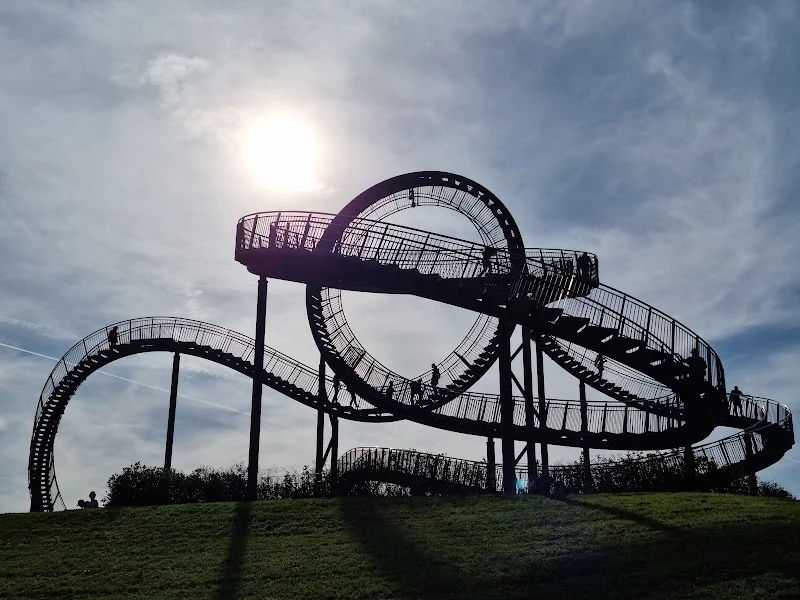
Tiger & Turtle - Magic Mountain is not an ordinary attraction, but a walkable large sculpture, a viewpoint, and a strong symbol of the industrial culture of the Ruhr area. Those who visit the landmark in Duisburg do not experience a loud amusement park, but an unusual change of perspective: steel curves, inclines, and a looping that cannot be entered for safety reasons lead step by step through a work of art that appears calm and clear during the day and transforms into a glowing line in the sky at night through 880 LEDs. The facility on Heinrich-Hildebrand-Höhe is freely accessible, open around the clock, and has been one of the most well-known motifs of the city since 2011. Because Tiger & Turtle connects art, views, and city history, the location is one of those places that should not only be seen but consciously experienced. On a clear day, the view extends over Duisburg, the Rhine, and as far as Düsseldorf; at the same time, the industrial surroundings with steelworks, Logport areas, and renaturalized green spaces remain part of the overall experience. Those who make the journey should wear sturdy shoes, allow time for the ascent, and bring a desire for architecture, landscape, and photo opportunities. ([www-aufbau.duisburg.de](https://www-aufbau.duisburg.de/tourismus/stadt_erleben/industriekultur/tiger-and-turtle))
Directions and Parking at Tiger & Turtle
Search queries related to Tiger & Turtle often revolve around practical access, and this is where the official visitor information provides clear guidance. You can reach the landmark by car via Ehinger Straße or Kaiserswerther Straße in 47249 Duisburg. It is important to note: Angerpark does not have its own parking spaces. The city of Duisburg points out that parking is generally available in the surrounding residential areas. For tour buses, parking options are provided along Ehinger Straße between Hermann-Rinne-Straße and Richard-Seiffert-Straße. If you are arriving by public transport, take tram line 903 to the stop “Tiger & Turtle.” This direct public transport connection is particularly pleasant for an outing because the walk afterwards becomes part of the visitor experience: only after getting off does the view of the hill, the green spaces of Angerpark, and finally the curved silhouette of the sculpture slowly open up. This is exactly what makes the location so suitable for day trips, photo tours, and spontaneous detours from the southern part of Duisburg. In the context of keyword analysis, access is a central theme because visitors primarily search for terms like access, parking, and public transport. For the content strategy, this means: practical orientation is not just an accessory here, but one of the most important user signals. ([www-aufbau.duisburg.de](https://www-aufbau.duisburg.de/tourismus/stadt_erleben/industriekultur/tiger-and-turtle))
Opening Hours, Free Admission, and Visitor Rules
Tiger & Turtle is one of the rare attractions that is not bound by traditional opening hours. According to the city of Duisburg, the facility is open day and night, and admission is free. This makes the visit particularly attractive for those planning sunsets, blue hour, or night shots. Especially in the dark, the sculpture reveals its special effect, as 880 LEDs trace the twists of the steel track against the night sky. At the same time, there are clear safety rules: in case of severe weather, strong winds, snow, or ice, Tiger & Turtle may be closed for safety reasons. Therefore, if you are planning a specific tour, you should remain somewhat flexible in case of unstable weather and pay attention to local notices. Practically, this means: the visit is generally uncomplicated, but not arbitrary. Sturdy footwear is explicitly advisable, as the path over the curved inclines and stairs requires attention both in dry and wet conditions. This contrast between free accessibility and clear self-responsibility is part of the charm. You do not come for a rigidly timed program, but for an open place where art, landscape, and weather together determine the mood. This makes Tiger & Turtle interesting not only for tourists but also for locals who can experience the place anew at different times of the day. ([www-aufbau.duisburg.de](https://www-aufbau.duisburg.de/tourismus/stadt_erleben/industriekultur/tiger-and-turtle))
History and Origin of the Landmark
The history of Tiger & Turtle is closely linked to the transformation of a former industrial area. The landmark stands on Heinrich-Hildebrand-Höhe in Angerpark, an area that has emerged from the renaturation and redesign process of the site. The official Duisburg representation emphasizes that the work was created in 2011 on the former hill and thus directly refers to the industrial past of the location. Artists Heike Mutter and Ulrich Genth created the sculpture as a conscious engagement with landscape, industry, and perception. The Route of Industrial Culture describes that the hill consists of different material than typical nature: it includes, among other things, slag from the production residues of the former zinc works MHD Sudamin. This origin is important because Tiger & Turtle does not simply stand on a green meadow but makes the layers of work, material, and redesign visible. The official tourism site also emphasizes that the work has received international attention since its opening in November 2011 and is among the most photographed motifs in the region. From an SEO perspective, the historical narrative is particularly valuable because it describes not just a photo spot but a place where industrial culture can be newly interpreted. Tiger & Turtle tells of structural change, urban space as an art area, and how a former hill site can become a public experience space. This is exactly why the location is exciting for visitors who seek more than just a beautiful view. ([www-aufbau.duisburg.de](https://www-aufbau.duisburg.de/tourismus/stadt_erleben/industriekultur/tiger-and-turtle))
Architecture, Dimensions, and the Unique Art Concept
The fascination of Tiger & Turtle lies not only in the view but also in the precise form of the sculpture. The Route of Industrial Culture describes the facility as a steel sculpture approximately 20 meters high with a footprint of about 40 by 41 meters, which is walkable up to a height of 13 meters. This creates the impression of a roller coaster that you explore on foot. This contrast between speed and slowness is the central art concept. What appears to be an amusement ride from a distance reveals itself up close as a carefully composed, walkable course with curves, inclines, and a looping that is not walkable. The official Duisburg site thus also refers to it as the “slowest roller coaster in the world.” For visitors, this is more than just a play on words: the path demands attention, speed adjustment, and a conscious look at the city and landscape. The sculpture is made of galvanized steel and was designed by Heike Mutter and Ulrich Genth to visibly consider the industrial origin of the site. At night, the object becomes a glowing line through the 880 LEDs, clearly standing out from the horizon. Thus, Tiger & Turtle functions during the day as a calm, sculptural structure and at night as a strong light signal. This dual role as a work of art and landmark is a main reason why the location triggers so many search queries for keywords like viewpoint, Magic Mountain, walkable roller coaster, and light sculpture. ([www-aufbau.duisburg.de](https://www-aufbau.duisburg.de/tourismus/stadt_erleben/industriekultur/tiger-and-turtle))
View, Photo Spots, and the On-Site Visitor Experience
Those who visit Tiger & Turtle usually come for the experience on the sculpture itself and for the panorama at the top point. The official city information describes the view on a clear day as a panorama from the skyline of Duisburg to Düsseldorf. Visible are not only the city and the Rhine but also the industrial surroundings with freight handling, cranes, steelworks, and large Logport areas. This contrast between industry and nature makes the place so impressive because it condenses the Ruhr area into a single line of sight. At the same time, the Duisburg tourism site emphasizes that Tiger & Turtle is among the most photographed and published motifs of recent times. For visitors, it is not just a place to look at but a place to stage perspective: the curved lines of the sculpture create new image axes, and depending on the time of day, light, and angle, the work appears calm, dramatic, or almost futuristic. The experience is particularly strong at dusk when the steel structure and LED lighting come together. Therefore, Tiger & Turtle works excellently on social media because the location is immediately recognizable and yet never looks the same. For families, couples, photographers, and day-trippers, it is an ideal mix of movement, views, and symbolic power. The path up is also part of the appeal: you do not simply experience a destination but a gradual approach that continuously reveals the panorama anew. This very dramaturgy makes Tiger & Turtle a place that remains memorable, even if you are only there for a short time. ([duisburg.de](https://www.duisburg.de/microsites/visit_duisburg/discover_the_city/industrial_heritage/tiger-turtle.php?utm_source=openai))
Guided Tours, Visitor Tips, and Current Notices for 2026
In addition to free individual visits, there are also guided tours at Tiger & Turtle. The city of Duisburg offers evening tours where the landmark can be experienced in special light. The official dates for 2026 are from May to October, including on 30.05., 27.06., 25.07., 15.08., 26.09., and 24.10.2026. The tour lasts about an hour. For adults, it costs 14 euros, for children aged 8 to 13 years 6 euros; groups pay a separate rate, and there is a maximum group size of 25 people. Important notes: the tour takes place even in the rain but will be canceled in case of thunderstorms or strong storms. Sturdy footwear and a flashlight are required. These details are not only relevant for travel planning but also for the search intent behind terms like program, tour, opening hours, and tickets. Those who want to see Tiger & Turtle in the best light should plan for sunset or early night, as this is when the LEDs and the view over the city fully unfold their effect. If you are arriving by car, you should also allow some time for parking search in the vicinity, as there are no parking spaces on site. If you prefer to travel comfortably and sustainably, take tram 903 directly to the stop “Tiger & Turtle.” Overall, the best visiting strategy is simple: bring enough time, check the weather, wear sturdy shoes, and understand the place not just as a photo spot but as a piece of living industrial culture. ([duisburg.de](https://www.duisburg.de/tourismus/stadt_erleben/fuehrungen_und_rundfahrten/tiger-turtle-magic-mountain.php?utm_source=openai))
Sources:
Mehr anzeigenWeniger anzeigen
Tiger & Turtle - Magic Mountain | Directions & Parking
Tiger & Turtle - Magic Mountain is not an ordinary attraction, but a walkable large sculpture, a viewpoint, and a strong symbol of the industrial culture of the Ruhr area. Those who visit the landmark in Duisburg do not experience a loud amusement park, but an unusual change of perspective: steel curves, inclines, and a looping that cannot be entered for safety reasons lead step by step through a work of art that appears calm and clear during the day and transforms into a glowing line in the sky at night through 880 LEDs. The facility on Heinrich-Hildebrand-Höhe is freely accessible, open around the clock, and has been one of the most well-known motifs of the city since 2011. Because Tiger & Turtle connects art, views, and city history, the location is one of those places that should not only be seen but consciously experienced. On a clear day, the view extends over Duisburg, the Rhine, and as far as Düsseldorf; at the same time, the industrial surroundings with steelworks, Logport areas, and renaturalized green spaces remain part of the overall experience. Those who make the journey should wear sturdy shoes, allow time for the ascent, and bring a desire for architecture, landscape, and photo opportunities. ([www-aufbau.duisburg.de](https://www-aufbau.duisburg.de/tourismus/stadt_erleben/industriekultur/tiger-and-turtle))
Directions and Parking at Tiger & Turtle
Search queries related to Tiger & Turtle often revolve around practical access, and this is where the official visitor information provides clear guidance. You can reach the landmark by car via Ehinger Straße or Kaiserswerther Straße in 47249 Duisburg. It is important to note: Angerpark does not have its own parking spaces. The city of Duisburg points out that parking is generally available in the surrounding residential areas. For tour buses, parking options are provided along Ehinger Straße between Hermann-Rinne-Straße and Richard-Seiffert-Straße. If you are arriving by public transport, take tram line 903 to the stop “Tiger & Turtle.” This direct public transport connection is particularly pleasant for an outing because the walk afterwards becomes part of the visitor experience: only after getting off does the view of the hill, the green spaces of Angerpark, and finally the curved silhouette of the sculpture slowly open up. This is exactly what makes the location so suitable for day trips, photo tours, and spontaneous detours from the southern part of Duisburg. In the context of keyword analysis, access is a central theme because visitors primarily search for terms like access, parking, and public transport. For the content strategy, this means: practical orientation is not just an accessory here, but one of the most important user signals. ([www-aufbau.duisburg.de](https://www-aufbau.duisburg.de/tourismus/stadt_erleben/industriekultur/tiger-and-turtle))
Opening Hours, Free Admission, and Visitor Rules
Tiger & Turtle is one of the rare attractions that is not bound by traditional opening hours. According to the city of Duisburg, the facility is open day and night, and admission is free. This makes the visit particularly attractive for those planning sunsets, blue hour, or night shots. Especially in the dark, the sculpture reveals its special effect, as 880 LEDs trace the twists of the steel track against the night sky. At the same time, there are clear safety rules: in case of severe weather, strong winds, snow, or ice, Tiger & Turtle may be closed for safety reasons. Therefore, if you are planning a specific tour, you should remain somewhat flexible in case of unstable weather and pay attention to local notices. Practically, this means: the visit is generally uncomplicated, but not arbitrary. Sturdy footwear is explicitly advisable, as the path over the curved inclines and stairs requires attention both in dry and wet conditions. This contrast between free accessibility and clear self-responsibility is part of the charm. You do not come for a rigidly timed program, but for an open place where art, landscape, and weather together determine the mood. This makes Tiger & Turtle interesting not only for tourists but also for locals who can experience the place anew at different times of the day. ([www-aufbau.duisburg.de](https://www-aufbau.duisburg.de/tourismus/stadt_erleben/industriekultur/tiger-and-turtle))
History and Origin of the Landmark
The history of Tiger & Turtle is closely linked to the transformation of a former industrial area. The landmark stands on Heinrich-Hildebrand-Höhe in Angerpark, an area that has emerged from the renaturation and redesign process of the site. The official Duisburg representation emphasizes that the work was created in 2011 on the former hill and thus directly refers to the industrial past of the location. Artists Heike Mutter and Ulrich Genth created the sculpture as a conscious engagement with landscape, industry, and perception. The Route of Industrial Culture describes that the hill consists of different material than typical nature: it includes, among other things, slag from the production residues of the former zinc works MHD Sudamin. This origin is important because Tiger & Turtle does not simply stand on a green meadow but makes the layers of work, material, and redesign visible. The official tourism site also emphasizes that the work has received international attention since its opening in November 2011 and is among the most photographed motifs in the region. From an SEO perspective, the historical narrative is particularly valuable because it describes not just a photo spot but a place where industrial culture can be newly interpreted. Tiger & Turtle tells of structural change, urban space as an art area, and how a former hill site can become a public experience space. This is exactly why the location is exciting for visitors who seek more than just a beautiful view. ([www-aufbau.duisburg.de](https://www-aufbau.duisburg.de/tourismus/stadt_erleben/industriekultur/tiger-and-turtle))
Architecture, Dimensions, and the Unique Art Concept
The fascination of Tiger & Turtle lies not only in the view but also in the precise form of the sculpture. The Route of Industrial Culture describes the facility as a steel sculpture approximately 20 meters high with a footprint of about 40 by 41 meters, which is walkable up to a height of 13 meters. This creates the impression of a roller coaster that you explore on foot. This contrast between speed and slowness is the central art concept. What appears to be an amusement ride from a distance reveals itself up close as a carefully composed, walkable course with curves, inclines, and a looping that is not walkable. The official Duisburg site thus also refers to it as the “slowest roller coaster in the world.” For visitors, this is more than just a play on words: the path demands attention, speed adjustment, and a conscious look at the city and landscape. The sculpture is made of galvanized steel and was designed by Heike Mutter and Ulrich Genth to visibly consider the industrial origin of the site. At night, the object becomes a glowing line through the 880 LEDs, clearly standing out from the horizon. Thus, Tiger & Turtle functions during the day as a calm, sculptural structure and at night as a strong light signal. This dual role as a work of art and landmark is a main reason why the location triggers so many search queries for keywords like viewpoint, Magic Mountain, walkable roller coaster, and light sculpture. ([www-aufbau.duisburg.de](https://www-aufbau.duisburg.de/tourismus/stadt_erleben/industriekultur/tiger-and-turtle))
View, Photo Spots, and the On-Site Visitor Experience
Those who visit Tiger & Turtle usually come for the experience on the sculpture itself and for the panorama at the top point. The official city information describes the view on a clear day as a panorama from the skyline of Duisburg to Düsseldorf. Visible are not only the city and the Rhine but also the industrial surroundings with freight handling, cranes, steelworks, and large Logport areas. This contrast between industry and nature makes the place so impressive because it condenses the Ruhr area into a single line of sight. At the same time, the Duisburg tourism site emphasizes that Tiger & Turtle is among the most photographed and published motifs of recent times. For visitors, it is not just a place to look at but a place to stage perspective: the curved lines of the sculpture create new image axes, and depending on the time of day, light, and angle, the work appears calm, dramatic, or almost futuristic. The experience is particularly strong at dusk when the steel structure and LED lighting come together. Therefore, Tiger & Turtle works excellently on social media because the location is immediately recognizable and yet never looks the same. For families, couples, photographers, and day-trippers, it is an ideal mix of movement, views, and symbolic power. The path up is also part of the appeal: you do not simply experience a destination but a gradual approach that continuously reveals the panorama anew. This very dramaturgy makes Tiger & Turtle a place that remains memorable, even if you are only there for a short time. ([duisburg.de](https://www.duisburg.de/microsites/visit_duisburg/discover_the_city/industrial_heritage/tiger-turtle.php?utm_source=openai))
Guided Tours, Visitor Tips, and Current Notices for 2026
In addition to free individual visits, there are also guided tours at Tiger & Turtle. The city of Duisburg offers evening tours where the landmark can be experienced in special light. The official dates for 2026 are from May to October, including on 30.05., 27.06., 25.07., 15.08., 26.09., and 24.10.2026. The tour lasts about an hour. For adults, it costs 14 euros, for children aged 8 to 13 years 6 euros; groups pay a separate rate, and there is a maximum group size of 25 people. Important notes: the tour takes place even in the rain but will be canceled in case of thunderstorms or strong storms. Sturdy footwear and a flashlight are required. These details are not only relevant for travel planning but also for the search intent behind terms like program, tour, opening hours, and tickets. Those who want to see Tiger & Turtle in the best light should plan for sunset or early night, as this is when the LEDs and the view over the city fully unfold their effect. If you are arriving by car, you should also allow some time for parking search in the vicinity, as there are no parking spaces on site. If you prefer to travel comfortably and sustainably, take tram 903 directly to the stop “Tiger & Turtle.” Overall, the best visiting strategy is simple: bring enough time, check the weather, wear sturdy shoes, and understand the place not just as a photo spot but as a piece of living industrial culture. ([duisburg.de](https://www.duisburg.de/tourismus/stadt_erleben/fuehrungen_und_rundfahrten/tiger-turtle-magic-mountain.php?utm_source=openai))
Sources:
Tiger & Turtle - Magic Mountain | Directions & Parking
Tiger & Turtle - Magic Mountain is not an ordinary attraction, but a walkable large sculpture, a viewpoint, and a strong symbol of the industrial culture of the Ruhr area. Those who visit the landmark in Duisburg do not experience a loud amusement park, but an unusual change of perspective: steel curves, inclines, and a looping that cannot be entered for safety reasons lead step by step through a work of art that appears calm and clear during the day and transforms into a glowing line in the sky at night through 880 LEDs. The facility on Heinrich-Hildebrand-Höhe is freely accessible, open around the clock, and has been one of the most well-known motifs of the city since 2011. Because Tiger & Turtle connects art, views, and city history, the location is one of those places that should not only be seen but consciously experienced. On a clear day, the view extends over Duisburg, the Rhine, and as far as Düsseldorf; at the same time, the industrial surroundings with steelworks, Logport areas, and renaturalized green spaces remain part of the overall experience. Those who make the journey should wear sturdy shoes, allow time for the ascent, and bring a desire for architecture, landscape, and photo opportunities. ([www-aufbau.duisburg.de](https://www-aufbau.duisburg.de/tourismus/stadt_erleben/industriekultur/tiger-and-turtle))
Directions and Parking at Tiger & Turtle
Search queries related to Tiger & Turtle often revolve around practical access, and this is where the official visitor information provides clear guidance. You can reach the landmark by car via Ehinger Straße or Kaiserswerther Straße in 47249 Duisburg. It is important to note: Angerpark does not have its own parking spaces. The city of Duisburg points out that parking is generally available in the surrounding residential areas. For tour buses, parking options are provided along Ehinger Straße between Hermann-Rinne-Straße and Richard-Seiffert-Straße. If you are arriving by public transport, take tram line 903 to the stop “Tiger & Turtle.” This direct public transport connection is particularly pleasant for an outing because the walk afterwards becomes part of the visitor experience: only after getting off does the view of the hill, the green spaces of Angerpark, and finally the curved silhouette of the sculpture slowly open up. This is exactly what makes the location so suitable for day trips, photo tours, and spontaneous detours from the southern part of Duisburg. In the context of keyword analysis, access is a central theme because visitors primarily search for terms like access, parking, and public transport. For the content strategy, this means: practical orientation is not just an accessory here, but one of the most important user signals. ([www-aufbau.duisburg.de](https://www-aufbau.duisburg.de/tourismus/stadt_erleben/industriekultur/tiger-and-turtle))
Opening Hours, Free Admission, and Visitor Rules
Tiger & Turtle is one of the rare attractions that is not bound by traditional opening hours. According to the city of Duisburg, the facility is open day and night, and admission is free. This makes the visit particularly attractive for those planning sunsets, blue hour, or night shots. Especially in the dark, the sculpture reveals its special effect, as 880 LEDs trace the twists of the steel track against the night sky. At the same time, there are clear safety rules: in case of severe weather, strong winds, snow, or ice, Tiger & Turtle may be closed for safety reasons. Therefore, if you are planning a specific tour, you should remain somewhat flexible in case of unstable weather and pay attention to local notices. Practically, this means: the visit is generally uncomplicated, but not arbitrary. Sturdy footwear is explicitly advisable, as the path over the curved inclines and stairs requires attention both in dry and wet conditions. This contrast between free accessibility and clear self-responsibility is part of the charm. You do not come for a rigidly timed program, but for an open place where art, landscape, and weather together determine the mood. This makes Tiger & Turtle interesting not only for tourists but also for locals who can experience the place anew at different times of the day. ([www-aufbau.duisburg.de](https://www-aufbau.duisburg.de/tourismus/stadt_erleben/industriekultur/tiger-and-turtle))
History and Origin of the Landmark
The history of Tiger & Turtle is closely linked to the transformation of a former industrial area. The landmark stands on Heinrich-Hildebrand-Höhe in Angerpark, an area that has emerged from the renaturation and redesign process of the site. The official Duisburg representation emphasizes that the work was created in 2011 on the former hill and thus directly refers to the industrial past of the location. Artists Heike Mutter and Ulrich Genth created the sculpture as a conscious engagement with landscape, industry, and perception. The Route of Industrial Culture describes that the hill consists of different material than typical nature: it includes, among other things, slag from the production residues of the former zinc works MHD Sudamin. This origin is important because Tiger & Turtle does not simply stand on a green meadow but makes the layers of work, material, and redesign visible. The official tourism site also emphasizes that the work has received international attention since its opening in November 2011 and is among the most photographed motifs in the region. From an SEO perspective, the historical narrative is particularly valuable because it describes not just a photo spot but a place where industrial culture can be newly interpreted. Tiger & Turtle tells of structural change, urban space as an art area, and how a former hill site can become a public experience space. This is exactly why the location is exciting for visitors who seek more than just a beautiful view. ([www-aufbau.duisburg.de](https://www-aufbau.duisburg.de/tourismus/stadt_erleben/industriekultur/tiger-and-turtle))
Architecture, Dimensions, and the Unique Art Concept
The fascination of Tiger & Turtle lies not only in the view but also in the precise form of the sculpture. The Route of Industrial Culture describes the facility as a steel sculpture approximately 20 meters high with a footprint of about 40 by 41 meters, which is walkable up to a height of 13 meters. This creates the impression of a roller coaster that you explore on foot. This contrast between speed and slowness is the central art concept. What appears to be an amusement ride from a distance reveals itself up close as a carefully composed, walkable course with curves, inclines, and a looping that is not walkable. The official Duisburg site thus also refers to it as the “slowest roller coaster in the world.” For visitors, this is more than just a play on words: the path demands attention, speed adjustment, and a conscious look at the city and landscape. The sculpture is made of galvanized steel and was designed by Heike Mutter and Ulrich Genth to visibly consider the industrial origin of the site. At night, the object becomes a glowing line through the 880 LEDs, clearly standing out from the horizon. Thus, Tiger & Turtle functions during the day as a calm, sculptural structure and at night as a strong light signal. This dual role as a work of art and landmark is a main reason why the location triggers so many search queries for keywords like viewpoint, Magic Mountain, walkable roller coaster, and light sculpture. ([www-aufbau.duisburg.de](https://www-aufbau.duisburg.de/tourismus/stadt_erleben/industriekultur/tiger-and-turtle))
View, Photo Spots, and the On-Site Visitor Experience
Those who visit Tiger & Turtle usually come for the experience on the sculpture itself and for the panorama at the top point. The official city information describes the view on a clear day as a panorama from the skyline of Duisburg to Düsseldorf. Visible are not only the city and the Rhine but also the industrial surroundings with freight handling, cranes, steelworks, and large Logport areas. This contrast between industry and nature makes the place so impressive because it condenses the Ruhr area into a single line of sight. At the same time, the Duisburg tourism site emphasizes that Tiger & Turtle is among the most photographed and published motifs of recent times. For visitors, it is not just a place to look at but a place to stage perspective: the curved lines of the sculpture create new image axes, and depending on the time of day, light, and angle, the work appears calm, dramatic, or almost futuristic. The experience is particularly strong at dusk when the steel structure and LED lighting come together. Therefore, Tiger & Turtle works excellently on social media because the location is immediately recognizable and yet never looks the same. For families, couples, photographers, and day-trippers, it is an ideal mix of movement, views, and symbolic power. The path up is also part of the appeal: you do not simply experience a destination but a gradual approach that continuously reveals the panorama anew. This very dramaturgy makes Tiger & Turtle a place that remains memorable, even if you are only there for a short time. ([duisburg.de](https://www.duisburg.de/microsites/visit_duisburg/discover_the_city/industrial_heritage/tiger-turtle.php?utm_source=openai))
Guided Tours, Visitor Tips, and Current Notices for 2026
In addition to free individual visits, there are also guided tours at Tiger & Turtle. The city of Duisburg offers evening tours where the landmark can be experienced in special light. The official dates for 2026 are from May to October, including on 30.05., 27.06., 25.07., 15.08., 26.09., and 24.10.2026. The tour lasts about an hour. For adults, it costs 14 euros, for children aged 8 to 13 years 6 euros; groups pay a separate rate, and there is a maximum group size of 25 people. Important notes: the tour takes place even in the rain but will be canceled in case of thunderstorms or strong storms. Sturdy footwear and a flashlight are required. These details are not only relevant for travel planning but also for the search intent behind terms like program, tour, opening hours, and tickets. Those who want to see Tiger & Turtle in the best light should plan for sunset or early night, as this is when the LEDs and the view over the city fully unfold their effect. If you are arriving by car, you should also allow some time for parking search in the vicinity, as there are no parking spaces on site. If you prefer to travel comfortably and sustainably, take tram 903 directly to the stop “Tiger & Turtle.” Overall, the best visiting strategy is simple: bring enough time, check the weather, wear sturdy shoes, and understand the place not just as a photo spot but as a piece of living industrial culture. ([duisburg.de](https://www.duisburg.de/tourismus/stadt_erleben/fuehrungen_und_rundfahrten/tiger-turtle-magic-mountain.php?utm_source=openai))
Sources:
Upcoming Events
No events found
Frequently Asked Questions
Reviews
Muhammad Shehzad
29. December 2025
A beautiful park and a human-made small hill. The hill was actually formed through dumping debris from factories. It’s quite high, and you can see Duisburg city as well as Düsseldorf airport from here. There is a beautiful staircase at the top of the hill which is open all year round. It’s a must-visit place if you like to see sunsets. You don’t need any tickets to enter the staircase.
Gi
3. November 2025
A very nice experience. You can take a walking trail around in nature. On the paths between the trees. When you go up, there is an interesting facility like an amusement park. You can go up the stairs, but you can't go down the other side. You have to go down the side you went up. Because there is a part in the middle where you can't go. At night, the lights come on, and you see the sunset. A spectacular sight.
Gary Knott
10. November 2025
Great, different, free! A walkable roller coaster, only the looping sections were blocked because you can't walk upside down! 😂 The walk up in complete darkness at first (at night 🌃) was a bit spooky 👻 but was well rewarded. 🎢💡
Bharath
1. December 2025
Tiger & Turtle is a unique and peaceful place with great views, especially at sunset. Perfect for a short walk and photos. Definitely worth a visit!
Dr. Muskan
27. January 2025
Free of cost.. Beautiful scenic view Lovely long walk and cycle paths of around 1.5 km to reach the point once you deboard the tram.. The loop is not accessible; you can only go up to a certain point. Best time to visit is during sunset or sunrise.. looks good when the lights are turned on.