
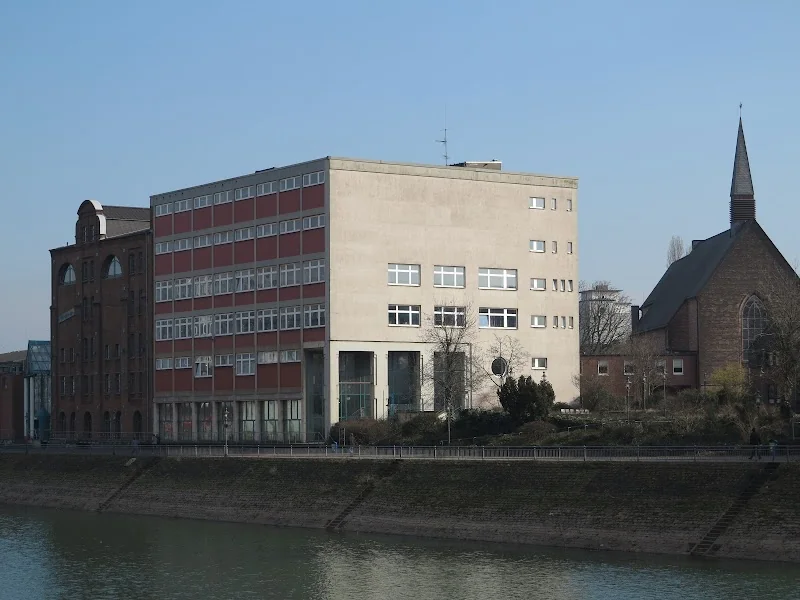
Duisburg
Karmelpl. 5, 47051 Duisburg, Deutschland
Duisburg City Archive | Opening Hours & Family Research
The Duisburg City Archive is the central point of contact for anyone interested in the history of the city, family research, or historical image and written sources. Located at Karmelplatz 5, the archive preserves documents from many centuries and makes them available for research, education, and the public. The range is exceptionally broad: from medieval documents to administrative records and digital sources and photographs. At the same time, the archive is not just a storage place but also an active site of mediation. Those who want to not only read about the city's history but experience it can find lectures, guided tours, exhibitions, and advice for historical research here. The connection between traditional reading room work and digital access is particularly strong, as many holdings are already cataloged or available online. Thus, the City Archive caters to genealogists, local historians, academically interested individuals, students, journalists, and anyone who wants to better understand Duisburg. ([stadtarchiv-duisburg.de](https://www.stadtarchiv-duisburg.de/))
Opening Hours, Contact, and Visit to the Reading Room
Anyone wishing to visit the Duisburg City Archive should first note the practical details: The address is Karmelplatz 5, 47051 Duisburg. The archive can be reached by phone at +49 203 283 2154, and the email address is stadtarchiv@stadt-duisburg.de. For regular service hours, the contact page states Monday to Thursday from 9:00 AM to 3:00 PM and Friday from 9:00 AM to 1:00 PM. The reading room itself is open on Tuesdays and Thursdays from 9:30 AM to 5:00 PM. This distinction is important because not every inquiry is automatically equivalent to a visit to the reading room. Written inquiries should be submitted via the form under Archive Use, so the team can assess in advance which holdings are relevant. This is particularly helpful for complex projects, as it saves preliminary work and may allow for the provision of the appropriate signatures or digitized materials in advance. ([stadtarchiv-duisburg.de](https://www.stadtarchiv-duisburg.de/kontakt/?utm_source=openai))
For planning an archive visit, it is also significant that the City Archive explicitly welcomes its users and supports on-site research. Those who come during opening hours can generally start their research without prior registration; however, for specific or extensive inquiries, the archive recommends contacting them by phone or email beforehand. This way, the staff can already identify relevant material in advance and prepare it accordingly. This saves time and increases the chance that the first visit will be productive. Additionally, a newsletter informs about news and events from the archive approximately once a quarter. This means that contact with the City Archive is useful not only for a one-time research inquiry but also for anyone who wants to stay updated on new topics, lectures, or projects in the long term. ([stadtarchiv-duisburg.de](https://www.stadtarchiv-duisburg.de/rechercheangebot/?utm_source=openai))
Family Research at the Duisburg City Archive
A particularly sought-after topic is family research, and this is precisely where the Duisburg City Archive offers an impressive source base. The most important source groups include civil registry documents, church books, address books, registration documents, census documents, and other genealogical sources. For many inquiries, the archive is thus one of the first addresses in the region. The civil registry records in Duisburg are usually cataloged up to the legally customary deadlines: birth records up to 1912, marriage records up to 1942, and death records up to 1992. Additionally, the certificate books are cataloged by year with name indexes. In the reading room, one can use the indexes, order the books specifically, or in many cases already view them digitally at the workstation. This provides a very comfortable starting point, especially when searching for specific individuals, family names, or addresses. ([archive.nrw.de](https://www.archive.nrw.de/stadtarchiv-duisburg/familienforschung))
Family research also benefits from the fact that the archive preserves not only the official records but also numerous supplementary sources. These include supporting documents with additional background information on family history, registration documents from 1929, census documents, and other collections that can make relationships, places of residence, and life paths visible. However, there is an important restriction regarding the registration documents: on-site access is not possible; instead, written inquiries are processed. For individuals who have died or moved away from Duisburg in the last 55 years, the archive refers to the residents' registration office. This shows that while research in the archive can be very fruitful, it also follows clear rules. Those who understand these conditions can plan their search precisely and save unnecessary trips. The combination of digital sources, reading room use, and written research makes the City Archive particularly valuable for genealogical projects. ([stadtarchiv-duisburg.de](https://www.stadtarchiv-duisburg.de/familienforschung/?utm_source=openai))
Using Church Books and Address Books Online
Among the most sought-after digital sources of the City Archive are the Duisburg church books and address books. The church book records begin in the mid-17th century and extend to the introduction of the state civil registry system in 1874. The City Archive holds copies of all church books from the Duisburg city area, some also from neighboring parishes of adjacent cities. This is particularly helpful for research because it allows not only classic baptism, marriage, and burial entries to be visible but also to trace church networks and regional connections. The church book copies can be viewed directly in the reading room and do not need to be ordered. Even more convenient is the digital access: all Duisburg church books, including name indexes, are also available online. So, if one can narrow down a family name, a community, or a time period, they often find the right page quickly through the digital structure. ([archive.nrw.de](https://www.archive.nrw.de/stadtarchiv-duisburg/familienforschung))
The address books are equally important for city and family history. The address books preserved at the Duisburg City Archive cover the period from 1833 to 1999. In practice, this allows for tracing places of residence, street names, heads of households, companies, and urban developments over many decades. Particularly useful is that the Duisburg address books are available digitally. The records have been expanded over time: from 1905, Ruhrort and Meiderich are included, from 1929, Hamborn, and from 1975, among others, Rheinhausen, Rumeln-Kaldenhausen, Homberg, Baerl, and Walsum. At the same time, the archive points out that the older address books of the formerly independent cities have not yet been fully digitized. Therefore, anyone specifically interested in Hamborn or other incorporated districts should always check the year of the source and whether it is already available online. This combination of digital access, regional depth, and historical continuity makes the address books so exciting for private research and scientific questions. ([stadtarchiv-duisburg.de](https://www.stadtarchiv-duisburg.de/familienforschung/?utm_source=openai))
For searchers, it is also helpful to understand the logic of the sources. Address books usually provide not only names but also street or company directories, offering insights into economic and infrastructural changes. For example, those wanting to trace the residences or workplaces of individual people can narrow down time periods through the entries and reconstruct transitions between districts. Church books and address books complement each other excellently: church books help find family events, while address books help locate them in urban space. This is precisely why terms like online, church books, address books, and Hamborn frequently appear in search inquiries. The Duisburg City Archive meets this demand with a digital research environment that appeals to both laypersons and experienced researchers. ([archive.nrw.de](https://www.archive.nrw.de/stadtarchiv-duisburg/familienforschung))
Holdings, History, and Scientific Work
The Duisburg City Archive is much more than a collection of historical documents. It primarily preserves certificates, records, official books, as well as image and sound documents, covering a period from the 12th century to the immediate present. With a total of nine kilometers of shelves, it is one of the largest municipal archives in North Rhine-Westphalia. Particularly impressive is the depth of the records: the archive has a complete series of city council minutes from 1538 and city accounts from 1348. This allows not only political decisions but also economic and social developments to be traced over centuries. The oldest document in the collection dates back to 1129. Additionally, there are around 3,000 medieval documents that document central urban rights and obligations. Therefore, anyone interested in early city history will find sources of extraordinary density and authenticity here. ([stadtarchiv-duisburg.de](https://www.stadtarchiv-duisburg.de/ueber-uns/))
The breadth of the holdings is also remarkable. The archive possesses certificates, official books, and records from formerly independent cities that were later incorporated, such as Ruhrort, Meiderich, Hamborn, and Rheinhausen. There are also about 4,000 maps, 13,000 building plans, and 4,000 posters, approximately 50,000 photographs documenting the history of the city of Duisburg in the 20th century, a largely complete collection of Duisburg daily newspapers from the mid-19th century, as well as predecessors from the 18th century. Additionally, there is an extensive reference library on city history with about 50,000 volumes. Thus, the City Archive is not only a research place for individual cases but also a scientific infrastructure for larger questions surrounding urban development, administrative history, transportation, culture, economy, and everyday life. Particularly practical is that individual maps, plans, and historical aerial photographs can be viewed via the Historical Geoportal Duisburg, and digitized local newspapers up to 1945 are available through zeitpunkt.nrw. ([stadtarchiv-duisburg.de](https://www.stadtarchiv-duisburg.de/ueber-uns/))
Another important component is the professional work on the preservation of the holdings. The archive has its own restoration workshop where damaged records, manuscripts, printed works, posters, maps, plans, parchments, certificates, seals, photo and film material are restored. In addition, archival-worthy documents are transferred to a permanent preservation system, cataloged in databases, and made accessible to the public after deadlines. Frequently used holdings are digitized and can be partially viewed online. This clearly shows that Duisburg is not only preserved but also actively modernized and made accessible. Scientific work is also closely linked to this self-understanding: together with the Mercator Society, the archive publishes the series Duisburg Research, regularly publishes new contributions, and works on further updates of the city history. Thus, anyone wanting to delve deeper will find not only sources but also research results and publications from first-hand. ([stadtarchiv-duisburg.de](https://www.stadtarchiv-duisburg.de/ueber-uns/))
Events, Team, and Digital Offers
The Duisburg City Archive explicitly sees itself as a public place of mediation. On the events page, the archive regularly announces lectures, guided tours, and thematic tours. This includes the series City History on Thursdays, which makes scientifically prepared topics accessible to a broader audience. Additionally, there are outdoor tours, events in the foyer, and changing presentations, such as the exhibition Duisburg in Transition, which highlights the city's image change based on advertising materials and city images. Such formats are important because they show the archive not only as a research place but also as a lively part of the urban society. Those interested in the development of Duisburg experience history there not abstractly but at concrete locations, images, and sources. This connection of research, education, and public communication is a central part of the profile of the institution. ([stadtarchiv-duisburg.de](https://www.stadtarchiv-duisburg.de/veranstaltungen-2/))
The team also makes it clear how broadly the archive is structured. The team page includes archivists, historians, a bookbinder, staff for the reading room and magazine, team assistance, student assistants, a voluntary social year in culture, projects for photo digitization, a house records project, and digital long-term archiving. Also mentioned are Dr. Andreas Pilger as the head of the institute and Dr. Michael Kanther as the deputy head of the institute, along with staff for public relations, collections, and historical projects. This diversity is a significant advantage for users, as it shows that advice does not happen in isolation but is supported by various disciplines. Those who make an inquiry benefit not only from archival knowledge but also from organizational experience, restoration expertise, and digital competence. This structure is crucial, especially for complex topics such as building history, family research, image collections, or old administrative records. ([stadtarchiv-duisburg.de](https://www.stadtarchiv-duisburg.de/team/))
For many visitors, the digital access is also a strong argument. The archive points to an online overview of holdings and already provides selected holdings fully or partially in digital form. This includes the Duisburg church books, address books, and other cataloged sources. In everyday life, this means: research can be prepared at home, continued specifically in the reading room, and supplemented by the team if necessary. This combination of online research and on-site support makes the Duisburg City Archive so user-friendly. Those wanting to learn about opening hours, contact, family research, team, or events can quickly find the appropriate entry points on the website. And those who delve deeper will soon realize that the archive not only preserves old holdings but actively uncovers, explains, and translates the city's history into the present. ([stadtarchiv-duisburg.de](https://www.stadtarchiv-duisburg.de/rechercheangebot/?utm_source=openai))
Sources:
Show moreShow less
Duisburg City Archive | Opening Hours & Family Research
The Duisburg City Archive is the central point of contact for anyone interested in the history of the city, family research, or historical image and written sources. Located at Karmelplatz 5, the archive preserves documents from many centuries and makes them available for research, education, and the public. The range is exceptionally broad: from medieval documents to administrative records and digital sources and photographs. At the same time, the archive is not just a storage place but also an active site of mediation. Those who want to not only read about the city's history but experience it can find lectures, guided tours, exhibitions, and advice for historical research here. The connection between traditional reading room work and digital access is particularly strong, as many holdings are already cataloged or available online. Thus, the City Archive caters to genealogists, local historians, academically interested individuals, students, journalists, and anyone who wants to better understand Duisburg. ([stadtarchiv-duisburg.de](https://www.stadtarchiv-duisburg.de/))
Opening Hours, Contact, and Visit to the Reading Room
Anyone wishing to visit the Duisburg City Archive should first note the practical details: The address is Karmelplatz 5, 47051 Duisburg. The archive can be reached by phone at +49 203 283 2154, and the email address is stadtarchiv@stadt-duisburg.de. For regular service hours, the contact page states Monday to Thursday from 9:00 AM to 3:00 PM and Friday from 9:00 AM to 1:00 PM. The reading room itself is open on Tuesdays and Thursdays from 9:30 AM to 5:00 PM. This distinction is important because not every inquiry is automatically equivalent to a visit to the reading room. Written inquiries should be submitted via the form under Archive Use, so the team can assess in advance which holdings are relevant. This is particularly helpful for complex projects, as it saves preliminary work and may allow for the provision of the appropriate signatures or digitized materials in advance. ([stadtarchiv-duisburg.de](https://www.stadtarchiv-duisburg.de/kontakt/?utm_source=openai))
For planning an archive visit, it is also significant that the City Archive explicitly welcomes its users and supports on-site research. Those who come during opening hours can generally start their research without prior registration; however, for specific or extensive inquiries, the archive recommends contacting them by phone or email beforehand. This way, the staff can already identify relevant material in advance and prepare it accordingly. This saves time and increases the chance that the first visit will be productive. Additionally, a newsletter informs about news and events from the archive approximately once a quarter. This means that contact with the City Archive is useful not only for a one-time research inquiry but also for anyone who wants to stay updated on new topics, lectures, or projects in the long term. ([stadtarchiv-duisburg.de](https://www.stadtarchiv-duisburg.de/rechercheangebot/?utm_source=openai))
Family Research at the Duisburg City Archive
A particularly sought-after topic is family research, and this is precisely where the Duisburg City Archive offers an impressive source base. The most important source groups include civil registry documents, church books, address books, registration documents, census documents, and other genealogical sources. For many inquiries, the archive is thus one of the first addresses in the region. The civil registry records in Duisburg are usually cataloged up to the legally customary deadlines: birth records up to 1912, marriage records up to 1942, and death records up to 1992. Additionally, the certificate books are cataloged by year with name indexes. In the reading room, one can use the indexes, order the books specifically, or in many cases already view them digitally at the workstation. This provides a very comfortable starting point, especially when searching for specific individuals, family names, or addresses. ([archive.nrw.de](https://www.archive.nrw.de/stadtarchiv-duisburg/familienforschung))
Family research also benefits from the fact that the archive preserves not only the official records but also numerous supplementary sources. These include supporting documents with additional background information on family history, registration documents from 1929, census documents, and other collections that can make relationships, places of residence, and life paths visible. However, there is an important restriction regarding the registration documents: on-site access is not possible; instead, written inquiries are processed. For individuals who have died or moved away from Duisburg in the last 55 years, the archive refers to the residents' registration office. This shows that while research in the archive can be very fruitful, it also follows clear rules. Those who understand these conditions can plan their search precisely and save unnecessary trips. The combination of digital sources, reading room use, and written research makes the City Archive particularly valuable for genealogical projects. ([stadtarchiv-duisburg.de](https://www.stadtarchiv-duisburg.de/familienforschung/?utm_source=openai))
Using Church Books and Address Books Online
Among the most sought-after digital sources of the City Archive are the Duisburg church books and address books. The church book records begin in the mid-17th century and extend to the introduction of the state civil registry system in 1874. The City Archive holds copies of all church books from the Duisburg city area, some also from neighboring parishes of adjacent cities. This is particularly helpful for research because it allows not only classic baptism, marriage, and burial entries to be visible but also to trace church networks and regional connections. The church book copies can be viewed directly in the reading room and do not need to be ordered. Even more convenient is the digital access: all Duisburg church books, including name indexes, are also available online. So, if one can narrow down a family name, a community, or a time period, they often find the right page quickly through the digital structure. ([archive.nrw.de](https://www.archive.nrw.de/stadtarchiv-duisburg/familienforschung))
The address books are equally important for city and family history. The address books preserved at the Duisburg City Archive cover the period from 1833 to 1999. In practice, this allows for tracing places of residence, street names, heads of households, companies, and urban developments over many decades. Particularly useful is that the Duisburg address books are available digitally. The records have been expanded over time: from 1905, Ruhrort and Meiderich are included, from 1929, Hamborn, and from 1975, among others, Rheinhausen, Rumeln-Kaldenhausen, Homberg, Baerl, and Walsum. At the same time, the archive points out that the older address books of the formerly independent cities have not yet been fully digitized. Therefore, anyone specifically interested in Hamborn or other incorporated districts should always check the year of the source and whether it is already available online. This combination of digital access, regional depth, and historical continuity makes the address books so exciting for private research and scientific questions. ([stadtarchiv-duisburg.de](https://www.stadtarchiv-duisburg.de/familienforschung/?utm_source=openai))
For searchers, it is also helpful to understand the logic of the sources. Address books usually provide not only names but also street or company directories, offering insights into economic and infrastructural changes. For example, those wanting to trace the residences or workplaces of individual people can narrow down time periods through the entries and reconstruct transitions between districts. Church books and address books complement each other excellently: church books help find family events, while address books help locate them in urban space. This is precisely why terms like online, church books, address books, and Hamborn frequently appear in search inquiries. The Duisburg City Archive meets this demand with a digital research environment that appeals to both laypersons and experienced researchers. ([archive.nrw.de](https://www.archive.nrw.de/stadtarchiv-duisburg/familienforschung))
Holdings, History, and Scientific Work
The Duisburg City Archive is much more than a collection of historical documents. It primarily preserves certificates, records, official books, as well as image and sound documents, covering a period from the 12th century to the immediate present. With a total of nine kilometers of shelves, it is one of the largest municipal archives in North Rhine-Westphalia. Particularly impressive is the depth of the records: the archive has a complete series of city council minutes from 1538 and city accounts from 1348. This allows not only political decisions but also economic and social developments to be traced over centuries. The oldest document in the collection dates back to 1129. Additionally, there are around 3,000 medieval documents that document central urban rights and obligations. Therefore, anyone interested in early city history will find sources of extraordinary density and authenticity here. ([stadtarchiv-duisburg.de](https://www.stadtarchiv-duisburg.de/ueber-uns/))
The breadth of the holdings is also remarkable. The archive possesses certificates, official books, and records from formerly independent cities that were later incorporated, such as Ruhrort, Meiderich, Hamborn, and Rheinhausen. There are also about 4,000 maps, 13,000 building plans, and 4,000 posters, approximately 50,000 photographs documenting the history of the city of Duisburg in the 20th century, a largely complete collection of Duisburg daily newspapers from the mid-19th century, as well as predecessors from the 18th century. Additionally, there is an extensive reference library on city history with about 50,000 volumes. Thus, the City Archive is not only a research place for individual cases but also a scientific infrastructure for larger questions surrounding urban development, administrative history, transportation, culture, economy, and everyday life. Particularly practical is that individual maps, plans, and historical aerial photographs can be viewed via the Historical Geoportal Duisburg, and digitized local newspapers up to 1945 are available through zeitpunkt.nrw. ([stadtarchiv-duisburg.de](https://www.stadtarchiv-duisburg.de/ueber-uns/))
Another important component is the professional work on the preservation of the holdings. The archive has its own restoration workshop where damaged records, manuscripts, printed works, posters, maps, plans, parchments, certificates, seals, photo and film material are restored. In addition, archival-worthy documents are transferred to a permanent preservation system, cataloged in databases, and made accessible to the public after deadlines. Frequently used holdings are digitized and can be partially viewed online. This clearly shows that Duisburg is not only preserved but also actively modernized and made accessible. Scientific work is also closely linked to this self-understanding: together with the Mercator Society, the archive publishes the series Duisburg Research, regularly publishes new contributions, and works on further updates of the city history. Thus, anyone wanting to delve deeper will find not only sources but also research results and publications from first-hand. ([stadtarchiv-duisburg.de](https://www.stadtarchiv-duisburg.de/ueber-uns/))
Events, Team, and Digital Offers
The Duisburg City Archive explicitly sees itself as a public place of mediation. On the events page, the archive regularly announces lectures, guided tours, and thematic tours. This includes the series City History on Thursdays, which makes scientifically prepared topics accessible to a broader audience. Additionally, there are outdoor tours, events in the foyer, and changing presentations, such as the exhibition Duisburg in Transition, which highlights the city's image change based on advertising materials and city images. Such formats are important because they show the archive not only as a research place but also as a lively part of the urban society. Those interested in the development of Duisburg experience history there not abstractly but at concrete locations, images, and sources. This connection of research, education, and public communication is a central part of the profile of the institution. ([stadtarchiv-duisburg.de](https://www.stadtarchiv-duisburg.de/veranstaltungen-2/))
The team also makes it clear how broadly the archive is structured. The team page includes archivists, historians, a bookbinder, staff for the reading room and magazine, team assistance, student assistants, a voluntary social year in culture, projects for photo digitization, a house records project, and digital long-term archiving. Also mentioned are Dr. Andreas Pilger as the head of the institute and Dr. Michael Kanther as the deputy head of the institute, along with staff for public relations, collections, and historical projects. This diversity is a significant advantage for users, as it shows that advice does not happen in isolation but is supported by various disciplines. Those who make an inquiry benefit not only from archival knowledge but also from organizational experience, restoration expertise, and digital competence. This structure is crucial, especially for complex topics such as building history, family research, image collections, or old administrative records. ([stadtarchiv-duisburg.de](https://www.stadtarchiv-duisburg.de/team/))
For many visitors, the digital access is also a strong argument. The archive points to an online overview of holdings and already provides selected holdings fully or partially in digital form. This includes the Duisburg church books, address books, and other cataloged sources. In everyday life, this means: research can be prepared at home, continued specifically in the reading room, and supplemented by the team if necessary. This combination of online research and on-site support makes the Duisburg City Archive so user-friendly. Those wanting to learn about opening hours, contact, family research, team, or events can quickly find the appropriate entry points on the website. And those who delve deeper will soon realize that the archive not only preserves old holdings but actively uncovers, explains, and translates the city's history into the present. ([stadtarchiv-duisburg.de](https://www.stadtarchiv-duisburg.de/rechercheangebot/?utm_source=openai))
Sources:
Duisburg City Archive | Opening Hours & Family Research
The Duisburg City Archive is the central point of contact for anyone interested in the history of the city, family research, or historical image and written sources. Located at Karmelplatz 5, the archive preserves documents from many centuries and makes them available for research, education, and the public. The range is exceptionally broad: from medieval documents to administrative records and digital sources and photographs. At the same time, the archive is not just a storage place but also an active site of mediation. Those who want to not only read about the city's history but experience it can find lectures, guided tours, exhibitions, and advice for historical research here. The connection between traditional reading room work and digital access is particularly strong, as many holdings are already cataloged or available online. Thus, the City Archive caters to genealogists, local historians, academically interested individuals, students, journalists, and anyone who wants to better understand Duisburg. ([stadtarchiv-duisburg.de](https://www.stadtarchiv-duisburg.de/))
Opening Hours, Contact, and Visit to the Reading Room
Anyone wishing to visit the Duisburg City Archive should first note the practical details: The address is Karmelplatz 5, 47051 Duisburg. The archive can be reached by phone at +49 203 283 2154, and the email address is stadtarchiv@stadt-duisburg.de. For regular service hours, the contact page states Monday to Thursday from 9:00 AM to 3:00 PM and Friday from 9:00 AM to 1:00 PM. The reading room itself is open on Tuesdays and Thursdays from 9:30 AM to 5:00 PM. This distinction is important because not every inquiry is automatically equivalent to a visit to the reading room. Written inquiries should be submitted via the form under Archive Use, so the team can assess in advance which holdings are relevant. This is particularly helpful for complex projects, as it saves preliminary work and may allow for the provision of the appropriate signatures or digitized materials in advance. ([stadtarchiv-duisburg.de](https://www.stadtarchiv-duisburg.de/kontakt/?utm_source=openai))
For planning an archive visit, it is also significant that the City Archive explicitly welcomes its users and supports on-site research. Those who come during opening hours can generally start their research without prior registration; however, for specific or extensive inquiries, the archive recommends contacting them by phone or email beforehand. This way, the staff can already identify relevant material in advance and prepare it accordingly. This saves time and increases the chance that the first visit will be productive. Additionally, a newsletter informs about news and events from the archive approximately once a quarter. This means that contact with the City Archive is useful not only for a one-time research inquiry but also for anyone who wants to stay updated on new topics, lectures, or projects in the long term. ([stadtarchiv-duisburg.de](https://www.stadtarchiv-duisburg.de/rechercheangebot/?utm_source=openai))
Family Research at the Duisburg City Archive
A particularly sought-after topic is family research, and this is precisely where the Duisburg City Archive offers an impressive source base. The most important source groups include civil registry documents, church books, address books, registration documents, census documents, and other genealogical sources. For many inquiries, the archive is thus one of the first addresses in the region. The civil registry records in Duisburg are usually cataloged up to the legally customary deadlines: birth records up to 1912, marriage records up to 1942, and death records up to 1992. Additionally, the certificate books are cataloged by year with name indexes. In the reading room, one can use the indexes, order the books specifically, or in many cases already view them digitally at the workstation. This provides a very comfortable starting point, especially when searching for specific individuals, family names, or addresses. ([archive.nrw.de](https://www.archive.nrw.de/stadtarchiv-duisburg/familienforschung))
Family research also benefits from the fact that the archive preserves not only the official records but also numerous supplementary sources. These include supporting documents with additional background information on family history, registration documents from 1929, census documents, and other collections that can make relationships, places of residence, and life paths visible. However, there is an important restriction regarding the registration documents: on-site access is not possible; instead, written inquiries are processed. For individuals who have died or moved away from Duisburg in the last 55 years, the archive refers to the residents' registration office. This shows that while research in the archive can be very fruitful, it also follows clear rules. Those who understand these conditions can plan their search precisely and save unnecessary trips. The combination of digital sources, reading room use, and written research makes the City Archive particularly valuable for genealogical projects. ([stadtarchiv-duisburg.de](https://www.stadtarchiv-duisburg.de/familienforschung/?utm_source=openai))
Using Church Books and Address Books Online
Among the most sought-after digital sources of the City Archive are the Duisburg church books and address books. The church book records begin in the mid-17th century and extend to the introduction of the state civil registry system in 1874. The City Archive holds copies of all church books from the Duisburg city area, some also from neighboring parishes of adjacent cities. This is particularly helpful for research because it allows not only classic baptism, marriage, and burial entries to be visible but also to trace church networks and regional connections. The church book copies can be viewed directly in the reading room and do not need to be ordered. Even more convenient is the digital access: all Duisburg church books, including name indexes, are also available online. So, if one can narrow down a family name, a community, or a time period, they often find the right page quickly through the digital structure. ([archive.nrw.de](https://www.archive.nrw.de/stadtarchiv-duisburg/familienforschung))
The address books are equally important for city and family history. The address books preserved at the Duisburg City Archive cover the period from 1833 to 1999. In practice, this allows for tracing places of residence, street names, heads of households, companies, and urban developments over many decades. Particularly useful is that the Duisburg address books are available digitally. The records have been expanded over time: from 1905, Ruhrort and Meiderich are included, from 1929, Hamborn, and from 1975, among others, Rheinhausen, Rumeln-Kaldenhausen, Homberg, Baerl, and Walsum. At the same time, the archive points out that the older address books of the formerly independent cities have not yet been fully digitized. Therefore, anyone specifically interested in Hamborn or other incorporated districts should always check the year of the source and whether it is already available online. This combination of digital access, regional depth, and historical continuity makes the address books so exciting for private research and scientific questions. ([stadtarchiv-duisburg.de](https://www.stadtarchiv-duisburg.de/familienforschung/?utm_source=openai))
For searchers, it is also helpful to understand the logic of the sources. Address books usually provide not only names but also street or company directories, offering insights into economic and infrastructural changes. For example, those wanting to trace the residences or workplaces of individual people can narrow down time periods through the entries and reconstruct transitions between districts. Church books and address books complement each other excellently: church books help find family events, while address books help locate them in urban space. This is precisely why terms like online, church books, address books, and Hamborn frequently appear in search inquiries. The Duisburg City Archive meets this demand with a digital research environment that appeals to both laypersons and experienced researchers. ([archive.nrw.de](https://www.archive.nrw.de/stadtarchiv-duisburg/familienforschung))
Holdings, History, and Scientific Work
The Duisburg City Archive is much more than a collection of historical documents. It primarily preserves certificates, records, official books, as well as image and sound documents, covering a period from the 12th century to the immediate present. With a total of nine kilometers of shelves, it is one of the largest municipal archives in North Rhine-Westphalia. Particularly impressive is the depth of the records: the archive has a complete series of city council minutes from 1538 and city accounts from 1348. This allows not only political decisions but also economic and social developments to be traced over centuries. The oldest document in the collection dates back to 1129. Additionally, there are around 3,000 medieval documents that document central urban rights and obligations. Therefore, anyone interested in early city history will find sources of extraordinary density and authenticity here. ([stadtarchiv-duisburg.de](https://www.stadtarchiv-duisburg.de/ueber-uns/))
The breadth of the holdings is also remarkable. The archive possesses certificates, official books, and records from formerly independent cities that were later incorporated, such as Ruhrort, Meiderich, Hamborn, and Rheinhausen. There are also about 4,000 maps, 13,000 building plans, and 4,000 posters, approximately 50,000 photographs documenting the history of the city of Duisburg in the 20th century, a largely complete collection of Duisburg daily newspapers from the mid-19th century, as well as predecessors from the 18th century. Additionally, there is an extensive reference library on city history with about 50,000 volumes. Thus, the City Archive is not only a research place for individual cases but also a scientific infrastructure for larger questions surrounding urban development, administrative history, transportation, culture, economy, and everyday life. Particularly practical is that individual maps, plans, and historical aerial photographs can be viewed via the Historical Geoportal Duisburg, and digitized local newspapers up to 1945 are available through zeitpunkt.nrw. ([stadtarchiv-duisburg.de](https://www.stadtarchiv-duisburg.de/ueber-uns/))
Another important component is the professional work on the preservation of the holdings. The archive has its own restoration workshop where damaged records, manuscripts, printed works, posters, maps, plans, parchments, certificates, seals, photo and film material are restored. In addition, archival-worthy documents are transferred to a permanent preservation system, cataloged in databases, and made accessible to the public after deadlines. Frequently used holdings are digitized and can be partially viewed online. This clearly shows that Duisburg is not only preserved but also actively modernized and made accessible. Scientific work is also closely linked to this self-understanding: together with the Mercator Society, the archive publishes the series Duisburg Research, regularly publishes new contributions, and works on further updates of the city history. Thus, anyone wanting to delve deeper will find not only sources but also research results and publications from first-hand. ([stadtarchiv-duisburg.de](https://www.stadtarchiv-duisburg.de/ueber-uns/))
Events, Team, and Digital Offers
The Duisburg City Archive explicitly sees itself as a public place of mediation. On the events page, the archive regularly announces lectures, guided tours, and thematic tours. This includes the series City History on Thursdays, which makes scientifically prepared topics accessible to a broader audience. Additionally, there are outdoor tours, events in the foyer, and changing presentations, such as the exhibition Duisburg in Transition, which highlights the city's image change based on advertising materials and city images. Such formats are important because they show the archive not only as a research place but also as a lively part of the urban society. Those interested in the development of Duisburg experience history there not abstractly but at concrete locations, images, and sources. This connection of research, education, and public communication is a central part of the profile of the institution. ([stadtarchiv-duisburg.de](https://www.stadtarchiv-duisburg.de/veranstaltungen-2/))
The team also makes it clear how broadly the archive is structured. The team page includes archivists, historians, a bookbinder, staff for the reading room and magazine, team assistance, student assistants, a voluntary social year in culture, projects for photo digitization, a house records project, and digital long-term archiving. Also mentioned are Dr. Andreas Pilger as the head of the institute and Dr. Michael Kanther as the deputy head of the institute, along with staff for public relations, collections, and historical projects. This diversity is a significant advantage for users, as it shows that advice does not happen in isolation but is supported by various disciplines. Those who make an inquiry benefit not only from archival knowledge but also from organizational experience, restoration expertise, and digital competence. This structure is crucial, especially for complex topics such as building history, family research, image collections, or old administrative records. ([stadtarchiv-duisburg.de](https://www.stadtarchiv-duisburg.de/team/))
For many visitors, the digital access is also a strong argument. The archive points to an online overview of holdings and already provides selected holdings fully or partially in digital form. This includes the Duisburg church books, address books, and other cataloged sources. In everyday life, this means: research can be prepared at home, continued specifically in the reading room, and supplemented by the team if necessary. This combination of online research and on-site support makes the Duisburg City Archive so user-friendly. Those wanting to learn about opening hours, contact, family research, team, or events can quickly find the appropriate entry points on the website. And those who delve deeper will soon realize that the archive not only preserves old holdings but actively uncovers, explains, and translates the city's history into the present. ([stadtarchiv-duisburg.de](https://www.stadtarchiv-duisburg.de/rechercheangebot/?utm_source=openai))
Sources:
Upcoming Events
No events found
Frequently Asked Questions
Reviews
Melli Mel
8. June 2025
Very friendly and helpful! The city archive competently supported me with my inquiry. The staff were patient, well-informed, and took the time to help me with my research. The atmosphere is calm and focused, perfect for working. Thank you for the great service!
Anne Schillat
9. August 2019
I didn't know the Duisburg inner harbor, we were here for the EXTRASCHICHT, I'm thrilled, but it also had to do with the atmosphere and the weather😍 Great, would love to come back👍😁 Best, Anne 😘
Carolin Picard
3. December 2024
Visited the city archive for private ancestry/origin research. Due to digital archiving, not all documents were accessible. Affordable and fair pricing, extraordinarily helpful and lovely staff, top!!!
Manuela Wolter
17. April 2020
The support we received from the staff was truly exceptional. We felt well taken care of and advised.
Arno Gropp
5. February 2022
For several years now, they have been offering a very interesting lecture series (city history on Thursdays) during the winter half-year, about every three weeks. However, it's over for this winter.