
Duisburg
Uerdinger Str. 183A, 47259 Duisburg, Deutschland
St. Dionysius | Church, History & Directions
St. Dionysius in Duisburg-Mündelheim is a place where centuries-old architectural history, vibrant community work, and quiet visits come together very pleasantly. The official parish describes the church as being around 800 years old and one of the most beautiful late Romanesque country churches in Duisburg. Those who come here do not experience an anonymous large building, but a developed place with clear architecture, historical depth, and an atmosphere that invites lingering. Today, St. Dionysius belongs to the parish of St. Judas Thaddeus based in Buchholz, but remains an important spiritual and cultural center for Mündelheim and southern Duisburg. It is particularly convenient for visitors that the church is open daily, making it suitable for a spontaneous visit, a quiet pause, an architectural discovery, or a planned tour. This mix of history, tranquility, good accessibility, and lived tradition makes St. Dionysius one of the most interesting church addresses in Duisburg. ([muendelheim.de](https://www.muendelheim.de/kath/index.php))
History of St. Dionysius Church in Mündelheim
The history of St. Dionysius goes back very far and does not begin with the current building. The parish refers to Christian settlements in Carolingian times, thus an early phase before 900, and finds suggest a hall church as a predecessor building. The place Mündelheim itself is already mentioned in 947 as Mundulingheim, and in the historical records, there are also legends surrounding the founding of several churches in the vicinity. For the ecclesiastical development of the district, it is important that St. Dionysius was already a religious reference point in the early Middle Ages and that the location asserted itself as a stable center of the village community over many centuries. In the 11th and 12th centuries, there was a hall church with a forecourt in the area of the current nave, which was already close in size to the later nave. Around 1150, the current tower was built in place of an older tower, and between 1220 and 1230, the current nave and choir followed. Thus, St. Dionysius belongs to the long line of early church buildings in the Lower Rhine, which were not only religiously but also topographically and socially formative. ([muendelheim.de](https://www.muendelheim.de/kath/index.php?show=Inhalt%2FKirchengebaeude.htm))
As history progressed, ownership and administrative structures shifted multiple times, which was typical for medieval church locations along the Rhine. In 1308, Count Adolf of Berg granted the patronage of the Mündelheim church to the Düsseldorf Lambertusstift, and this affiliation remained until 1803. At the same time, the parish area grew long beyond the current district and encompassed a large part of today's southern Duisburg before new parish structures emerged in the 19th and 20th centuries. Today, St. Dionysius is part of the parish of St. Judas Thaddeus, which connects the historical continuity with the modern pastoral structure. Particularly significant was the year 1945: Due to artillery fire from the other side of the Rhine, the tower and church roof were severely damaged, and the Gothic frescoes also suffered from penetrating rainwater. The restoration of the tower was completed in 1951, and in 1955, not only was a heating system installed, but also archaeologically interesting excavations were conducted, which revealed evidence of the predecessor church. In 1971, a sacristy extension was added to the south side. This means that the history of St. Dionysius cannot be read as a completed monument but as an ongoing story of preservation, restoration, and continuation. ([muendelheim.de](https://www.muendelheim.de/kath/index.php?show=Inhalt%2FKirchengebaeude.htm))
Architecture and Interior of the Late Romanesque Church
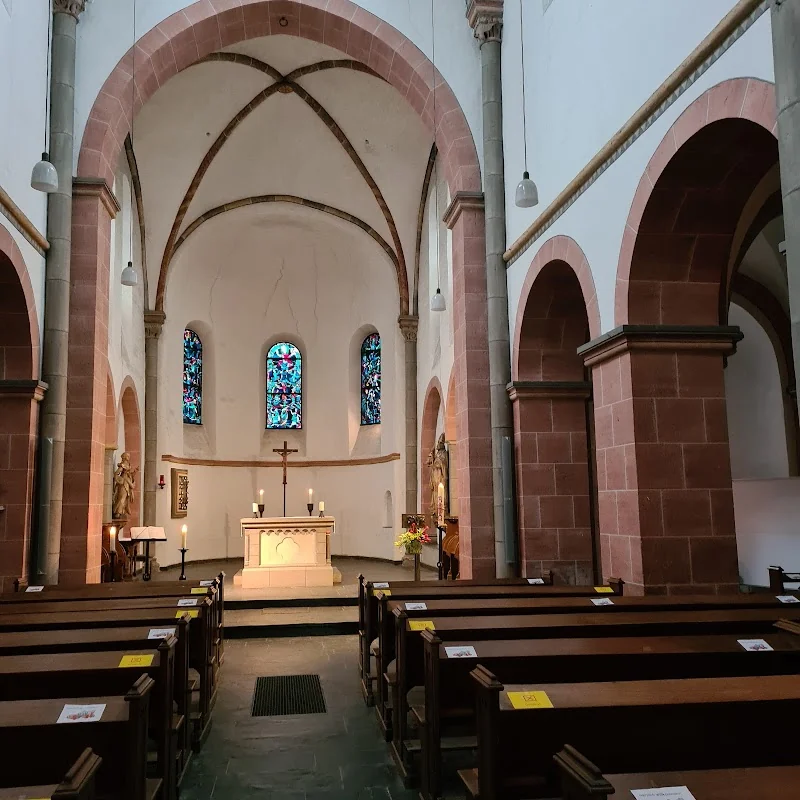
Architecturally, St. Dionysius is one of the most impressive late Romanesque churches in southern Duisburg. The official description refers to the building as a three-nave pillar basilica with a length of 30.5 meters and a width of 14.4 meters. These dimensions already show that it is a clearly structured, but not oversized church space, whose proportions are deliberately designed for tranquility and harmony. Outside, the staggered building mass from east to west shapes the image, and the five-story tower, with its narrow windows, almost resembles a fortified tower. Four bells belong to the tower; the oldest were cast in 1643 and 1681. It is precisely this combination of Romanesque severity and historical layering that makes the external impression so appealing: The building appears defensible yet inviting, simple yet rich in details. The fact that the church was severely damaged in 1945 and that the reconstruction was completed in 1955 also explains why historical substance and restored elements consciously stand side by side here. For all those interested in church architecture in the Rhineland, St. Dionysius is thus a particularly vivid example of the continuity of Romanesque forms over many centuries. ([muendelheim.de](https://www.muendelheim.de/kath/index.php?show=Inhalt%2FKirchengebaeude.htm))
Inside, the church shows a remarkable balance of proportions. The bays are equipped with ribbed vaults, in the nave and choir with strip ribs, and the capitals are variably designed. Foliage, birds, and buds form a fine imagery that makes the space feel alive despite its clear structure. Particularly exciting are two cube capitals with finely sculpted tendrils from around 1150, which apparently come from a predecessor church and can be seen on the western blind arches of the side aisles. Such building elements are more than decorative remnants; they make visible how architectural history overlaps in a church space. Additionally, there are color coatings that are oriented towards the color spectrum of the Romanesque period, and a preserved remnant of a Gothic fresco cycle in the form of Saint Catherine on a pillar arch of the north wall. From the 16th to 18th centuries, there are also sculptures of saints, including a Pietà, Dionysius, Mary Magdalene, and Sebastian. In the chancel, altar, wall tabernacle, and standing cross serve as towering liturgical signs. Therefore, when entering the church, one does not only feel historical distance but also a carefully designed spatial effect that supports silence, prayer, and contemplation. ([muendelheim.de](https://www.muendelheim.de/kath/index.php?show=Inhalt%2FKirchengebaeude.htm))
Opening Hours, Services, and Community Life
St. Dionysius is very accessible for visitors, as the church is open daily from 9 AM to 5 PM. This makes the place attractive not only for believers but also for people who want to quietly view a historical church, explore it photographically, or simply spend a few minutes in the quiet space. The parish also offers an online tour and information about guided tours, making it easy to prepare for a visit. The dedicated page explicitly describes the church as a space where people can find peace and a sense of home. This orientation is palpable in St. Dionysius: The building is not only an object of observation but a lived place where prayer, history, and the present intertwine. For the user intention regarding opening hours, visits, and church attendance, it is particularly important that St. Dionysius is regularly open and does not have the character of a rigid museum. The visit can be intentionally short, but it can also be used as a quiet and focused break in the daily routine. This distinction sets many village churches apart from mere excursion destinations. ([muendelheim.de](https://www.muendelheim.de/kath/index.php?show=Inhalt%2FKirchengebaeude.htm))
Liturgically, the church remains actively involved in community life. According to the published service times, a Holy Mass takes place every first, third, and possibly fifth Sunday of the month at 10 AM. On the second Sunday of the month, there is a Protestant service at 9:30 AM, and on the third Sunday of the month, a word service is celebrated at 10 AM. Additionally, on the last Thursday of the month at 4 PM, a Holy Mass is scheduled at the Malteserstift. This mix of Catholic, ecumenical, and community-oriented events shows that St. Dionysius should not only be perceived as a historical building but as an active place of faith and neighborhood. The parish also points out that short-term changes may occur and that the current dates are listed in the parish news. Therefore, anyone wishing to combine a visit with a service should check the current information in advance. This connection of monument, place of worship, and meeting space makes St. Dionysius so important for Duisburg-Mündelheim. ([muendelheim.de](https://www.muendelheim.de/kath/index.php?show=Inhalt%2FGottesdienste.htm))
Cultural life is also part of the community. The homepage of the parish explicitly refers to MunDio, meaning concerts and readings, and current dates are visibly displayed on the website. Thus, St. Dionysius is more than a place for Sunday mass: The church opens up for music, word, and cultural formats that make the space newly experienceable. Particularly for late Romanesque churches, this use is especially sensible because acoustics, room height, and architecture often create a special effect. For search terms related to events, culture, and current dates, this information is important as it shows that the place is regularly integrated into a lively program. Therefore, anyone looking for St. Dionysius not only out of religious interest but also for a cultural encounter with a special atmosphere will find a convincing point of contact here. The parish, music groups, the support association, and various groups collectively demonstrate an active environment that fills the historical building with the present. ([muendelheim.de](https://www.muendelheim.de/kath/index.php))
Directions, Bus Connections, and Parking in Duisburg-Mündelheim
For directions, the official notices from the parish are particularly helpful. St. Dionysius is listed in Mündelheim with the address Sermer Straße 1; at the same time, it appears in the Diocese of Essen directory for Duisburg under Uerdinger Straße 183a. For visitors, this means primarily: The location is in the immediate vicinity of Mündelheim and is very well accessible via Uerdinger Straße. Those coming by car from the B288 should turn left into Uerdinger Straße at the Duisburg-Süd junction and will reach their destination after about 500 meters. From Krefeld, the entrance is accordingly to the right into Uerdinger Straße. These clear instructions make the church particularly easy to find, even for those visiting the district for the first time. The journey is thus practical for church visits, short stops, or cultural events. Particularly for older churches, such a concrete route description is a real plus because it reduces uncertainties and facilitates planning. ([muendelheim.de](https://muendelheim.de/kath/index.php?show=Inhalt%2FAnfahrt.htm))
St. Dionysius is also well integrated into public transport. Buses of line 942 stop in the immediate vicinity. Additionally, the stops of line 941 are about 400 meters or approximately 600 meters away, depending on whether one is traveling from Krefeld to Duisburg or in the opposite direction. Those walking from there can orient themselves according to the timetable. For many visitors, this is a pleasant compromise between direct accessibility and the quiet, rural character of the surroundings. When it comes to parking, the parish also provides pleasantly clear information: Along Uerdinger Straße, there are usually enough free parking spaces, and there is also another parking lot about 300 meters away. This means that St. Dionysius is conveniently accessible for both drivers and public transport users. Therefore, anyone visiting the church for a service, concert, tour, or quiet visit does not have to expect a long search for parking. The journey is simple enough to focus on what matters: the church, the space, and history. ([muendelheim.de](https://muendelheim.de/kath/index.php?show=Inhalt%2FAnfahrt.htm))
Guided Tours, Online Tour, and Quiet Visits
A particularly useful advantage of St. Dionysius is the online tour on the official website. It provides an initial impression of the space and helps to better categorize the architecture, liturgical furnishings, and spatial effect even before the visit. Those who like to prepare can recognize the most important viewpoints in this way and then pay attention to details on-site. This is complemented by the information about guided tours offered by the parish. This is especially useful for groups, history-interested guests, or visitors who want to not only see the church space but also understand it in content. Particularly for a church with so many historical layers, a guided exploration is worthwhile because the path from the Carolingian prehistory through the Romanesque building to the war and restoration phases is not immediately visible. Guided tours and digital insights thus make a church visit a much more layered experience. ([muendelheim.de](https://www.muendelheim.de/kath/index.php?show=Inhalt%2FKirchengebaeude.htm))
For individual visitors, the charm of St. Dionysius lies precisely in the free, quiet approach. The church is open daily, the interior is clearly structured, and the official description emphasizes the opportunity to find peace here. This is an important note for all those who seek a church not merely as a sightseeing spot but as a place of gathering. Those who walk attentively will discover the finely crafted capitals, the remnants of medieval art, the sculptures from several centuries, and the balanced spatial arrangement of the building. Because the church is relatively manageable, an intense impression is quickly formed without overwhelming the visitor with too many stimuli. This quality makes St. Dionysius a place where one can focus on what is essential: on history, on form, and on the quiet details that make an old church so unique. For SEO seekers looking for guided tours, tours, visits, and tranquility, this is a clear added value. ([muendelheim.de](https://www.muendelheim.de/kath/index.php?show=Inhalt%2FKirchengebaeude.htm))
Why St. Dionysius is Among the Special Churches in Duisburg
St. Dionysius is remarkable not because the church is particularly large, but because it impressively connects history, use, and identity. The parish calls it one of the oldest churches in Duisburg, and one can feel this in the interplay of building mass, space, and local anchoring. Mündelheim has been part of the city of Duisburg since 1929, yet the church continues to preserve the character of a developed place that originates from much older times. The combination of late Romanesque architecture, historical depth, regular services, and cultural programs makes St. Dionysius a fixed reference point in southern Duisburg. In other words: Here stands not only a monument but a living place that has been repeatedly used, restored, and filled with meaning over the centuries. For visitors seeking a church with genuine presence in Duisburg, this is a strong reason to add St. Dionysius to their list. ([muendelheim.de](https://www.muendelheim.de/kath/index.php))
St. Dionysius also provides exactly the right answers to the search intentions behind frequent Google inquiries. Those searching for history will find early mentions, medieval construction phases, and the war damages of the 20th century. Those looking for opening hours receive the clear indication of daily from 9 AM to 5 PM. Those needing directions and parking get concrete information about B288, Uerdinger Straße, bus line 942, line 941, and parking options in the vicinity. Those searching for service times find a regular schedule with Catholic, Protestant, and word services. And those wanting to experience a special church building in Duisburg discover a late Romanesque basilica with carefully restored and art-historically exciting details. This is precisely why St. Dionysius fits so well with search terms related to church, history, directions, parking, opening hours, guided tours, and culture. It is a place that not only answers these topics but makes them experienceable in a real, convincing environment. ([muendelheim.de](https://www.muendelheim.de/kath/index.php?show=Inhalt%2FKirchengebaeude.htm))
Sources:
- St. Dionysius, Duisburg Mündelheim - Official Parish Page
- St. Dionysius Church Duisburg-Mündelheim - Church Building
- St. Dionysius, Duisburg Mündelheim - Directions and Parking
- St. Dionysius, Duisburg Mündelheim - Service Times
- Diocese of Essen - Duisburg
- Diocese of Essen - With the Germany Ticket on Church and Pilgrimage Tour
Show moreShow less
St. Dionysius | Church, History & Directions
St. Dionysius in Duisburg-Mündelheim is a place where centuries-old architectural history, vibrant community work, and quiet visits come together very pleasantly. The official parish describes the church as being around 800 years old and one of the most beautiful late Romanesque country churches in Duisburg. Those who come here do not experience an anonymous large building, but a developed place with clear architecture, historical depth, and an atmosphere that invites lingering. Today, St. Dionysius belongs to the parish of St. Judas Thaddeus based in Buchholz, but remains an important spiritual and cultural center for Mündelheim and southern Duisburg. It is particularly convenient for visitors that the church is open daily, making it suitable for a spontaneous visit, a quiet pause, an architectural discovery, or a planned tour. This mix of history, tranquility, good accessibility, and lived tradition makes St. Dionysius one of the most interesting church addresses in Duisburg. ([muendelheim.de](https://www.muendelheim.de/kath/index.php))
History of St. Dionysius Church in Mündelheim
The history of St. Dionysius goes back very far and does not begin with the current building. The parish refers to Christian settlements in Carolingian times, thus an early phase before 900, and finds suggest a hall church as a predecessor building. The place Mündelheim itself is already mentioned in 947 as Mundulingheim, and in the historical records, there are also legends surrounding the founding of several churches in the vicinity. For the ecclesiastical development of the district, it is important that St. Dionysius was already a religious reference point in the early Middle Ages and that the location asserted itself as a stable center of the village community over many centuries. In the 11th and 12th centuries, there was a hall church with a forecourt in the area of the current nave, which was already close in size to the later nave. Around 1150, the current tower was built in place of an older tower, and between 1220 and 1230, the current nave and choir followed. Thus, St. Dionysius belongs to the long line of early church buildings in the Lower Rhine, which were not only religiously but also topographically and socially formative. ([muendelheim.de](https://www.muendelheim.de/kath/index.php?show=Inhalt%2FKirchengebaeude.htm))
As history progressed, ownership and administrative structures shifted multiple times, which was typical for medieval church locations along the Rhine. In 1308, Count Adolf of Berg granted the patronage of the Mündelheim church to the Düsseldorf Lambertusstift, and this affiliation remained until 1803. At the same time, the parish area grew long beyond the current district and encompassed a large part of today's southern Duisburg before new parish structures emerged in the 19th and 20th centuries. Today, St. Dionysius is part of the parish of St. Judas Thaddeus, which connects the historical continuity with the modern pastoral structure. Particularly significant was the year 1945: Due to artillery fire from the other side of the Rhine, the tower and church roof were severely damaged, and the Gothic frescoes also suffered from penetrating rainwater. The restoration of the tower was completed in 1951, and in 1955, not only was a heating system installed, but also archaeologically interesting excavations were conducted, which revealed evidence of the predecessor church. In 1971, a sacristy extension was added to the south side. This means that the history of St. Dionysius cannot be read as a completed monument but as an ongoing story of preservation, restoration, and continuation. ([muendelheim.de](https://www.muendelheim.de/kath/index.php?show=Inhalt%2FKirchengebaeude.htm))
Architecture and Interior of the Late Romanesque Church
Architecturally, St. Dionysius is one of the most impressive late Romanesque churches in southern Duisburg. The official description refers to the building as a three-nave pillar basilica with a length of 30.5 meters and a width of 14.4 meters. These dimensions already show that it is a clearly structured, but not oversized church space, whose proportions are deliberately designed for tranquility and harmony. Outside, the staggered building mass from east to west shapes the image, and the five-story tower, with its narrow windows, almost resembles a fortified tower. Four bells belong to the tower; the oldest were cast in 1643 and 1681. It is precisely this combination of Romanesque severity and historical layering that makes the external impression so appealing: The building appears defensible yet inviting, simple yet rich in details. The fact that the church was severely damaged in 1945 and that the reconstruction was completed in 1955 also explains why historical substance and restored elements consciously stand side by side here. For all those interested in church architecture in the Rhineland, St. Dionysius is thus a particularly vivid example of the continuity of Romanesque forms over many centuries. ([muendelheim.de](https://www.muendelheim.de/kath/index.php?show=Inhalt%2FKirchengebaeude.htm))
Inside, the church shows a remarkable balance of proportions. The bays are equipped with ribbed vaults, in the nave and choir with strip ribs, and the capitals are variably designed. Foliage, birds, and buds form a fine imagery that makes the space feel alive despite its clear structure. Particularly exciting are two cube capitals with finely sculpted tendrils from around 1150, which apparently come from a predecessor church and can be seen on the western blind arches of the side aisles. Such building elements are more than decorative remnants; they make visible how architectural history overlaps in a church space. Additionally, there are color coatings that are oriented towards the color spectrum of the Romanesque period, and a preserved remnant of a Gothic fresco cycle in the form of Saint Catherine on a pillar arch of the north wall. From the 16th to 18th centuries, there are also sculptures of saints, including a Pietà, Dionysius, Mary Magdalene, and Sebastian. In the chancel, altar, wall tabernacle, and standing cross serve as towering liturgical signs. Therefore, when entering the church, one does not only feel historical distance but also a carefully designed spatial effect that supports silence, prayer, and contemplation. ([muendelheim.de](https://www.muendelheim.de/kath/index.php?show=Inhalt%2FKirchengebaeude.htm))
Opening Hours, Services, and Community Life
St. Dionysius is very accessible for visitors, as the church is open daily from 9 AM to 5 PM. This makes the place attractive not only for believers but also for people who want to quietly view a historical church, explore it photographically, or simply spend a few minutes in the quiet space. The parish also offers an online tour and information about guided tours, making it easy to prepare for a visit. The dedicated page explicitly describes the church as a space where people can find peace and a sense of home. This orientation is palpable in St. Dionysius: The building is not only an object of observation but a lived place where prayer, history, and the present intertwine. For the user intention regarding opening hours, visits, and church attendance, it is particularly important that St. Dionysius is regularly open and does not have the character of a rigid museum. The visit can be intentionally short, but it can also be used as a quiet and focused break in the daily routine. This distinction sets many village churches apart from mere excursion destinations. ([muendelheim.de](https://www.muendelheim.de/kath/index.php?show=Inhalt%2FKirchengebaeude.htm))
Liturgically, the church remains actively involved in community life. According to the published service times, a Holy Mass takes place every first, third, and possibly fifth Sunday of the month at 10 AM. On the second Sunday of the month, there is a Protestant service at 9:30 AM, and on the third Sunday of the month, a word service is celebrated at 10 AM. Additionally, on the last Thursday of the month at 4 PM, a Holy Mass is scheduled at the Malteserstift. This mix of Catholic, ecumenical, and community-oriented events shows that St. Dionysius should not only be perceived as a historical building but as an active place of faith and neighborhood. The parish also points out that short-term changes may occur and that the current dates are listed in the parish news. Therefore, anyone wishing to combine a visit with a service should check the current information in advance. This connection of monument, place of worship, and meeting space makes St. Dionysius so important for Duisburg-Mündelheim. ([muendelheim.de](https://www.muendelheim.de/kath/index.php?show=Inhalt%2FGottesdienste.htm))
Cultural life is also part of the community. The homepage of the parish explicitly refers to MunDio, meaning concerts and readings, and current dates are visibly displayed on the website. Thus, St. Dionysius is more than a place for Sunday mass: The church opens up for music, word, and cultural formats that make the space newly experienceable. Particularly for late Romanesque churches, this use is especially sensible because acoustics, room height, and architecture often create a special effect. For search terms related to events, culture, and current dates, this information is important as it shows that the place is regularly integrated into a lively program. Therefore, anyone looking for St. Dionysius not only out of religious interest but also for a cultural encounter with a special atmosphere will find a convincing point of contact here. The parish, music groups, the support association, and various groups collectively demonstrate an active environment that fills the historical building with the present. ([muendelheim.de](https://www.muendelheim.de/kath/index.php))
Directions, Bus Connections, and Parking in Duisburg-Mündelheim
For directions, the official notices from the parish are particularly helpful. St. Dionysius is listed in Mündelheim with the address Sermer Straße 1; at the same time, it appears in the Diocese of Essen directory for Duisburg under Uerdinger Straße 183a. For visitors, this means primarily: The location is in the immediate vicinity of Mündelheim and is very well accessible via Uerdinger Straße. Those coming by car from the B288 should turn left into Uerdinger Straße at the Duisburg-Süd junction and will reach their destination after about 500 meters. From Krefeld, the entrance is accordingly to the right into Uerdinger Straße. These clear instructions make the church particularly easy to find, even for those visiting the district for the first time. The journey is thus practical for church visits, short stops, or cultural events. Particularly for older churches, such a concrete route description is a real plus because it reduces uncertainties and facilitates planning. ([muendelheim.de](https://muendelheim.de/kath/index.php?show=Inhalt%2FAnfahrt.htm))
St. Dionysius is also well integrated into public transport. Buses of line 942 stop in the immediate vicinity. Additionally, the stops of line 941 are about 400 meters or approximately 600 meters away, depending on whether one is traveling from Krefeld to Duisburg or in the opposite direction. Those walking from there can orient themselves according to the timetable. For many visitors, this is a pleasant compromise between direct accessibility and the quiet, rural character of the surroundings. When it comes to parking, the parish also provides pleasantly clear information: Along Uerdinger Straße, there are usually enough free parking spaces, and there is also another parking lot about 300 meters away. This means that St. Dionysius is conveniently accessible for both drivers and public transport users. Therefore, anyone visiting the church for a service, concert, tour, or quiet visit does not have to expect a long search for parking. The journey is simple enough to focus on what matters: the church, the space, and history. ([muendelheim.de](https://muendelheim.de/kath/index.php?show=Inhalt%2FAnfahrt.htm))
Guided Tours, Online Tour, and Quiet Visits
A particularly useful advantage of St. Dionysius is the online tour on the official website. It provides an initial impression of the space and helps to better categorize the architecture, liturgical furnishings, and spatial effect even before the visit. Those who like to prepare can recognize the most important viewpoints in this way and then pay attention to details on-site. This is complemented by the information about guided tours offered by the parish. This is especially useful for groups, history-interested guests, or visitors who want to not only see the church space but also understand it in content. Particularly for a church with so many historical layers, a guided exploration is worthwhile because the path from the Carolingian prehistory through the Romanesque building to the war and restoration phases is not immediately visible. Guided tours and digital insights thus make a church visit a much more layered experience. ([muendelheim.de](https://www.muendelheim.de/kath/index.php?show=Inhalt%2FKirchengebaeude.htm))
For individual visitors, the charm of St. Dionysius lies precisely in the free, quiet approach. The church is open daily, the interior is clearly structured, and the official description emphasizes the opportunity to find peace here. This is an important note for all those who seek a church not merely as a sightseeing spot but as a place of gathering. Those who walk attentively will discover the finely crafted capitals, the remnants of medieval art, the sculptures from several centuries, and the balanced spatial arrangement of the building. Because the church is relatively manageable, an intense impression is quickly formed without overwhelming the visitor with too many stimuli. This quality makes St. Dionysius a place where one can focus on what is essential: on history, on form, and on the quiet details that make an old church so unique. For SEO seekers looking for guided tours, tours, visits, and tranquility, this is a clear added value. ([muendelheim.de](https://www.muendelheim.de/kath/index.php?show=Inhalt%2FKirchengebaeude.htm))
Why St. Dionysius is Among the Special Churches in Duisburg
St. Dionysius is remarkable not because the church is particularly large, but because it impressively connects history, use, and identity. The parish calls it one of the oldest churches in Duisburg, and one can feel this in the interplay of building mass, space, and local anchoring. Mündelheim has been part of the city of Duisburg since 1929, yet the church continues to preserve the character of a developed place that originates from much older times. The combination of late Romanesque architecture, historical depth, regular services, and cultural programs makes St. Dionysius a fixed reference point in southern Duisburg. In other words: Here stands not only a monument but a living place that has been repeatedly used, restored, and filled with meaning over the centuries. For visitors seeking a church with genuine presence in Duisburg, this is a strong reason to add St. Dionysius to their list. ([muendelheim.de](https://www.muendelheim.de/kath/index.php))
St. Dionysius also provides exactly the right answers to the search intentions behind frequent Google inquiries. Those searching for history will find early mentions, medieval construction phases, and the war damages of the 20th century. Those looking for opening hours receive the clear indication of daily from 9 AM to 5 PM. Those needing directions and parking get concrete information about B288, Uerdinger Straße, bus line 942, line 941, and parking options in the vicinity. Those searching for service times find a regular schedule with Catholic, Protestant, and word services. And those wanting to experience a special church building in Duisburg discover a late Romanesque basilica with carefully restored and art-historically exciting details. This is precisely why St. Dionysius fits so well with search terms related to church, history, directions, parking, opening hours, guided tours, and culture. It is a place that not only answers these topics but makes them experienceable in a real, convincing environment. ([muendelheim.de](https://www.muendelheim.de/kath/index.php?show=Inhalt%2FKirchengebaeude.htm))
Sources:
- St. Dionysius, Duisburg Mündelheim - Official Parish Page
- St. Dionysius Church Duisburg-Mündelheim - Church Building
- St. Dionysius, Duisburg Mündelheim - Directions and Parking
- St. Dionysius, Duisburg Mündelheim - Service Times
- Diocese of Essen - Duisburg
- Diocese of Essen - With the Germany Ticket on Church and Pilgrimage Tour
St. Dionysius | Church, History & Directions
St. Dionysius in Duisburg-Mündelheim is a place where centuries-old architectural history, vibrant community work, and quiet visits come together very pleasantly. The official parish describes the church as being around 800 years old and one of the most beautiful late Romanesque country churches in Duisburg. Those who come here do not experience an anonymous large building, but a developed place with clear architecture, historical depth, and an atmosphere that invites lingering. Today, St. Dionysius belongs to the parish of St. Judas Thaddeus based in Buchholz, but remains an important spiritual and cultural center for Mündelheim and southern Duisburg. It is particularly convenient for visitors that the church is open daily, making it suitable for a spontaneous visit, a quiet pause, an architectural discovery, or a planned tour. This mix of history, tranquility, good accessibility, and lived tradition makes St. Dionysius one of the most interesting church addresses in Duisburg. ([muendelheim.de](https://www.muendelheim.de/kath/index.php))
History of St. Dionysius Church in Mündelheim
The history of St. Dionysius goes back very far and does not begin with the current building. The parish refers to Christian settlements in Carolingian times, thus an early phase before 900, and finds suggest a hall church as a predecessor building. The place Mündelheim itself is already mentioned in 947 as Mundulingheim, and in the historical records, there are also legends surrounding the founding of several churches in the vicinity. For the ecclesiastical development of the district, it is important that St. Dionysius was already a religious reference point in the early Middle Ages and that the location asserted itself as a stable center of the village community over many centuries. In the 11th and 12th centuries, there was a hall church with a forecourt in the area of the current nave, which was already close in size to the later nave. Around 1150, the current tower was built in place of an older tower, and between 1220 and 1230, the current nave and choir followed. Thus, St. Dionysius belongs to the long line of early church buildings in the Lower Rhine, which were not only religiously but also topographically and socially formative. ([muendelheim.de](https://www.muendelheim.de/kath/index.php?show=Inhalt%2FKirchengebaeude.htm))
As history progressed, ownership and administrative structures shifted multiple times, which was typical for medieval church locations along the Rhine. In 1308, Count Adolf of Berg granted the patronage of the Mündelheim church to the Düsseldorf Lambertusstift, and this affiliation remained until 1803. At the same time, the parish area grew long beyond the current district and encompassed a large part of today's southern Duisburg before new parish structures emerged in the 19th and 20th centuries. Today, St. Dionysius is part of the parish of St. Judas Thaddeus, which connects the historical continuity with the modern pastoral structure. Particularly significant was the year 1945: Due to artillery fire from the other side of the Rhine, the tower and church roof were severely damaged, and the Gothic frescoes also suffered from penetrating rainwater. The restoration of the tower was completed in 1951, and in 1955, not only was a heating system installed, but also archaeologically interesting excavations were conducted, which revealed evidence of the predecessor church. In 1971, a sacristy extension was added to the south side. This means that the history of St. Dionysius cannot be read as a completed monument but as an ongoing story of preservation, restoration, and continuation. ([muendelheim.de](https://www.muendelheim.de/kath/index.php?show=Inhalt%2FKirchengebaeude.htm))
Architecture and Interior of the Late Romanesque Church
Architecturally, St. Dionysius is one of the most impressive late Romanesque churches in southern Duisburg. The official description refers to the building as a three-nave pillar basilica with a length of 30.5 meters and a width of 14.4 meters. These dimensions already show that it is a clearly structured, but not oversized church space, whose proportions are deliberately designed for tranquility and harmony. Outside, the staggered building mass from east to west shapes the image, and the five-story tower, with its narrow windows, almost resembles a fortified tower. Four bells belong to the tower; the oldest were cast in 1643 and 1681. It is precisely this combination of Romanesque severity and historical layering that makes the external impression so appealing: The building appears defensible yet inviting, simple yet rich in details. The fact that the church was severely damaged in 1945 and that the reconstruction was completed in 1955 also explains why historical substance and restored elements consciously stand side by side here. For all those interested in church architecture in the Rhineland, St. Dionysius is thus a particularly vivid example of the continuity of Romanesque forms over many centuries. ([muendelheim.de](https://www.muendelheim.de/kath/index.php?show=Inhalt%2FKirchengebaeude.htm))
Inside, the church shows a remarkable balance of proportions. The bays are equipped with ribbed vaults, in the nave and choir with strip ribs, and the capitals are variably designed. Foliage, birds, and buds form a fine imagery that makes the space feel alive despite its clear structure. Particularly exciting are two cube capitals with finely sculpted tendrils from around 1150, which apparently come from a predecessor church and can be seen on the western blind arches of the side aisles. Such building elements are more than decorative remnants; they make visible how architectural history overlaps in a church space. Additionally, there are color coatings that are oriented towards the color spectrum of the Romanesque period, and a preserved remnant of a Gothic fresco cycle in the form of Saint Catherine on a pillar arch of the north wall. From the 16th to 18th centuries, there are also sculptures of saints, including a Pietà, Dionysius, Mary Magdalene, and Sebastian. In the chancel, altar, wall tabernacle, and standing cross serve as towering liturgical signs. Therefore, when entering the church, one does not only feel historical distance but also a carefully designed spatial effect that supports silence, prayer, and contemplation. ([muendelheim.de](https://www.muendelheim.de/kath/index.php?show=Inhalt%2FKirchengebaeude.htm))
Opening Hours, Services, and Community Life
St. Dionysius is very accessible for visitors, as the church is open daily from 9 AM to 5 PM. This makes the place attractive not only for believers but also for people who want to quietly view a historical church, explore it photographically, or simply spend a few minutes in the quiet space. The parish also offers an online tour and information about guided tours, making it easy to prepare for a visit. The dedicated page explicitly describes the church as a space where people can find peace and a sense of home. This orientation is palpable in St. Dionysius: The building is not only an object of observation but a lived place where prayer, history, and the present intertwine. For the user intention regarding opening hours, visits, and church attendance, it is particularly important that St. Dionysius is regularly open and does not have the character of a rigid museum. The visit can be intentionally short, but it can also be used as a quiet and focused break in the daily routine. This distinction sets many village churches apart from mere excursion destinations. ([muendelheim.de](https://www.muendelheim.de/kath/index.php?show=Inhalt%2FKirchengebaeude.htm))
Liturgically, the church remains actively involved in community life. According to the published service times, a Holy Mass takes place every first, third, and possibly fifth Sunday of the month at 10 AM. On the second Sunday of the month, there is a Protestant service at 9:30 AM, and on the third Sunday of the month, a word service is celebrated at 10 AM. Additionally, on the last Thursday of the month at 4 PM, a Holy Mass is scheduled at the Malteserstift. This mix of Catholic, ecumenical, and community-oriented events shows that St. Dionysius should not only be perceived as a historical building but as an active place of faith and neighborhood. The parish also points out that short-term changes may occur and that the current dates are listed in the parish news. Therefore, anyone wishing to combine a visit with a service should check the current information in advance. This connection of monument, place of worship, and meeting space makes St. Dionysius so important for Duisburg-Mündelheim. ([muendelheim.de](https://www.muendelheim.de/kath/index.php?show=Inhalt%2FGottesdienste.htm))
Cultural life is also part of the community. The homepage of the parish explicitly refers to MunDio, meaning concerts and readings, and current dates are visibly displayed on the website. Thus, St. Dionysius is more than a place for Sunday mass: The church opens up for music, word, and cultural formats that make the space newly experienceable. Particularly for late Romanesque churches, this use is especially sensible because acoustics, room height, and architecture often create a special effect. For search terms related to events, culture, and current dates, this information is important as it shows that the place is regularly integrated into a lively program. Therefore, anyone looking for St. Dionysius not only out of religious interest but also for a cultural encounter with a special atmosphere will find a convincing point of contact here. The parish, music groups, the support association, and various groups collectively demonstrate an active environment that fills the historical building with the present. ([muendelheim.de](https://www.muendelheim.de/kath/index.php))
Directions, Bus Connections, and Parking in Duisburg-Mündelheim
For directions, the official notices from the parish are particularly helpful. St. Dionysius is listed in Mündelheim with the address Sermer Straße 1; at the same time, it appears in the Diocese of Essen directory for Duisburg under Uerdinger Straße 183a. For visitors, this means primarily: The location is in the immediate vicinity of Mündelheim and is very well accessible via Uerdinger Straße. Those coming by car from the B288 should turn left into Uerdinger Straße at the Duisburg-Süd junction and will reach their destination after about 500 meters. From Krefeld, the entrance is accordingly to the right into Uerdinger Straße. These clear instructions make the church particularly easy to find, even for those visiting the district for the first time. The journey is thus practical for church visits, short stops, or cultural events. Particularly for older churches, such a concrete route description is a real plus because it reduces uncertainties and facilitates planning. ([muendelheim.de](https://muendelheim.de/kath/index.php?show=Inhalt%2FAnfahrt.htm))
St. Dionysius is also well integrated into public transport. Buses of line 942 stop in the immediate vicinity. Additionally, the stops of line 941 are about 400 meters or approximately 600 meters away, depending on whether one is traveling from Krefeld to Duisburg or in the opposite direction. Those walking from there can orient themselves according to the timetable. For many visitors, this is a pleasant compromise between direct accessibility and the quiet, rural character of the surroundings. When it comes to parking, the parish also provides pleasantly clear information: Along Uerdinger Straße, there are usually enough free parking spaces, and there is also another parking lot about 300 meters away. This means that St. Dionysius is conveniently accessible for both drivers and public transport users. Therefore, anyone visiting the church for a service, concert, tour, or quiet visit does not have to expect a long search for parking. The journey is simple enough to focus on what matters: the church, the space, and history. ([muendelheim.de](https://muendelheim.de/kath/index.php?show=Inhalt%2FAnfahrt.htm))
Guided Tours, Online Tour, and Quiet Visits
A particularly useful advantage of St. Dionysius is the online tour on the official website. It provides an initial impression of the space and helps to better categorize the architecture, liturgical furnishings, and spatial effect even before the visit. Those who like to prepare can recognize the most important viewpoints in this way and then pay attention to details on-site. This is complemented by the information about guided tours offered by the parish. This is especially useful for groups, history-interested guests, or visitors who want to not only see the church space but also understand it in content. Particularly for a church with so many historical layers, a guided exploration is worthwhile because the path from the Carolingian prehistory through the Romanesque building to the war and restoration phases is not immediately visible. Guided tours and digital insights thus make a church visit a much more layered experience. ([muendelheim.de](https://www.muendelheim.de/kath/index.php?show=Inhalt%2FKirchengebaeude.htm))
For individual visitors, the charm of St. Dionysius lies precisely in the free, quiet approach. The church is open daily, the interior is clearly structured, and the official description emphasizes the opportunity to find peace here. This is an important note for all those who seek a church not merely as a sightseeing spot but as a place of gathering. Those who walk attentively will discover the finely crafted capitals, the remnants of medieval art, the sculptures from several centuries, and the balanced spatial arrangement of the building. Because the church is relatively manageable, an intense impression is quickly formed without overwhelming the visitor with too many stimuli. This quality makes St. Dionysius a place where one can focus on what is essential: on history, on form, and on the quiet details that make an old church so unique. For SEO seekers looking for guided tours, tours, visits, and tranquility, this is a clear added value. ([muendelheim.de](https://www.muendelheim.de/kath/index.php?show=Inhalt%2FKirchengebaeude.htm))
Why St. Dionysius is Among the Special Churches in Duisburg
St. Dionysius is remarkable not because the church is particularly large, but because it impressively connects history, use, and identity. The parish calls it one of the oldest churches in Duisburg, and one can feel this in the interplay of building mass, space, and local anchoring. Mündelheim has been part of the city of Duisburg since 1929, yet the church continues to preserve the character of a developed place that originates from much older times. The combination of late Romanesque architecture, historical depth, regular services, and cultural programs makes St. Dionysius a fixed reference point in southern Duisburg. In other words: Here stands not only a monument but a living place that has been repeatedly used, restored, and filled with meaning over the centuries. For visitors seeking a church with genuine presence in Duisburg, this is a strong reason to add St. Dionysius to their list. ([muendelheim.de](https://www.muendelheim.de/kath/index.php))
St. Dionysius also provides exactly the right answers to the search intentions behind frequent Google inquiries. Those searching for history will find early mentions, medieval construction phases, and the war damages of the 20th century. Those looking for opening hours receive the clear indication of daily from 9 AM to 5 PM. Those needing directions and parking get concrete information about B288, Uerdinger Straße, bus line 942, line 941, and parking options in the vicinity. Those searching for service times find a regular schedule with Catholic, Protestant, and word services. And those wanting to experience a special church building in Duisburg discover a late Romanesque basilica with carefully restored and art-historically exciting details. This is precisely why St. Dionysius fits so well with search terms related to church, history, directions, parking, opening hours, guided tours, and culture. It is a place that not only answers these topics but makes them experienceable in a real, convincing environment. ([muendelheim.de](https://www.muendelheim.de/kath/index.php?show=Inhalt%2FKirchengebaeude.htm))
Sources:
- St. Dionysius, Duisburg Mündelheim - Official Parish Page
- St. Dionysius Church Duisburg-Mündelheim - Church Building
- St. Dionysius, Duisburg Mündelheim - Directions and Parking
- St. Dionysius, Duisburg Mündelheim - Service Times
- Diocese of Essen - Duisburg
- Diocese of Essen - With the Germany Ticket on Church and Pilgrimage Tour
Upcoming Events
No events found
Frequently Asked Questions
Reviews
Friedhelm Engelking
30. March 2021
This church is a place where I always find my spiritual balance and can communicate with God in prayer about my late wife.
Anna-Katharina Holstein
26. December 2024
Here in Mündelheim, there's also the tradition that families, individuals, and institutions create an Advent window on the respective dates in Advent. Ours at the senior home was created. There was mulled wine and children's punch, a lot of singing, and it was well attended.
A M (UAM)
9. July 2025
Beautiful church with outstanding acoustics, friendly congregation members, all very, very helpful.
Adam L
18. September 2021
Praise be to Jesus Christ forever, Amen. I was very impressed by the magnificent church building in Duisburg Mündelheim. Additionally, the church was open, and I could kneel before the Lord and pray. Thank you for that.
Marcel Samel
7. February 2022
Beautiful church from around 1130, quiet, spiritually uplifting place, lovely old mural (St. Catherine), Romanesque building, small and fine on a hill. Services and cultural events.