
Duisburg
Am Markt 1, 47229 Duisburg, Deutschland
Marketplace Friemersheim | Weekly Market & Directions
The Marketplace Friemersheim is much more than just a place on the map of Duisburg. It is the visible center of a district that has preserved its rural roots to this day and is also an integral part of the everyday life of a developed city. Between Kaiserstraße and Kronprinzenstraße, history, community, supply, and short distances come together. Those who visit the square experience not an anonymous traffic junction, but a place with a recognizable identity, where market activities, shops, historical buildings, and life in the district intertwine. The city of Duisburg describes Friemersheim itself as a place with rural charm, whose village character has remained intact despite industrialization. The market forms an important address for shopping, encounters, and local orientation in this environment. Additionally, defining objects such as the Market Woman sculpture and the high bunker at the market make the square visually distinctive. ([duisburg.de](https://www.duisburg.de/microsites/sieben_bezirke/rheinhausen/friemersheim/friemersheim.php))
Weekly Market and Market Days at Marketplace Friemersheim
The most important search impulse around Marketplace Friemersheim is clearly the weekly market. This is where one of the great everyday advantages of this place lies: The square is not only historically interesting, but it also has a clear function as a shopping and meeting point in the district to this day. The Duisburg market regulations list Friemersheim as a public weekly market location and specify the marketplace between Kaiser- and Kronprinzenstraße as the exact area. The market takes place on Tuesdays and Fridays from 08:00 to 13:00. In practice, this means: The square regularly becomes a lively space where fresh food, everyday goods, and the movement of a classic neighborhood market become visible. The event description for the weekly market emphasizes that a colorful, diverse market with a wide range of fruits, vegetables, potatoes, sausages, meat, cheese, eggs, fish, baked goods, as well as flowers and plants takes place there every week; the offer is supplemented by textiles, shoes, and gift items. Furthermore, the market is described as a meeting point for the residents of the neighborhood, which aptly highlights the social function of the square. Spatially, the market is also clearly defined: The city designates the weekly market as a shopping source with approximately 200 meters of product presentation. From an SEO perspective, this is a strong signal, as search queries like weekly market Friemersheim, Marketplace Friemersheim, Kaiserstraße, or Kronprinzenstraße usually target this combination of shopping, orientation, and local belonging. Particularly interesting is the Pentecost regulation: According to the market regulations, the market is set up on the Friday before and the Tuesday after Pentecost on Kronprinzenstraße. This shows that the market is not rigid but integrates into the district and its events. ([duisburg.de](https://duisburg.de/rathaus/rathausundpolitik/ortsrecht/S32.04-Marktsatzung_01.12.2023.pdf))
History of the Town Center of Friemersheim
To understand Marketplace Friemersheim, one must read the place as a historically grown village center. The cultural and monument source from KuLaDig describes Friemersheim as a place in the south of Duisburg on the lower terrace of the Rhine floodplain. For the settlement history, it is crucial that Friemersheim played a regional role very early on: Between 809 and 814, Charlemagne is said to have gifted Friemersheim from Frankish royal estates to the monastery of Werden. Later, a chapel was built in the current town center at the site of the Möllerhof as a precursor to the parish church. This explains why the church square and its surroundings are still so important for the structure of the place today. KuLaDig explicitly describes Friemersheim as a street village, whose center has been condensed through public functions. This is precisely where the historical connection to the marketplace lies: The place does not have an artificially created center but a core that has grown over centuries, where the church, parsonage, teachers' house, school, inns, and craft businesses shaped the village center. The Duisburg city side also confirms this rural character and points out that Friemersheim still reminds one of an old village despite industrialization. Additionally, the historical migration of the city describes the place as a historical cultural landscape in the Rhine floodplain and refers to archaeological finds, historical estates, and buildings. The teachers' house Friemersheim, built around 1800 as a caretaker's house, impressively complements this impression: It shows how closely living, schooling, and village life were interconnected. For visitors, this mixture is particularly important because it explains why the marketplace does not feel like an interchangeable place but like the open stage of a grown local image. The marketplace is thus part of an identity shaped equally by agricultural history, ecclesiastical center, and later urban development. ([kuladig.de](https://www.kuladig.de/Objektansicht/Drucken/BODEON-811-13062019-293785))
Directions to Marketplace Friemersheim by Bus and Train
The search intent for directions to Marketplace Friemersheim usually revolves around simple, reliable orientation. Here, the municipal transport documents are particularly helpful, which name Friemersheim, Market as an important hub in the bus network. In the local transport plan of the city of Duisburg, Friemersheim, Market is listed as a line section and transfer point; among others, the city bus lines West 2_1 and West 2_2 are mentioned. The plan also refers to relevant transfer relationships, such as to Rheinhausen, Bahnhof and Rheinhausen, Markt. This is useful for visitors as it shows that the marketplace is integrated into a broader network of district connections and is not isolated. The city’s offer pages for the marketplace itself also work with a route planning link, emphasizing the central role of the route for visitors. Practically, this means: Those who want to reach the square by bus and train benefit from the functional location in the district and from the proximity to further public transport connections in Rheinhausen. The market is thus easily accessible not only for residents but also for guests from neighboring districts. The temporal structure is particularly important: Those who want to visit the weekly market should ideally arrive on Tuesday or Friday morning, as the market runs between 08:00 and 13:00 then. This is crucial for planning, as the square has a different dynamic on market days than on regular days. The journey also plays a role for events such as the Pentecost fair, as the marketplace is then used as a festival area. The combination of bus lines, market times, and central location makes Friemersheim a place that can be targeted specifically or reached spontaneously on foot from the surrounding area. ([duisburg.de](https://www.duisburg.de/microsites/pbv/verkehr/nahverkehrskonzepte.php.media/83128/3._Nahverkehrsplan_Stadt_Duisburg_Gesamtdokument.pdf?utm_source=openai))
Parking and Orientation at Kaiserstraße and Kronprinzenstraße
The topic of parking at Marketplace Friemersheim is often searched very specifically, but the reliable information from official sources approaches it differently: They primarily name the exact location of the marketplace between Kaiser- and Kronprinzenstraße and refer to route planning rather than a separate parking garage directly at the square. This is important for orientation on site, as it creates a clear urban planning framework. The marketplace is located in a developed, rather compact town center surrounded by streets, shops, and various public functions. The DuisburgLive page explicitly describes the place as a square where a number of shops are located and which is additionally enlivened by the weekly market. If you come by car, it is therefore advisable to use the surrounding streets as a point of orientation and to check the current traffic situation. This is especially true on market days and even more so at Pentecost when the market use, according to regulations, shifts to Kronprinzenstraße. From this, a practical SEO benefit can also be derived: Many local search queries revolve not only around parking itself but around the combination of directions, market times, and wayfinding in the town center. For visitors with a short stay, the square is well suited as a walking destination because the paths in the town center are manageable and the central location makes orientation easier. Therefore, those looking for parking options should focus less on large parking facilities and more on finding a good starting position in the vicinity of Kaiserstraße, Kronprinzenstraße, and the adjacent side streets. The most important practical recommendation is therefore: first plan the route, then check the current situation on site, and allow some buffer for the journey on market days. This way, the visit remains relaxed, and the historical town center is not unnecessarily burdened by search traffic. ([duisburg.de](https://duisburg.de/rathaus/rathausundpolitik/ortsrecht/S32.04-Marktsatzung_01.12.2023.pdf))
Pentecost Fair, Meeting Point, and Events in Everyday Life
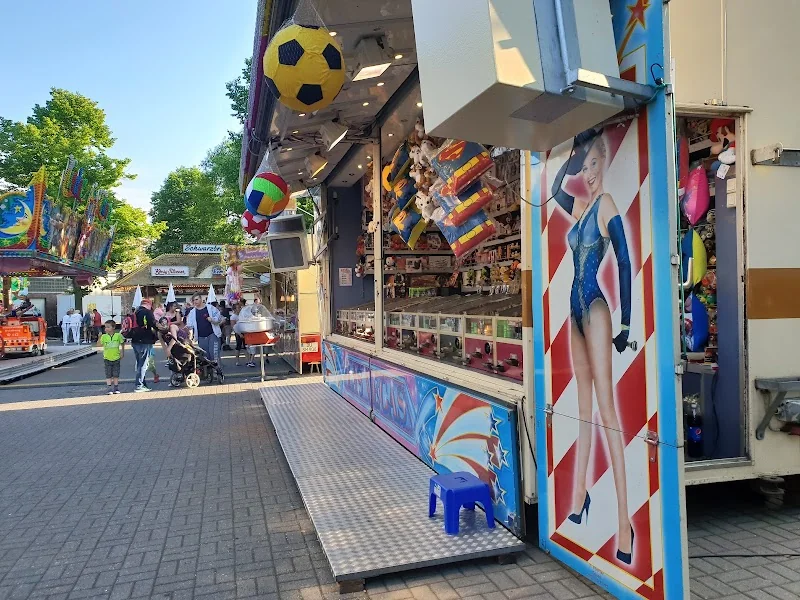
Marketplace Friemersheim shows its second strong side whenever the shopping place becomes an event venue. A central example is the Pentecost Fair Friemersheim, which according to DuisburgLive takes place directly at the marketplace. A colorful family program with rides, game and fun booths, as well as gastronomic offerings is described there. This is particularly valuable for SEO logic, as search queries not only target the market in the narrower sense but also experiences, leisure, and seasonal events. The square is thus both a place for everyday life and a temporary stage for festivities. In addition, the Market Woman sculpture by Antonius Linn illustrates how strongly the public perception of the square is connected with trade and encounters. The bronze was donated in 1988 and stands at the marketplace towards Kronprinzenstraße. It sets a visual accent that makes the square unmistakable and is excellent for pictures of Marketplace Friemersheim. The city library's book bus also stops at the marketplace on Thursdays, further confirming the place as a meeting point for the neighborhood. This connection of market, fair, public art, and municipal services is a typical feature of functioning town centers: The square is not only used but also animated. For this reason, Friemersheim also works well as a local search term, as people are not just looking for a space but a place with recurring events. Those who visit the marketplace experience a neighborhood-specific meeting point on normal days and a clearly visible transformation towards a fair and family event on festive days. For the content profile, this is ideal: The topic of events can be credibly linked here with the weekly market, Pentecost fair, book bus, and the role of the square as a social center without inventing anything. ([duisburglive.de](https://www.duisburglive.de/event/2026/05/23/pfingstkirmes-friemersheim/?cHash=0762ea04a7a6ed8f5a1a1741ddd58349&utm_source=openai))
Images of Marketplace Friemersheim: Motifs, Atmosphere, and Photo Spots
The keyword images of Marketplace Friemersheim is particularly interesting because it expresses not only information but also visual expectation. Those searching for images usually want to see how the place actually looks, and Friemersheim has quite a lot to offer in this regard. The square is part of a historical village structure that is described in the monument description as nearly closed and surrounded by trees, namely the church square or town center. This means for the imagery: Not only the market itself but also the structure of the entire town center is photogenic. Particularly striking are the Market Woman sculpture towards Kronprinzenstraße and the high bunker at the market, which was intended to provide shelter as a six-story building during World War II and was later repurposed for residential use. Both objects provide strong motifs with high recognition value because they make history visible without appearing museum-like. Additionally, the daily and weekly use of the square creates an atmosphere that is significantly livelier than that of a mere traffic square. The Duisburg city page on Friemersheim also mentions that the place has retained its rural charm. This is typically seen in photos: no artificial staging, but a real neighborhood with its own life. For practical image searches, it is also useful that the marketplace can be well defined by its exact location between Kaiser- and Kronprinzenstraße. Those who want to take their own pictures will find different moods there depending on the time of day: morning market life, more tranquility at noon, and significantly more activity on fair days. Therefore, for a high-quality selection of images, not only individual objects are important but also the combination of square, sculpture, historical environment, and everyday operation. Thus, a simple place name becomes a visual theme with history, atmosphere, and local identity. ([kuladig.de](https://www.kuladig.de/Objektansicht/Drucken/BODEON-811-13062019-293785))
Sources:
Mehr anzeigenWeniger anzeigen
Marketplace Friemersheim | Weekly Market & Directions
The Marketplace Friemersheim is much more than just a place on the map of Duisburg. It is the visible center of a district that has preserved its rural roots to this day and is also an integral part of the everyday life of a developed city. Between Kaiserstraße and Kronprinzenstraße, history, community, supply, and short distances come together. Those who visit the square experience not an anonymous traffic junction, but a place with a recognizable identity, where market activities, shops, historical buildings, and life in the district intertwine. The city of Duisburg describes Friemersheim itself as a place with rural charm, whose village character has remained intact despite industrialization. The market forms an important address for shopping, encounters, and local orientation in this environment. Additionally, defining objects such as the Market Woman sculpture and the high bunker at the market make the square visually distinctive. ([duisburg.de](https://www.duisburg.de/microsites/sieben_bezirke/rheinhausen/friemersheim/friemersheim.php))
Weekly Market and Market Days at Marketplace Friemersheim
The most important search impulse around Marketplace Friemersheim is clearly the weekly market. This is where one of the great everyday advantages of this place lies: The square is not only historically interesting, but it also has a clear function as a shopping and meeting point in the district to this day. The Duisburg market regulations list Friemersheim as a public weekly market location and specify the marketplace between Kaiser- and Kronprinzenstraße as the exact area. The market takes place on Tuesdays and Fridays from 08:00 to 13:00. In practice, this means: The square regularly becomes a lively space where fresh food, everyday goods, and the movement of a classic neighborhood market become visible. The event description for the weekly market emphasizes that a colorful, diverse market with a wide range of fruits, vegetables, potatoes, sausages, meat, cheese, eggs, fish, baked goods, as well as flowers and plants takes place there every week; the offer is supplemented by textiles, shoes, and gift items. Furthermore, the market is described as a meeting point for the residents of the neighborhood, which aptly highlights the social function of the square. Spatially, the market is also clearly defined: The city designates the weekly market as a shopping source with approximately 200 meters of product presentation. From an SEO perspective, this is a strong signal, as search queries like weekly market Friemersheim, Marketplace Friemersheim, Kaiserstraße, or Kronprinzenstraße usually target this combination of shopping, orientation, and local belonging. Particularly interesting is the Pentecost regulation: According to the market regulations, the market is set up on the Friday before and the Tuesday after Pentecost on Kronprinzenstraße. This shows that the market is not rigid but integrates into the district and its events. ([duisburg.de](https://duisburg.de/rathaus/rathausundpolitik/ortsrecht/S32.04-Marktsatzung_01.12.2023.pdf))
History of the Town Center of Friemersheim
To understand Marketplace Friemersheim, one must read the place as a historically grown village center. The cultural and monument source from KuLaDig describes Friemersheim as a place in the south of Duisburg on the lower terrace of the Rhine floodplain. For the settlement history, it is crucial that Friemersheim played a regional role very early on: Between 809 and 814, Charlemagne is said to have gifted Friemersheim from Frankish royal estates to the monastery of Werden. Later, a chapel was built in the current town center at the site of the Möllerhof as a precursor to the parish church. This explains why the church square and its surroundings are still so important for the structure of the place today. KuLaDig explicitly describes Friemersheim as a street village, whose center has been condensed through public functions. This is precisely where the historical connection to the marketplace lies: The place does not have an artificially created center but a core that has grown over centuries, where the church, parsonage, teachers' house, school, inns, and craft businesses shaped the village center. The Duisburg city side also confirms this rural character and points out that Friemersheim still reminds one of an old village despite industrialization. Additionally, the historical migration of the city describes the place as a historical cultural landscape in the Rhine floodplain and refers to archaeological finds, historical estates, and buildings. The teachers' house Friemersheim, built around 1800 as a caretaker's house, impressively complements this impression: It shows how closely living, schooling, and village life were interconnected. For visitors, this mixture is particularly important because it explains why the marketplace does not feel like an interchangeable place but like the open stage of a grown local image. The marketplace is thus part of an identity shaped equally by agricultural history, ecclesiastical center, and later urban development. ([kuladig.de](https://www.kuladig.de/Objektansicht/Drucken/BODEON-811-13062019-293785))
Directions to Marketplace Friemersheim by Bus and Train
The search intent for directions to Marketplace Friemersheim usually revolves around simple, reliable orientation. Here, the municipal transport documents are particularly helpful, which name Friemersheim, Market as an important hub in the bus network. In the local transport plan of the city of Duisburg, Friemersheim, Market is listed as a line section and transfer point; among others, the city bus lines West 2_1 and West 2_2 are mentioned. The plan also refers to relevant transfer relationships, such as to Rheinhausen, Bahnhof and Rheinhausen, Markt. This is useful for visitors as it shows that the marketplace is integrated into a broader network of district connections and is not isolated. The city’s offer pages for the marketplace itself also work with a route planning link, emphasizing the central role of the route for visitors. Practically, this means: Those who want to reach the square by bus and train benefit from the functional location in the district and from the proximity to further public transport connections in Rheinhausen. The market is thus easily accessible not only for residents but also for guests from neighboring districts. The temporal structure is particularly important: Those who want to visit the weekly market should ideally arrive on Tuesday or Friday morning, as the market runs between 08:00 and 13:00 then. This is crucial for planning, as the square has a different dynamic on market days than on regular days. The journey also plays a role for events such as the Pentecost fair, as the marketplace is then used as a festival area. The combination of bus lines, market times, and central location makes Friemersheim a place that can be targeted specifically or reached spontaneously on foot from the surrounding area. ([duisburg.de](https://www.duisburg.de/microsites/pbv/verkehr/nahverkehrskonzepte.php.media/83128/3._Nahverkehrsplan_Stadt_Duisburg_Gesamtdokument.pdf?utm_source=openai))
Parking and Orientation at Kaiserstraße and Kronprinzenstraße
The topic of parking at Marketplace Friemersheim is often searched very specifically, but the reliable information from official sources approaches it differently: They primarily name the exact location of the marketplace between Kaiser- and Kronprinzenstraße and refer to route planning rather than a separate parking garage directly at the square. This is important for orientation on site, as it creates a clear urban planning framework. The marketplace is located in a developed, rather compact town center surrounded by streets, shops, and various public functions. The DuisburgLive page explicitly describes the place as a square where a number of shops are located and which is additionally enlivened by the weekly market. If you come by car, it is therefore advisable to use the surrounding streets as a point of orientation and to check the current traffic situation. This is especially true on market days and even more so at Pentecost when the market use, according to regulations, shifts to Kronprinzenstraße. From this, a practical SEO benefit can also be derived: Many local search queries revolve not only around parking itself but around the combination of directions, market times, and wayfinding in the town center. For visitors with a short stay, the square is well suited as a walking destination because the paths in the town center are manageable and the central location makes orientation easier. Therefore, those looking for parking options should focus less on large parking facilities and more on finding a good starting position in the vicinity of Kaiserstraße, Kronprinzenstraße, and the adjacent side streets. The most important practical recommendation is therefore: first plan the route, then check the current situation on site, and allow some buffer for the journey on market days. This way, the visit remains relaxed, and the historical town center is not unnecessarily burdened by search traffic. ([duisburg.de](https://duisburg.de/rathaus/rathausundpolitik/ortsrecht/S32.04-Marktsatzung_01.12.2023.pdf))
Pentecost Fair, Meeting Point, and Events in Everyday Life
Marketplace Friemersheim shows its second strong side whenever the shopping place becomes an event venue. A central example is the Pentecost Fair Friemersheim, which according to DuisburgLive takes place directly at the marketplace. A colorful family program with rides, game and fun booths, as well as gastronomic offerings is described there. This is particularly valuable for SEO logic, as search queries not only target the market in the narrower sense but also experiences, leisure, and seasonal events. The square is thus both a place for everyday life and a temporary stage for festivities. In addition, the Market Woman sculpture by Antonius Linn illustrates how strongly the public perception of the square is connected with trade and encounters. The bronze was donated in 1988 and stands at the marketplace towards Kronprinzenstraße. It sets a visual accent that makes the square unmistakable and is excellent for pictures of Marketplace Friemersheim. The city library's book bus also stops at the marketplace on Thursdays, further confirming the place as a meeting point for the neighborhood. This connection of market, fair, public art, and municipal services is a typical feature of functioning town centers: The square is not only used but also animated. For this reason, Friemersheim also works well as a local search term, as people are not just looking for a space but a place with recurring events. Those who visit the marketplace experience a neighborhood-specific meeting point on normal days and a clearly visible transformation towards a fair and family event on festive days. For the content profile, this is ideal: The topic of events can be credibly linked here with the weekly market, Pentecost fair, book bus, and the role of the square as a social center without inventing anything. ([duisburglive.de](https://www.duisburglive.de/event/2026/05/23/pfingstkirmes-friemersheim/?cHash=0762ea04a7a6ed8f5a1a1741ddd58349&utm_source=openai))
Images of Marketplace Friemersheim: Motifs, Atmosphere, and Photo Spots
The keyword images of Marketplace Friemersheim is particularly interesting because it expresses not only information but also visual expectation. Those searching for images usually want to see how the place actually looks, and Friemersheim has quite a lot to offer in this regard. The square is part of a historical village structure that is described in the monument description as nearly closed and surrounded by trees, namely the church square or town center. This means for the imagery: Not only the market itself but also the structure of the entire town center is photogenic. Particularly striking are the Market Woman sculpture towards Kronprinzenstraße and the high bunker at the market, which was intended to provide shelter as a six-story building during World War II and was later repurposed for residential use. Both objects provide strong motifs with high recognition value because they make history visible without appearing museum-like. Additionally, the daily and weekly use of the square creates an atmosphere that is significantly livelier than that of a mere traffic square. The Duisburg city page on Friemersheim also mentions that the place has retained its rural charm. This is typically seen in photos: no artificial staging, but a real neighborhood with its own life. For practical image searches, it is also useful that the marketplace can be well defined by its exact location between Kaiser- and Kronprinzenstraße. Those who want to take their own pictures will find different moods there depending on the time of day: morning market life, more tranquility at noon, and significantly more activity on fair days. Therefore, for a high-quality selection of images, not only individual objects are important but also the combination of square, sculpture, historical environment, and everyday operation. Thus, a simple place name becomes a visual theme with history, atmosphere, and local identity. ([kuladig.de](https://www.kuladig.de/Objektansicht/Drucken/BODEON-811-13062019-293785))
Sources:
Marketplace Friemersheim | Weekly Market & Directions
The Marketplace Friemersheim is much more than just a place on the map of Duisburg. It is the visible center of a district that has preserved its rural roots to this day and is also an integral part of the everyday life of a developed city. Between Kaiserstraße and Kronprinzenstraße, history, community, supply, and short distances come together. Those who visit the square experience not an anonymous traffic junction, but a place with a recognizable identity, where market activities, shops, historical buildings, and life in the district intertwine. The city of Duisburg describes Friemersheim itself as a place with rural charm, whose village character has remained intact despite industrialization. The market forms an important address for shopping, encounters, and local orientation in this environment. Additionally, defining objects such as the Market Woman sculpture and the high bunker at the market make the square visually distinctive. ([duisburg.de](https://www.duisburg.de/microsites/sieben_bezirke/rheinhausen/friemersheim/friemersheim.php))
Weekly Market and Market Days at Marketplace Friemersheim
The most important search impulse around Marketplace Friemersheim is clearly the weekly market. This is where one of the great everyday advantages of this place lies: The square is not only historically interesting, but it also has a clear function as a shopping and meeting point in the district to this day. The Duisburg market regulations list Friemersheim as a public weekly market location and specify the marketplace between Kaiser- and Kronprinzenstraße as the exact area. The market takes place on Tuesdays and Fridays from 08:00 to 13:00. In practice, this means: The square regularly becomes a lively space where fresh food, everyday goods, and the movement of a classic neighborhood market become visible. The event description for the weekly market emphasizes that a colorful, diverse market with a wide range of fruits, vegetables, potatoes, sausages, meat, cheese, eggs, fish, baked goods, as well as flowers and plants takes place there every week; the offer is supplemented by textiles, shoes, and gift items. Furthermore, the market is described as a meeting point for the residents of the neighborhood, which aptly highlights the social function of the square. Spatially, the market is also clearly defined: The city designates the weekly market as a shopping source with approximately 200 meters of product presentation. From an SEO perspective, this is a strong signal, as search queries like weekly market Friemersheim, Marketplace Friemersheim, Kaiserstraße, or Kronprinzenstraße usually target this combination of shopping, orientation, and local belonging. Particularly interesting is the Pentecost regulation: According to the market regulations, the market is set up on the Friday before and the Tuesday after Pentecost on Kronprinzenstraße. This shows that the market is not rigid but integrates into the district and its events. ([duisburg.de](https://duisburg.de/rathaus/rathausundpolitik/ortsrecht/S32.04-Marktsatzung_01.12.2023.pdf))
History of the Town Center of Friemersheim
To understand Marketplace Friemersheim, one must read the place as a historically grown village center. The cultural and monument source from KuLaDig describes Friemersheim as a place in the south of Duisburg on the lower terrace of the Rhine floodplain. For the settlement history, it is crucial that Friemersheim played a regional role very early on: Between 809 and 814, Charlemagne is said to have gifted Friemersheim from Frankish royal estates to the monastery of Werden. Later, a chapel was built in the current town center at the site of the Möllerhof as a precursor to the parish church. This explains why the church square and its surroundings are still so important for the structure of the place today. KuLaDig explicitly describes Friemersheim as a street village, whose center has been condensed through public functions. This is precisely where the historical connection to the marketplace lies: The place does not have an artificially created center but a core that has grown over centuries, where the church, parsonage, teachers' house, school, inns, and craft businesses shaped the village center. The Duisburg city side also confirms this rural character and points out that Friemersheim still reminds one of an old village despite industrialization. Additionally, the historical migration of the city describes the place as a historical cultural landscape in the Rhine floodplain and refers to archaeological finds, historical estates, and buildings. The teachers' house Friemersheim, built around 1800 as a caretaker's house, impressively complements this impression: It shows how closely living, schooling, and village life were interconnected. For visitors, this mixture is particularly important because it explains why the marketplace does not feel like an interchangeable place but like the open stage of a grown local image. The marketplace is thus part of an identity shaped equally by agricultural history, ecclesiastical center, and later urban development. ([kuladig.de](https://www.kuladig.de/Objektansicht/Drucken/BODEON-811-13062019-293785))
Directions to Marketplace Friemersheim by Bus and Train
The search intent for directions to Marketplace Friemersheim usually revolves around simple, reliable orientation. Here, the municipal transport documents are particularly helpful, which name Friemersheim, Market as an important hub in the bus network. In the local transport plan of the city of Duisburg, Friemersheim, Market is listed as a line section and transfer point; among others, the city bus lines West 2_1 and West 2_2 are mentioned. The plan also refers to relevant transfer relationships, such as to Rheinhausen, Bahnhof and Rheinhausen, Markt. This is useful for visitors as it shows that the marketplace is integrated into a broader network of district connections and is not isolated. The city’s offer pages for the marketplace itself also work with a route planning link, emphasizing the central role of the route for visitors. Practically, this means: Those who want to reach the square by bus and train benefit from the functional location in the district and from the proximity to further public transport connections in Rheinhausen. The market is thus easily accessible not only for residents but also for guests from neighboring districts. The temporal structure is particularly important: Those who want to visit the weekly market should ideally arrive on Tuesday or Friday morning, as the market runs between 08:00 and 13:00 then. This is crucial for planning, as the square has a different dynamic on market days than on regular days. The journey also plays a role for events such as the Pentecost fair, as the marketplace is then used as a festival area. The combination of bus lines, market times, and central location makes Friemersheim a place that can be targeted specifically or reached spontaneously on foot from the surrounding area. ([duisburg.de](https://www.duisburg.de/microsites/pbv/verkehr/nahverkehrskonzepte.php.media/83128/3._Nahverkehrsplan_Stadt_Duisburg_Gesamtdokument.pdf?utm_source=openai))
Parking and Orientation at Kaiserstraße and Kronprinzenstraße
The topic of parking at Marketplace Friemersheim is often searched very specifically, but the reliable information from official sources approaches it differently: They primarily name the exact location of the marketplace between Kaiser- and Kronprinzenstraße and refer to route planning rather than a separate parking garage directly at the square. This is important for orientation on site, as it creates a clear urban planning framework. The marketplace is located in a developed, rather compact town center surrounded by streets, shops, and various public functions. The DuisburgLive page explicitly describes the place as a square where a number of shops are located and which is additionally enlivened by the weekly market. If you come by car, it is therefore advisable to use the surrounding streets as a point of orientation and to check the current traffic situation. This is especially true on market days and even more so at Pentecost when the market use, according to regulations, shifts to Kronprinzenstraße. From this, a practical SEO benefit can also be derived: Many local search queries revolve not only around parking itself but around the combination of directions, market times, and wayfinding in the town center. For visitors with a short stay, the square is well suited as a walking destination because the paths in the town center are manageable and the central location makes orientation easier. Therefore, those looking for parking options should focus less on large parking facilities and more on finding a good starting position in the vicinity of Kaiserstraße, Kronprinzenstraße, and the adjacent side streets. The most important practical recommendation is therefore: first plan the route, then check the current situation on site, and allow some buffer for the journey on market days. This way, the visit remains relaxed, and the historical town center is not unnecessarily burdened by search traffic. ([duisburg.de](https://duisburg.de/rathaus/rathausundpolitik/ortsrecht/S32.04-Marktsatzung_01.12.2023.pdf))
Pentecost Fair, Meeting Point, and Events in Everyday Life
Marketplace Friemersheim shows its second strong side whenever the shopping place becomes an event venue. A central example is the Pentecost Fair Friemersheim, which according to DuisburgLive takes place directly at the marketplace. A colorful family program with rides, game and fun booths, as well as gastronomic offerings is described there. This is particularly valuable for SEO logic, as search queries not only target the market in the narrower sense but also experiences, leisure, and seasonal events. The square is thus both a place for everyday life and a temporary stage for festivities. In addition, the Market Woman sculpture by Antonius Linn illustrates how strongly the public perception of the square is connected with trade and encounters. The bronze was donated in 1988 and stands at the marketplace towards Kronprinzenstraße. It sets a visual accent that makes the square unmistakable and is excellent for pictures of Marketplace Friemersheim. The city library's book bus also stops at the marketplace on Thursdays, further confirming the place as a meeting point for the neighborhood. This connection of market, fair, public art, and municipal services is a typical feature of functioning town centers: The square is not only used but also animated. For this reason, Friemersheim also works well as a local search term, as people are not just looking for a space but a place with recurring events. Those who visit the marketplace experience a neighborhood-specific meeting point on normal days and a clearly visible transformation towards a fair and family event on festive days. For the content profile, this is ideal: The topic of events can be credibly linked here with the weekly market, Pentecost fair, book bus, and the role of the square as a social center without inventing anything. ([duisburglive.de](https://www.duisburglive.de/event/2026/05/23/pfingstkirmes-friemersheim/?cHash=0762ea04a7a6ed8f5a1a1741ddd58349&utm_source=openai))
Images of Marketplace Friemersheim: Motifs, Atmosphere, and Photo Spots
The keyword images of Marketplace Friemersheim is particularly interesting because it expresses not only information but also visual expectation. Those searching for images usually want to see how the place actually looks, and Friemersheim has quite a lot to offer in this regard. The square is part of a historical village structure that is described in the monument description as nearly closed and surrounded by trees, namely the church square or town center. This means for the imagery: Not only the market itself but also the structure of the entire town center is photogenic. Particularly striking are the Market Woman sculpture towards Kronprinzenstraße and the high bunker at the market, which was intended to provide shelter as a six-story building during World War II and was later repurposed for residential use. Both objects provide strong motifs with high recognition value because they make history visible without appearing museum-like. Additionally, the daily and weekly use of the square creates an atmosphere that is significantly livelier than that of a mere traffic square. The Duisburg city page on Friemersheim also mentions that the place has retained its rural charm. This is typically seen in photos: no artificial staging, but a real neighborhood with its own life. For practical image searches, it is also useful that the marketplace can be well defined by its exact location between Kaiser- and Kronprinzenstraße. Those who want to take their own pictures will find different moods there depending on the time of day: morning market life, more tranquility at noon, and significantly more activity on fair days. Therefore, for a high-quality selection of images, not only individual objects are important but also the combination of square, sculpture, historical environment, and everyday operation. Thus, a simple place name becomes a visual theme with history, atmosphere, and local identity. ([kuladig.de](https://www.kuladig.de/Objektansicht/Drucken/BODEON-811-13062019-293785))
Sources:
Upcoming Events
No events found
Frequently Asked Questions
Reviews
Mario Niedzwiedz
7. August 2022
No Go
Flinker Läufer
24. June 2025
The market is small, lacking attractive shops and dining options. You also look in vain for toilets and peace here. It's always loud and cramped due to cars, buses, and long-term parkers. Accidents happen regularly here. Not recommended.
Mirko 78
12. April 2024
The marketplace mostly serves as a parking lot. I can't say exactly when market days are. I was there one Friday afternoon and there was a market. But there were still parking spaces available.
Kiru Rajah
14. March 2023
The marketplace in Friemersheim is a beautiful place, perfect for shopping and relaxing. Although the market has become smaller in recent years, it hasn't lost its charm. The atmosphere is cozy, and everyone can do their shopping in peace without being disturbed. The variety of products at the market is remarkable. From fresh fruits and vegetables to handmade crafts and jewelry, there's something for everyone here. The quality of the goods is exceptionally good, and the prices are fair. Another advantage of the marketplace in Friemersheim is the excellent parking options in the area. This makes it easier to reach the marketplace and makes shopping even more enjoyable. The proximity to other attractions in the area also makes Friemersheim a perfect destination for outings. In summary, the marketplace in Friemersheim is a place of peace and relaxation where you can buy high-quality products at fair prices. The parking options in the area are also noteworthy and make visiting the market easier. Anyone who hasn't been here yet should definitely give it a try and see for themselves the beauty and quality of the marketplace in Friemersheim.
Hans Georg Henseler
5. June 2019
Small marketplace. You shouldn't forget to use the parking disc when you park your car there for shopping. The local authorities quickly issue tickets. There's a Penny market right at the market.