
Duisburg
Josef-Kiefer-Straße 10, 47051 Duisburg, Deutschland
Marienkirche Alt-Duisburg | History & Concerts
Marienkirche Alt-Duisburg is a place where city history, community life, and music overlap in a special way. Those looking for Marienkirche city center, photos, or a Protestant church in Alt-Duisburg will find not only a historic monument here but also a vibrant meeting point for services, family offerings, and concerts. The official parish describes the long development of the church from the founding by the Knights Hospitaller through the neoclassical reconstruction to its current use; baukunst-nrw complements the architectural historical view of the rarely preserved old building fabric in Duisburg. At the same time, current reports from the church district show that Marienkirche continues to be actively used and plays a significant role as a concert and event venue in the city center. This mix of history, present, and atmosphere makes it an exciting location for those seeking photos as well as for visitors interested in culture, spirituality, and city identity. ([ekadu.de](https://ekadu.de/orte/marienkirche/))
Photos, Architecture, and First Impressions of Marienkirche
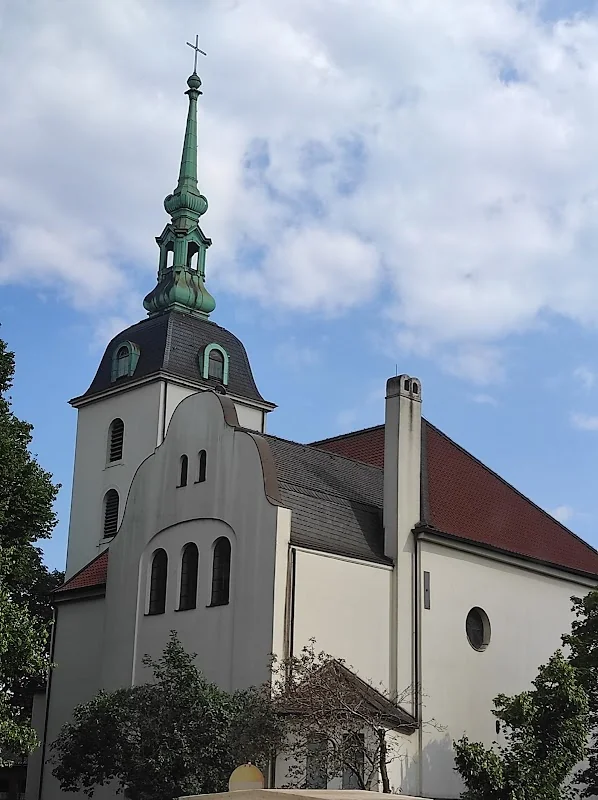
Those searching for Marienkirche photos usually want to quickly understand how this place feels before visiting. The official parish website is particularly useful for this, as it contains a photo gallery of Marienkirche and links the location with current events and the history of the parish. The architectural documentation from baukunst-nrw adds to this perspective with several exterior views and places the building in a historical context. It becomes clear that Marienkirche does not appear as an anonymous large object but as a structure with a clear stance: narrow, calm, historically significant, and simultaneously present. This mix is crucial for the visual effect, as the church not only displays religious symbolism but also the layers of a very long urban development. The origins from the time of the Knights Hospitaller and the later neoclassical reconstruction are already considered in the building's appearance, creating a visual tension that is immediately readable in photos. ([ekadu.de](https://ekadu.de/orte/marienkirche/))
Particularly striking is the fact that Marienkirche, according to baukunst-nrw, is one of the few preserved testimonies of old building fabric in Duisburg. This is not just a historical footnote for visitors but also shapes the feeling on site: One does not stand in front of an arbitrary city center church but in front of a building that has shaped the silhouette of the city and stands out due to its simple appearance and patina green tower roof. This is important for photo searches because the church provides a motif that makes history visible without resorting to the monumental. The building appears both reserved and precise, and it is precisely from this that its photographic strength arises. Those looking at pictures of Marienkirche quickly recognize that the church does not impress through decoration but through stance, proportion, and the visible depth of its architectural history. ([baukunst-nrw.de](https://www.baukunst-nrw.de/objekte/Marienkirche-Duisburg--1647.htm))
From an SEO perspective, this is also relevant: The keyword Marienkirche photos not only refers to a photo gallery but also to the desire for a genuine impression of the place, architecture, and atmosphere. Marienkirche fulfills this wish because it becomes visually tangible in both the parish presentation and the architectural documentation. The first images show a church that does not hide in Alt-Duisburg but openly plays its role as a historical anchor point. Additionally, the church today does not appear as a mere museum object but stands in a vibrant context. A building that is regularly photographed, used, and present in church media generates more attention than a silent monument. This combination makes Marienkirche interesting for visitors and search engines alike. ([ekadu.de](https://ekadu.de/orte/marienkirche/))
History of Marienkirche in Alt-Duisburg
The history of Marienkirche begins, according to the Evangelical congregation of Alt-Duisburg, around 1150, when the Knights Hospitaller founded their first German establishment in Duisburg. In this context, a church was built in honor of Saint Mary and the Baptist John, as well as a hospital. As early as 1187, a parish district was assigned to the order's church, indicating that the place assumed a firm ecclesiastical and social role very early on. Around 1475, the Knight Johannes Wassenberg also wrote the first chronicle of the city, and around 1500, Marienkirche is described as a place with two chapels and 13 altars. These early indications make it clear that the church was not only a sacred space but also a central component of Duisburg's urban development. Therefore, those visiting Marienkirche today stand at a point where medieval religious, urban, and social history intersect. ([ekadu.de](https://ekadu.de/orte/marienkirche/))
The confessional history of the place is also remarkable. In 1554, Johannes Rithlinger preached in an evangelical manner and shared communion with bread and wine for all believers, thus integrating Marienkirche early into the history of the Reformation. In 1566, Johannes Corputius included the church in his city map; at that time, it had been expanded in the 15th century with a Gothic choir and a chapel. Later, due to structural decay, the building was partially demolished in 1789 and underwent neoclassical reconstruction from 1797 to 1802. During this process, the church nave was stripped, and the two towers were replaced by a single tower. The historical span is therefore extraordinary: medieval origins, Reformation cuts, and neoclassical reformation are closely intertwined in a single building. This creates the historical allure that makes Marienkirche interesting far beyond an ordinary parish location today. ([ekadu.de](https://ekadu.de/orte/marienkirche/))
The later development shows that the church has been repeatedly adapted to changing times without losing its historical identity. In 1665, Regina Degheners donated the baptismal bowl still used in the church today, in 1896/97 galleries were installed, and a confirmation room was built, and during World War II, Marienkirche was only slightly damaged. It was not until 1969 that the rectory and community center were added, continuing the spatial expansion of the site into the present. Additionally, during excavations in 1987, remains of the foundation from the 10th or 11th century were discovered. Baukunst-nrw summarizes this long process and emphasizes that the church was built from 1153 to 1156, closed in 1789, largely rebuilt later, and completed in the neoclassical style in 1802. This sequence makes Marienkirche a place where not only a single architectural style is visible but a whole city history. ([ekadu.de](https://ekadu.de/orte/marienkirche/))
Services and Community Life in the City Center
Marienkirche is not only historically significant but is also firmly anchored in today's community life. The current service calendar of the Evangelical Church District of Duisburg regularly lists Marienkirche as a place for services of the Evangelical congregation of Alt-Duisburg. Additionally, the parish recently made it clear that services are intentionally celebrated in Marienkirche during the winter months when other spaces are used differently for cost or organizational reasons. This shows: The church is not a silent monument space but an actively used center of evangelical life in Duisburg's city center. For visitors looking for Marienkirche city center or current dates, this is important information, as it means that one does not only see historical substance there but experiences community in everyday life. ([kirche-duisburg.de](https://kirche-duisburg.de/inhalt/gottesdienste/))
The official parish website also makes it clear how broad life around Marienkirche is structured. The Marienkirche page features not only services but also offerings such as morning hour with breakfast, coffee gatherings in the emergency church, and end-of-week services. These entries are SEO-relevant because they show that Marienkirche responds with different formats to various age groups and interests. Families, seniors, regular service attendees, and people who are initially only looking for a cultural or social entry point find here a place that is not reduced to a single purpose. The history of the house is thus continued in the present: once a Knights Hospitaller church, later an evangelical preaching place, today a site for devotion, encounter, and community work. This multifacetedness is valuable for the perception in the city because it strengthens the image of a lively city center community that does not retreat into its past but actively translates it into the present. ([ekadu.de](https://ekadu.de/orte/marienkirche/))
Those looking for a suitable place for service visits in Alt-Duisburg also benefit from the fact that Marienkirche remains visible in the official calendars and news of the church district. This is a signal of reliability and public presence. The church is thus not only architecturally interesting but continues to fulfill the actual purpose of an evangelical church building: It is a place where liturgy, community, and urban life come together. For search engines, terms like services Marienkirche, Evangelical congregation Alt-Duisburg, and Marienkirche Duisburg are therefore not just keywords but expressions of a real, regular usage profile. Marienkirche thus remains a space where the past does not seem closed but is embedded in the weekly rhythm of the community. ([kirche-duisburg.de](https://kirche-duisburg.de/inhalt/gottesdienste/))
Concerts, Music at Marientor, and Special Acoustics
Today, Marienkirche is also a significant cultural venue. The Evangelical Church District of Duisburg explicitly refers to it in a current report as a house of worship and a popular concert venue. This is important for the perception of the location, as the church is thus understood not only as a sacred space but also as an open musical event venue. This is particularly evident in the series Music in Marienkirche, which is organized by the Erato Academy for Music and Language Rhein-Ruhr e.V. and supported by the Susanne Scholten Foundation, Sparkasse Duisburg, and the city of Duisburg. This shows that the church stands in a professionally supported cultural context. Additionally, the format Music at Marientor appears repeatedly on the parish's website with concerts of varying ensembles. The range extends from chamber music to clarinet programs to Vivaldi's Seasons, and this diversity makes Marienkirche particularly attractive to music enthusiasts. ([kirche-duisburg.de](https://kirche-duisburg.de/aktuelles/musik-am-marientor-mit-vivaldis-jahreszeiten-34742))
A look at individual events shows how flexibly the space is used. For example, a clarinet choir from the German Clarinet Society was a guest, presenting a matinee evening with jazz, folk, and classical music; the report mentioned a one-hour concert with free admission and a request for donations. Another concert featured a program with works by Brahms, Ligeti, and Wagner adaptations on stage, and the parish referred to the concert series Music at Marientor. In the autumn edition of the parish newsletter, recurring dates with clear musical profiles also appear, such as Masterful Clarinet Music with Hungarian influences, Vivaldi's Four Seasons, Waltz Fever and Operetta Dreams, or an annual Schubertiade on the Sunday of the Dead. All this shows: Marienkirche is not only an occasional performance venue but a fixed address in Duisburg's cultural calendar. ([kirche-duisburg.de](https://kirche-duisburg.de/aktuelles/klarinettenchor-spielt-jazz-folk-und-klassik-in-der-marienkirche-27651))
Part of the musical identity is also that the space itself is used for musical work. The page of the Salvatorkirche explicitly mentions that rehearsals take place there on Thursdays from 7:30 PM to 9:30 PM. Thus, Marienkirche is not only a stage for concerts but also a place of preparation, choir singing, and regular work on music projects. For visitors looking for acoustics, church music, or a special concert venue, this is a strong signal. The place combines architectural clarity with acoustic function and remains interesting precisely because of this: Music resonates in a church that has historically grown, is urbanly anchored, and is culturally open. Therefore, those searching for concerts Marienkirche or Music at Marientor will find here not an isolated event space but a developed cultural address with a religious background and strong public presence. ([kirche-duisburg.de](https://kirche-duisburg.de/aktuelles/musik-am-marientor-mit-vivaldis-jahreszeiten-34742))
Directions to Marienkirche in Duisburg
For orientation, it is important that the parish lists Marienkirche as a fixed location in 47051 Duisburg on its directions and address page. Current event pages of the church district also locate concerts and services on Josef-Kiefer-Straße, clearly within the Alt-Duisburg area. Therefore, those searching for Marienkirche using terms like Marienkirche directions, Marienkirche address, or Marienkirche city center will land at a clear urban reference point and not at a remote specialty location. This is an SEO advantage because the church can be very well connected with the district, the city center, and the historic old town. For visitors, this primarily means: Marienkirche belongs to the urban center of Duisburg and can be easily integrated into a tour through Alt-Duisburg or the area around Marientor. ([ekadu.de](https://ekadu.de/kontakt/anfahrt/))
Since the official parish website serves as a central point of contact, it also collects the current locations of the parish in an overview. This is practical for Marienkirche because it does not appear only as an individual object but as part of a larger parish structure with additional locations and offerings. This simplifies planning when one wants to combine a service, concert, or a short visit. Even if no specific parking information is provided here, the central location in Alt-Duisburg is an important part of the usage concept: The church is urbanly embedded, publicly perceivable, and closely connected with the cultural and church life on site. Those needing precise directions should use the parish's directions page and current event announcements as authoritative orientation. However, for the contextual classification, a glance at the address and today's uses is sufficient: Marienkirche is a city center location with history, community life, and cultural programming. ([ekadu.de](https://ekadu.de/kontakt/anfahrt/))
Sources:
- Evangelical Parish of Alt-Duisburg - Marienkirche
- Evangelical Parish of Alt-Duisburg - Directions and Addresses
- Evangelical Church District Duisburg - Clarinet Choir Plays Jazz, Folk, and Classical Music in Marienkirche
- baukunst-nrw - Marienkirche Duisburg
- Evangelical in Alt-Duisburg - Parish Newsletter Autumn 2025
Show moreShow less
Marienkirche Alt-Duisburg | History & Concerts
Marienkirche Alt-Duisburg is a place where city history, community life, and music overlap in a special way. Those looking for Marienkirche city center, photos, or a Protestant church in Alt-Duisburg will find not only a historic monument here but also a vibrant meeting point for services, family offerings, and concerts. The official parish describes the long development of the church from the founding by the Knights Hospitaller through the neoclassical reconstruction to its current use; baukunst-nrw complements the architectural historical view of the rarely preserved old building fabric in Duisburg. At the same time, current reports from the church district show that Marienkirche continues to be actively used and plays a significant role as a concert and event venue in the city center. This mix of history, present, and atmosphere makes it an exciting location for those seeking photos as well as for visitors interested in culture, spirituality, and city identity. ([ekadu.de](https://ekadu.de/orte/marienkirche/))
Photos, Architecture, and First Impressions of Marienkirche
Those searching for Marienkirche photos usually want to quickly understand how this place feels before visiting. The official parish website is particularly useful for this, as it contains a photo gallery of Marienkirche and links the location with current events and the history of the parish. The architectural documentation from baukunst-nrw adds to this perspective with several exterior views and places the building in a historical context. It becomes clear that Marienkirche does not appear as an anonymous large object but as a structure with a clear stance: narrow, calm, historically significant, and simultaneously present. This mix is crucial for the visual effect, as the church not only displays religious symbolism but also the layers of a very long urban development. The origins from the time of the Knights Hospitaller and the later neoclassical reconstruction are already considered in the building's appearance, creating a visual tension that is immediately readable in photos. ([ekadu.de](https://ekadu.de/orte/marienkirche/))
Particularly striking is the fact that Marienkirche, according to baukunst-nrw, is one of the few preserved testimonies of old building fabric in Duisburg. This is not just a historical footnote for visitors but also shapes the feeling on site: One does not stand in front of an arbitrary city center church but in front of a building that has shaped the silhouette of the city and stands out due to its simple appearance and patina green tower roof. This is important for photo searches because the church provides a motif that makes history visible without resorting to the monumental. The building appears both reserved and precise, and it is precisely from this that its photographic strength arises. Those looking at pictures of Marienkirche quickly recognize that the church does not impress through decoration but through stance, proportion, and the visible depth of its architectural history. ([baukunst-nrw.de](https://www.baukunst-nrw.de/objekte/Marienkirche-Duisburg--1647.htm))
From an SEO perspective, this is also relevant: The keyword Marienkirche photos not only refers to a photo gallery but also to the desire for a genuine impression of the place, architecture, and atmosphere. Marienkirche fulfills this wish because it becomes visually tangible in both the parish presentation and the architectural documentation. The first images show a church that does not hide in Alt-Duisburg but openly plays its role as a historical anchor point. Additionally, the church today does not appear as a mere museum object but stands in a vibrant context. A building that is regularly photographed, used, and present in church media generates more attention than a silent monument. This combination makes Marienkirche interesting for visitors and search engines alike. ([ekadu.de](https://ekadu.de/orte/marienkirche/))
History of Marienkirche in Alt-Duisburg
The history of Marienkirche begins, according to the Evangelical congregation of Alt-Duisburg, around 1150, when the Knights Hospitaller founded their first German establishment in Duisburg. In this context, a church was built in honor of Saint Mary and the Baptist John, as well as a hospital. As early as 1187, a parish district was assigned to the order's church, indicating that the place assumed a firm ecclesiastical and social role very early on. Around 1475, the Knight Johannes Wassenberg also wrote the first chronicle of the city, and around 1500, Marienkirche is described as a place with two chapels and 13 altars. These early indications make it clear that the church was not only a sacred space but also a central component of Duisburg's urban development. Therefore, those visiting Marienkirche today stand at a point where medieval religious, urban, and social history intersect. ([ekadu.de](https://ekadu.de/orte/marienkirche/))
The confessional history of the place is also remarkable. In 1554, Johannes Rithlinger preached in an evangelical manner and shared communion with bread and wine for all believers, thus integrating Marienkirche early into the history of the Reformation. In 1566, Johannes Corputius included the church in his city map; at that time, it had been expanded in the 15th century with a Gothic choir and a chapel. Later, due to structural decay, the building was partially demolished in 1789 and underwent neoclassical reconstruction from 1797 to 1802. During this process, the church nave was stripped, and the two towers were replaced by a single tower. The historical span is therefore extraordinary: medieval origins, Reformation cuts, and neoclassical reformation are closely intertwined in a single building. This creates the historical allure that makes Marienkirche interesting far beyond an ordinary parish location today. ([ekadu.de](https://ekadu.de/orte/marienkirche/))
The later development shows that the church has been repeatedly adapted to changing times without losing its historical identity. In 1665, Regina Degheners donated the baptismal bowl still used in the church today, in 1896/97 galleries were installed, and a confirmation room was built, and during World War II, Marienkirche was only slightly damaged. It was not until 1969 that the rectory and community center were added, continuing the spatial expansion of the site into the present. Additionally, during excavations in 1987, remains of the foundation from the 10th or 11th century were discovered. Baukunst-nrw summarizes this long process and emphasizes that the church was built from 1153 to 1156, closed in 1789, largely rebuilt later, and completed in the neoclassical style in 1802. This sequence makes Marienkirche a place where not only a single architectural style is visible but a whole city history. ([ekadu.de](https://ekadu.de/orte/marienkirche/))
Services and Community Life in the City Center
Marienkirche is not only historically significant but is also firmly anchored in today's community life. The current service calendar of the Evangelical Church District of Duisburg regularly lists Marienkirche as a place for services of the Evangelical congregation of Alt-Duisburg. Additionally, the parish recently made it clear that services are intentionally celebrated in Marienkirche during the winter months when other spaces are used differently for cost or organizational reasons. This shows: The church is not a silent monument space but an actively used center of evangelical life in Duisburg's city center. For visitors looking for Marienkirche city center or current dates, this is important information, as it means that one does not only see historical substance there but experiences community in everyday life. ([kirche-duisburg.de](https://kirche-duisburg.de/inhalt/gottesdienste/))
The official parish website also makes it clear how broad life around Marienkirche is structured. The Marienkirche page features not only services but also offerings such as morning hour with breakfast, coffee gatherings in the emergency church, and end-of-week services. These entries are SEO-relevant because they show that Marienkirche responds with different formats to various age groups and interests. Families, seniors, regular service attendees, and people who are initially only looking for a cultural or social entry point find here a place that is not reduced to a single purpose. The history of the house is thus continued in the present: once a Knights Hospitaller church, later an evangelical preaching place, today a site for devotion, encounter, and community work. This multifacetedness is valuable for the perception in the city because it strengthens the image of a lively city center community that does not retreat into its past but actively translates it into the present. ([ekadu.de](https://ekadu.de/orte/marienkirche/))
Those looking for a suitable place for service visits in Alt-Duisburg also benefit from the fact that Marienkirche remains visible in the official calendars and news of the church district. This is a signal of reliability and public presence. The church is thus not only architecturally interesting but continues to fulfill the actual purpose of an evangelical church building: It is a place where liturgy, community, and urban life come together. For search engines, terms like services Marienkirche, Evangelical congregation Alt-Duisburg, and Marienkirche Duisburg are therefore not just keywords but expressions of a real, regular usage profile. Marienkirche thus remains a space where the past does not seem closed but is embedded in the weekly rhythm of the community. ([kirche-duisburg.de](https://kirche-duisburg.de/inhalt/gottesdienste/))
Concerts, Music at Marientor, and Special Acoustics
Today, Marienkirche is also a significant cultural venue. The Evangelical Church District of Duisburg explicitly refers to it in a current report as a house of worship and a popular concert venue. This is important for the perception of the location, as the church is thus understood not only as a sacred space but also as an open musical event venue. This is particularly evident in the series Music in Marienkirche, which is organized by the Erato Academy for Music and Language Rhein-Ruhr e.V. and supported by the Susanne Scholten Foundation, Sparkasse Duisburg, and the city of Duisburg. This shows that the church stands in a professionally supported cultural context. Additionally, the format Music at Marientor appears repeatedly on the parish's website with concerts of varying ensembles. The range extends from chamber music to clarinet programs to Vivaldi's Seasons, and this diversity makes Marienkirche particularly attractive to music enthusiasts. ([kirche-duisburg.de](https://kirche-duisburg.de/aktuelles/musik-am-marientor-mit-vivaldis-jahreszeiten-34742))
A look at individual events shows how flexibly the space is used. For example, a clarinet choir from the German Clarinet Society was a guest, presenting a matinee evening with jazz, folk, and classical music; the report mentioned a one-hour concert with free admission and a request for donations. Another concert featured a program with works by Brahms, Ligeti, and Wagner adaptations on stage, and the parish referred to the concert series Music at Marientor. In the autumn edition of the parish newsletter, recurring dates with clear musical profiles also appear, such as Masterful Clarinet Music with Hungarian influences, Vivaldi's Four Seasons, Waltz Fever and Operetta Dreams, or an annual Schubertiade on the Sunday of the Dead. All this shows: Marienkirche is not only an occasional performance venue but a fixed address in Duisburg's cultural calendar. ([kirche-duisburg.de](https://kirche-duisburg.de/aktuelles/klarinettenchor-spielt-jazz-folk-und-klassik-in-der-marienkirche-27651))
Part of the musical identity is also that the space itself is used for musical work. The page of the Salvatorkirche explicitly mentions that rehearsals take place there on Thursdays from 7:30 PM to 9:30 PM. Thus, Marienkirche is not only a stage for concerts but also a place of preparation, choir singing, and regular work on music projects. For visitors looking for acoustics, church music, or a special concert venue, this is a strong signal. The place combines architectural clarity with acoustic function and remains interesting precisely because of this: Music resonates in a church that has historically grown, is urbanly anchored, and is culturally open. Therefore, those searching for concerts Marienkirche or Music at Marientor will find here not an isolated event space but a developed cultural address with a religious background and strong public presence. ([kirche-duisburg.de](https://kirche-duisburg.de/aktuelles/musik-am-marientor-mit-vivaldis-jahreszeiten-34742))
Directions to Marienkirche in Duisburg
For orientation, it is important that the parish lists Marienkirche as a fixed location in 47051 Duisburg on its directions and address page. Current event pages of the church district also locate concerts and services on Josef-Kiefer-Straße, clearly within the Alt-Duisburg area. Therefore, those searching for Marienkirche using terms like Marienkirche directions, Marienkirche address, or Marienkirche city center will land at a clear urban reference point and not at a remote specialty location. This is an SEO advantage because the church can be very well connected with the district, the city center, and the historic old town. For visitors, this primarily means: Marienkirche belongs to the urban center of Duisburg and can be easily integrated into a tour through Alt-Duisburg or the area around Marientor. ([ekadu.de](https://ekadu.de/kontakt/anfahrt/))
Since the official parish website serves as a central point of contact, it also collects the current locations of the parish in an overview. This is practical for Marienkirche because it does not appear only as an individual object but as part of a larger parish structure with additional locations and offerings. This simplifies planning when one wants to combine a service, concert, or a short visit. Even if no specific parking information is provided here, the central location in Alt-Duisburg is an important part of the usage concept: The church is urbanly embedded, publicly perceivable, and closely connected with the cultural and church life on site. Those needing precise directions should use the parish's directions page and current event announcements as authoritative orientation. However, for the contextual classification, a glance at the address and today's uses is sufficient: Marienkirche is a city center location with history, community life, and cultural programming. ([ekadu.de](https://ekadu.de/kontakt/anfahrt/))
Sources:
- Evangelical Parish of Alt-Duisburg - Marienkirche
- Evangelical Parish of Alt-Duisburg - Directions and Addresses
- Evangelical Church District Duisburg - Clarinet Choir Plays Jazz, Folk, and Classical Music in Marienkirche
- baukunst-nrw - Marienkirche Duisburg
- Evangelical in Alt-Duisburg - Parish Newsletter Autumn 2025
Marienkirche Alt-Duisburg | History & Concerts
Marienkirche Alt-Duisburg is a place where city history, community life, and music overlap in a special way. Those looking for Marienkirche city center, photos, or a Protestant church in Alt-Duisburg will find not only a historic monument here but also a vibrant meeting point for services, family offerings, and concerts. The official parish describes the long development of the church from the founding by the Knights Hospitaller through the neoclassical reconstruction to its current use; baukunst-nrw complements the architectural historical view of the rarely preserved old building fabric in Duisburg. At the same time, current reports from the church district show that Marienkirche continues to be actively used and plays a significant role as a concert and event venue in the city center. This mix of history, present, and atmosphere makes it an exciting location for those seeking photos as well as for visitors interested in culture, spirituality, and city identity. ([ekadu.de](https://ekadu.de/orte/marienkirche/))
Photos, Architecture, and First Impressions of Marienkirche
Those searching for Marienkirche photos usually want to quickly understand how this place feels before visiting. The official parish website is particularly useful for this, as it contains a photo gallery of Marienkirche and links the location with current events and the history of the parish. The architectural documentation from baukunst-nrw adds to this perspective with several exterior views and places the building in a historical context. It becomes clear that Marienkirche does not appear as an anonymous large object but as a structure with a clear stance: narrow, calm, historically significant, and simultaneously present. This mix is crucial for the visual effect, as the church not only displays religious symbolism but also the layers of a very long urban development. The origins from the time of the Knights Hospitaller and the later neoclassical reconstruction are already considered in the building's appearance, creating a visual tension that is immediately readable in photos. ([ekadu.de](https://ekadu.de/orte/marienkirche/))
Particularly striking is the fact that Marienkirche, according to baukunst-nrw, is one of the few preserved testimonies of old building fabric in Duisburg. This is not just a historical footnote for visitors but also shapes the feeling on site: One does not stand in front of an arbitrary city center church but in front of a building that has shaped the silhouette of the city and stands out due to its simple appearance and patina green tower roof. This is important for photo searches because the church provides a motif that makes history visible without resorting to the monumental. The building appears both reserved and precise, and it is precisely from this that its photographic strength arises. Those looking at pictures of Marienkirche quickly recognize that the church does not impress through decoration but through stance, proportion, and the visible depth of its architectural history. ([baukunst-nrw.de](https://www.baukunst-nrw.de/objekte/Marienkirche-Duisburg--1647.htm))
From an SEO perspective, this is also relevant: The keyword Marienkirche photos not only refers to a photo gallery but also to the desire for a genuine impression of the place, architecture, and atmosphere. Marienkirche fulfills this wish because it becomes visually tangible in both the parish presentation and the architectural documentation. The first images show a church that does not hide in Alt-Duisburg but openly plays its role as a historical anchor point. Additionally, the church today does not appear as a mere museum object but stands in a vibrant context. A building that is regularly photographed, used, and present in church media generates more attention than a silent monument. This combination makes Marienkirche interesting for visitors and search engines alike. ([ekadu.de](https://ekadu.de/orte/marienkirche/))
History of Marienkirche in Alt-Duisburg
The history of Marienkirche begins, according to the Evangelical congregation of Alt-Duisburg, around 1150, when the Knights Hospitaller founded their first German establishment in Duisburg. In this context, a church was built in honor of Saint Mary and the Baptist John, as well as a hospital. As early as 1187, a parish district was assigned to the order's church, indicating that the place assumed a firm ecclesiastical and social role very early on. Around 1475, the Knight Johannes Wassenberg also wrote the first chronicle of the city, and around 1500, Marienkirche is described as a place with two chapels and 13 altars. These early indications make it clear that the church was not only a sacred space but also a central component of Duisburg's urban development. Therefore, those visiting Marienkirche today stand at a point where medieval religious, urban, and social history intersect. ([ekadu.de](https://ekadu.de/orte/marienkirche/))
The confessional history of the place is also remarkable. In 1554, Johannes Rithlinger preached in an evangelical manner and shared communion with bread and wine for all believers, thus integrating Marienkirche early into the history of the Reformation. In 1566, Johannes Corputius included the church in his city map; at that time, it had been expanded in the 15th century with a Gothic choir and a chapel. Later, due to structural decay, the building was partially demolished in 1789 and underwent neoclassical reconstruction from 1797 to 1802. During this process, the church nave was stripped, and the two towers were replaced by a single tower. The historical span is therefore extraordinary: medieval origins, Reformation cuts, and neoclassical reformation are closely intertwined in a single building. This creates the historical allure that makes Marienkirche interesting far beyond an ordinary parish location today. ([ekadu.de](https://ekadu.de/orte/marienkirche/))
The later development shows that the church has been repeatedly adapted to changing times without losing its historical identity. In 1665, Regina Degheners donated the baptismal bowl still used in the church today, in 1896/97 galleries were installed, and a confirmation room was built, and during World War II, Marienkirche was only slightly damaged. It was not until 1969 that the rectory and community center were added, continuing the spatial expansion of the site into the present. Additionally, during excavations in 1987, remains of the foundation from the 10th or 11th century were discovered. Baukunst-nrw summarizes this long process and emphasizes that the church was built from 1153 to 1156, closed in 1789, largely rebuilt later, and completed in the neoclassical style in 1802. This sequence makes Marienkirche a place where not only a single architectural style is visible but a whole city history. ([ekadu.de](https://ekadu.de/orte/marienkirche/))
Services and Community Life in the City Center
Marienkirche is not only historically significant but is also firmly anchored in today's community life. The current service calendar of the Evangelical Church District of Duisburg regularly lists Marienkirche as a place for services of the Evangelical congregation of Alt-Duisburg. Additionally, the parish recently made it clear that services are intentionally celebrated in Marienkirche during the winter months when other spaces are used differently for cost or organizational reasons. This shows: The church is not a silent monument space but an actively used center of evangelical life in Duisburg's city center. For visitors looking for Marienkirche city center or current dates, this is important information, as it means that one does not only see historical substance there but experiences community in everyday life. ([kirche-duisburg.de](https://kirche-duisburg.de/inhalt/gottesdienste/))
The official parish website also makes it clear how broad life around Marienkirche is structured. The Marienkirche page features not only services but also offerings such as morning hour with breakfast, coffee gatherings in the emergency church, and end-of-week services. These entries are SEO-relevant because they show that Marienkirche responds with different formats to various age groups and interests. Families, seniors, regular service attendees, and people who are initially only looking for a cultural or social entry point find here a place that is not reduced to a single purpose. The history of the house is thus continued in the present: once a Knights Hospitaller church, later an evangelical preaching place, today a site for devotion, encounter, and community work. This multifacetedness is valuable for the perception in the city because it strengthens the image of a lively city center community that does not retreat into its past but actively translates it into the present. ([ekadu.de](https://ekadu.de/orte/marienkirche/))
Those looking for a suitable place for service visits in Alt-Duisburg also benefit from the fact that Marienkirche remains visible in the official calendars and news of the church district. This is a signal of reliability and public presence. The church is thus not only architecturally interesting but continues to fulfill the actual purpose of an evangelical church building: It is a place where liturgy, community, and urban life come together. For search engines, terms like services Marienkirche, Evangelical congregation Alt-Duisburg, and Marienkirche Duisburg are therefore not just keywords but expressions of a real, regular usage profile. Marienkirche thus remains a space where the past does not seem closed but is embedded in the weekly rhythm of the community. ([kirche-duisburg.de](https://kirche-duisburg.de/inhalt/gottesdienste/))
Concerts, Music at Marientor, and Special Acoustics
Today, Marienkirche is also a significant cultural venue. The Evangelical Church District of Duisburg explicitly refers to it in a current report as a house of worship and a popular concert venue. This is important for the perception of the location, as the church is thus understood not only as a sacred space but also as an open musical event venue. This is particularly evident in the series Music in Marienkirche, which is organized by the Erato Academy for Music and Language Rhein-Ruhr e.V. and supported by the Susanne Scholten Foundation, Sparkasse Duisburg, and the city of Duisburg. This shows that the church stands in a professionally supported cultural context. Additionally, the format Music at Marientor appears repeatedly on the parish's website with concerts of varying ensembles. The range extends from chamber music to clarinet programs to Vivaldi's Seasons, and this diversity makes Marienkirche particularly attractive to music enthusiasts. ([kirche-duisburg.de](https://kirche-duisburg.de/aktuelles/musik-am-marientor-mit-vivaldis-jahreszeiten-34742))
A look at individual events shows how flexibly the space is used. For example, a clarinet choir from the German Clarinet Society was a guest, presenting a matinee evening with jazz, folk, and classical music; the report mentioned a one-hour concert with free admission and a request for donations. Another concert featured a program with works by Brahms, Ligeti, and Wagner adaptations on stage, and the parish referred to the concert series Music at Marientor. In the autumn edition of the parish newsletter, recurring dates with clear musical profiles also appear, such as Masterful Clarinet Music with Hungarian influences, Vivaldi's Four Seasons, Waltz Fever and Operetta Dreams, or an annual Schubertiade on the Sunday of the Dead. All this shows: Marienkirche is not only an occasional performance venue but a fixed address in Duisburg's cultural calendar. ([kirche-duisburg.de](https://kirche-duisburg.de/aktuelles/klarinettenchor-spielt-jazz-folk-und-klassik-in-der-marienkirche-27651))
Part of the musical identity is also that the space itself is used for musical work. The page of the Salvatorkirche explicitly mentions that rehearsals take place there on Thursdays from 7:30 PM to 9:30 PM. Thus, Marienkirche is not only a stage for concerts but also a place of preparation, choir singing, and regular work on music projects. For visitors looking for acoustics, church music, or a special concert venue, this is a strong signal. The place combines architectural clarity with acoustic function and remains interesting precisely because of this: Music resonates in a church that has historically grown, is urbanly anchored, and is culturally open. Therefore, those searching for concerts Marienkirche or Music at Marientor will find here not an isolated event space but a developed cultural address with a religious background and strong public presence. ([kirche-duisburg.de](https://kirche-duisburg.de/aktuelles/musik-am-marientor-mit-vivaldis-jahreszeiten-34742))
Directions to Marienkirche in Duisburg
For orientation, it is important that the parish lists Marienkirche as a fixed location in 47051 Duisburg on its directions and address page. Current event pages of the church district also locate concerts and services on Josef-Kiefer-Straße, clearly within the Alt-Duisburg area. Therefore, those searching for Marienkirche using terms like Marienkirche directions, Marienkirche address, or Marienkirche city center will land at a clear urban reference point and not at a remote specialty location. This is an SEO advantage because the church can be very well connected with the district, the city center, and the historic old town. For visitors, this primarily means: Marienkirche belongs to the urban center of Duisburg and can be easily integrated into a tour through Alt-Duisburg or the area around Marientor. ([ekadu.de](https://ekadu.de/kontakt/anfahrt/))
Since the official parish website serves as a central point of contact, it also collects the current locations of the parish in an overview. This is practical for Marienkirche because it does not appear only as an individual object but as part of a larger parish structure with additional locations and offerings. This simplifies planning when one wants to combine a service, concert, or a short visit. Even if no specific parking information is provided here, the central location in Alt-Duisburg is an important part of the usage concept: The church is urbanly embedded, publicly perceivable, and closely connected with the cultural and church life on site. Those needing precise directions should use the parish's directions page and current event announcements as authoritative orientation. However, for the contextual classification, a glance at the address and today's uses is sufficient: Marienkirche is a city center location with history, community life, and cultural programming. ([ekadu.de](https://ekadu.de/kontakt/anfahrt/))
Sources:
- Evangelical Parish of Alt-Duisburg - Marienkirche
- Evangelical Parish of Alt-Duisburg - Directions and Addresses
- Evangelical Church District Duisburg - Clarinet Choir Plays Jazz, Folk, and Classical Music in Marienkirche
- baukunst-nrw - Marienkirche Duisburg
- Evangelical in Alt-Duisburg - Parish Newsletter Autumn 2025
Upcoming Events
No events found
Frequently Asked Questions
Reviews
Doris W.
9. May 2025
The church has a really beautiful acoustics. Perfect for concerts. Unfortunately, the church is located in a shady area.
Mänsef Jelel
13. February 2023
The story of Luzie-Lotta in the mini mass on Sunday with Stephan Blank was really beautiful. All the kids, whether 2 or 6 years old, and even the adults were included in the singing, dancing, the story, and even crafting. A big thank you for that. We will definitely be back in March.
Peter Tries
4. May 2023
The church has been newly restored. It serves not only for services but also as a rehearsal space for the Salvatorkantorei Duisburg. We rehearse there on Thursdays from 7:30 PM to 9:30 PM. Singers are warmly welcome. More on the Salvatorkantorei Duisburg website.
Peter Hionsek
18. April 2019
The Marien Church in Duisburg has certainly experienced a lot since its existence. If it could tell us, we would surely hear interesting stories. This Marien Church here in Duisburg is the oldest German settlement of the Johanniter Order. It is said to have served as a hospital and church around the year 1150. It has been mentioned as a parish church since 1187. Protestant services were held here starting in 1554. The church was renewed around 1797 - 1802. Today, the Marien Church stands next to a high bunker from the war, and the immediate surroundings of this church can be referred to as the current red-light district of Duisburg. But in spite of that, a rectory and a community center have been added here. Actually, this place in Old Duisburg, in this entertainment district, is the right spot for a church; here, sinners could seek peace for their souls if they wanted to. However, there would need to be such a service from the church first. Perhaps this is a suggestion worth considering. Innovation also needs to happen in the church, and the Protestant church likes to present itself as open-minded......... On April 17, 2019, around noon, my wife and I were at this church, but the church door was locked. We couldn't get an impression of the church from the inside. We'll probably have to stop by again......
Jennifer Funken
20. May 2023
Every second Saturday, we have youth group meetings from the Johanniter Jzdort. We didn't choose the place for nothing 😊