
Duisburg
Karmelpl. 1-3, 47051 Duisburg, Deutschland
Karmel Duisburg | Church at the Inner Harbor & History
The Karmel Duisburg, also known as the Karmel Church at the Inner Harbor, is much more than a church at an attractive address. Here, medieval roots, the memory of destroyed and newly built sacred spaces, a vibrant community, and an open place of silence come together in the heart of Duisburg's city center. When one arrives at Karmelplatz 1-3, they do not experience a closed church space, but rather a place that is visited daily by people who pray, linger, celebrate services, listen to music, or simply want to step out of the pace of everyday life for a moment. The location is closely connected to the Inner Harbor and the Old Town, but also to a community that gathers from many parts of Duisburg and beyond. The church is known as an open church, it is open all day and is used daily by many people. At the same time, it remains a liturgical place with regular Eucharistic celebrations, Taizé forms, contemplation, Children's Church, and offerings for various language and community groups. ([karmel-duisburg.eu](https://karmel-duisburg.eu/karmel/krypta/))
Photos, Architecture, and History of the Karmel Church
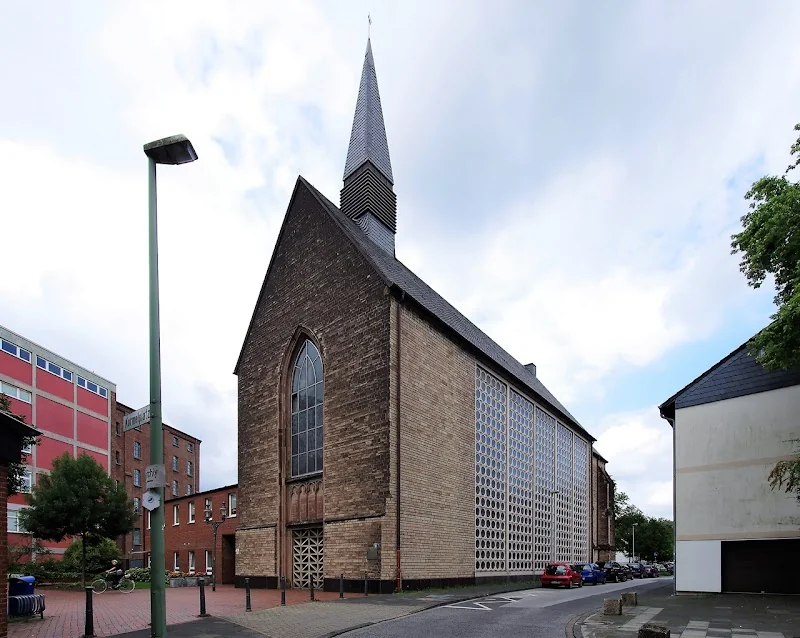
The history of the site goes deep into the city history of Duisburg. On the grounds of the present Karmel Church stood the Minorite Church, which was associated with the Franciscans; the historical side of the Karmel website traces the development back to the 13th century when Franciscans appeared in Duisburg in 1265. After the destruction of World War II, a new church building was erected on the foundations of the old church. The architect Heinz Thoma used the old floor plan and wall remnants, so the contours of the former church remain recognizable. At the same time, he introduced new elements of the time, especially in the south and west walls, where historical forms and concrete architecture visibly stand side by side. This tension between continuity and new beginnings continues to shape the appearance of the church today and explains why photos of the Karmel Church often appear so impressive: The building tells history without becoming museum-like. ([karmel-duisburg.eu](https://karmel-duisburg.eu/karmel/blick-in-die-geschichte-karmel-duisburg/2/?utm_source=openai))
Inside, the church is also not a smooth, symmetrical new building, but a space with visible breaks and overlays. The asymmetrical floor plan refers to many renovations in its eventful history. The vault over the choir area recalls the medieval origin, while the wooden roof structure over the main nave suggests the style of the Minorites, who preferred wooden ceilings instead of elaborate vaults. The building was consecrated in 1961 as the church “Mother of Good Counsel.” In 1995, the interior was modified again in the spirit of liturgical renewal: the altar area was moved closer to the congregation, the space became more open, and the separation by former communion benches lost significance. Thus, a church space was created that not only architecturally represents community but also practically enables it. ([karmel-duisburg.eu](https://karmel-duisburg.eu/karmel/krypta/))
Especially striking are the windows and the light atmosphere in the space. The south wall features over five hundred circular windows, each framed in squares; in the east choir, multicolored windows shine that are not representational in a narrow sense but have a very strong atmospheric effect. In the west wall, a large window with motifs from the Book of Revelation has a special effect in the afternoon. Since 2001, a large organ from the Klais company with nineteen registers has expanded the musical character of the space. Another reference point is the steles from 2008 with images of Edith Stein and Titus Brandsma, which commemorate two Carmelite saints and martyrs of the 20th century. Therefore, anyone who photographs the Karmel Church is not just capturing a building but a narrative of history, liturgy, art, and light. ([karmel-duisburg.eu](https://karmel-duisburg.eu/karmel/krypta/))
In 1961, Carmelites and Carmelite Sisters came to Duisburg and brought a new tone to the city. The community around the new Karmel Church was initially established as an outpost of the parish of Liebfrauen and was named “Mother of Good Counsel.” Later, this developed into the vibrant community at the Inner Harbor today. This development is also part of the building and cultural history of the site: the church is not only the result of reconstruction but also an expression of a spiritual new beginning in the post-war period that continues to resonate today. The interplay of centuries-old memory, post-war architecture, later redesign, and current use makes the Karmel Church one of the most exciting sacred places in the center of Duisburg. ([karmel-duisburg.eu](https://karmel-duisburg.eu/karmel/blick-in-die-geschichte-karmel-duisburg/6/))
Directions, Parking, and Karmelplatz 1-3
For searching “Karmelplatz Duisburg” or “Karmelplatz 1-3,” orientation is relatively simple: the official location address is Karmelplatz 1-3, 47051 Duisburg. The church is located in the area of the Inner Harbor and thus in close proximity to the city center and the Old Town. Those arriving by train can take the U-Bahn 901 from the main station towards Ruhrort/Hamborn to the Rathaus stop. From there, one goes right behind the town hall into Brüderstraße to Karmelplatz at the Rathaus exit. This route is not only practical but also pleasantly short, as the path leads through an urban environment that can accommodate pedestrians well. ([innenhafen-portal.de](https://www.innenhafen-portal.de/standort/karmel-kirche/))
The church is also accessible by car. The official directions mention the route via the A3, the DU-Kaiserberg motorway interchange, the A40 towards Venlo, then onto the A59 towards DU-Center, Duissern, and Düsseldorf, and finally the exit DU-Duissern. After that, one follows Kardinal-Galen-Straße for about a kilometer. For visitors, it is particularly important that there is a large parking lot at Burgplatz in front of the town hall and Salvatorkirche. From there, a footpath leads right past Salvatorkirche to the Karmel Church at the Inner Harbor. Therefore, those looking for parking near the Karmel Church will usually find the best orientation via Burgplatz, town hall, and Salvatorkirche. ([karmel-duisburg.eu](https://karmel-duisburg.eu/wp-content/uploads/2012/09/KTS_Karmelkirche_Duisburg.pdf))
The location at the Inner Harbor makes the way additionally attractive. The Duisburg Inner Harbor is only a few minutes from the city and is now an urban district with gastronomy, museums, and modern architecture. This is relevant for the Karmel Church because the way to the church is often associated with a city stroll, an appointment by the water, or a visit to the center. The Inner Harbor is a place where one can stroll, discover, and breathe; this mixture fits well with the Karmel Church, whose visitors often consciously seek a quiet counterpoint to everyday life. For directions and parking, this means: the church is central but not hectic; it is easily accessible but not an anonymous transit point. ([duisburg.de](https://duisburg.de/tourismus/stadt_erleben/industriekultur/duisburger-innenhafen.php))
Those traveling by bike or on foot also benefit from the inner-city location. The proximity to the town hall, Salvatorkirche, Burgplatz, and the paths along the Inner Harbor makes orientation easier, even for first-time visitors to the church. The connection of Inner Harbor, Old Town, and Karmelplatz makes the address relevant for search engines, but in reality, it is also very practical for everyday use: it is a place that can be targeted both for a service and spontaneously during a city tour. That is why many people search for terms like directions, parking, or Karmelplatz Duisburg when they want to visit the church. ([karmel-duisburg.eu](https://karmel-duisburg.eu/wp-content/uploads/2012/09/KTS_Karmelkirche_Duisburg.pdf))
Services, Taizé, and Silent Offerings at Karmel Duisburg
The Karmel Church is not just a place for sightseeing but an active community with regular worship life. The official schedule lists regular Eucharistic celebrations on Sundays at 11 am and Thursdays at 3 pm. Additionally, there is a Taizé service on the first Saturday of the month at 6 pm. On weekdays, there is a time of silence in the meditation room at 12 pm, Fridays at 6 pm there are paths into silence, and on the first Tuesday of the month, there is dancing and silence at 7:00 or 7:30 pm. Thus, Karmel Duisburg covers a wide spectrum between classic Eucharist, meditative formats, and contemplative offerings. ([karmel-duisburg.eu](https://karmel-duisburg.eu/terminvorschau-2/gottesdienste/))
There are also services for various language and community groups. The schedule lists the Croatian community with services on Sundays at 2 pm and Tuesdays at 6 pm, the Hungarian community on the first Sunday of the month at 4 pm, and the Tamil community on Sundays at 10 am in the meeting place. This shows that the Karmel Church does not only offer a single liturgy but is a diversely used ecclesiastical place. For search intentions like “program,” “services,” or “today,” this diversity is particularly important because it explains why Karmel Duisburg is perceived in the city as a lively, multilingual community. ([karmel-duisburg.eu](https://karmel-duisburg.eu/terminvorschau-2/gottesdienste/))
There are also clearly recognizable offerings for families. The Children's Church Karmel takes place about every two months and is aimed at families with children aged zero to six years. The services are intentionally kept short and work with singing, movement, and action in a child-friendly manner. Afterwards, there is interaction and conversation. In addition, there is the liturgical circle, which develops suggestions for the design of the liturgy and participates in Eucharistic celebrations as well as word services. All of this makes it clear that Karmel Duisburg does not only function on Sundays but carries a whole network of participation, preparation, and shared practice. ([karmel-duisburg.eu](https://karmel-duisburg.eu/terminvorschau-2/gottesdienste/))
For those seeking modern forms, Karmel also offers digital and spiritual connection opportunities. The Sunday 11 am service can be celebrated online. There are also tips for participating at home, such as preparing a candle, bread, and a drink as a sign of shared liturgy. This shows a community that understands presence and digital participation not as opposites. For search terms like Taizé, contemplation, silence, or online service, the Karmel Church is therefore a particularly suitable place because it combines classical ecclesiastical forms with open, contemporary expressions. ([karmel-duisburg.eu](https://karmel-duisburg.eu/gottesdienst-sonntags-um-11-uhr-online-mitfeiern/?utm_source=openai))
Crypte, Meditation Room, and Open Church at the Inner Harbor
The special appeal of Karmel Duisburg also lies in the inner rooms that extend beyond the church space. One enters the church through a foyer. To the left, a door with the word “Shalom / Peace” written in 43 languages leads to a room for activities of the community and the church congregation. Straight ahead, one reaches the sacristy and the meditation room. There, services in smaller circles, various forms of meditation, children's catechesis, and liturgical gatherings take place. In front of the sacristy door, a staircase leads down to the crypt. This spatial arrangement makes it clear upon entering that the Karmel Church is not just a sacred building but a multifunctional spiritual place. ([karmel-duisburg.eu](https://karmel-duisburg.eu/karmel/krypta/))
The crypt itself points to the depth of the place. According to the official history, the remains of abbots and monks have rested there for centuries. Above in the church, people of today gather for contemporary services. This connection between past and present is not a decorative detail but part of the church's self-understanding. The church is oriented eastward, meaning the choir is directed towards the east, and the asymmetrical floor plan recalls many renovations that the building has experienced throughout history. The small connection between the choir area and the altar area, the lattice with its open structure, also belongs to this language of space: it not only separates but can also connect. ([karmel-duisburg.eu](https://karmel-duisburg.eu/karmel/krypta/))
In the space itself, the signs are clearly set. The baroque Madonna from the 16th century, revered as the Mother of Good Counsel, is a frequent point of contact for people with personal concerns. Next to it is a Pietà in the choir area, depicting pain and care. Right at the entrance are the memorial steles for Edith Stein and Titus Brandsma. In recent years, the names of those baptized have also been kept visible in the round windows at the baptismal font, and there is also a book of remembrance for the deceased for whom the resurrection liturgy has been celebrated in this church. Therefore, anyone who visits the Karmel Church experiences a church that works not only liturgically but also biographically and culturally in terms of memory. ([karmel-duisburg.eu](https://karmel-duisburg.eu/karmel/krypta/))
The official site explicitly describes the Karmel Church as open all day. Many people come by daily, write petitions in a book, and linger at the statue of Mary or in the room of silence. Here, the strength of the Open Church is evident: it is accessible without appearing arbitrary; it is quiet without being empty. For search queries like open church, crypt, meditation room, or quiet church at the Inner Harbor, Karmel Duisburg is therefore a true core destination because here architecture, spiritual practice, and community life support each other. ([karmel-duisburg.eu](https://karmel-duisburg.eu/karmel/krypta/))
Inner Harbor, Salvatorkirche, and the Surroundings Around Karmel
The Karmel Duisburg is situated in an environment that tells its own story. The Duisburg Inner Harbor is now considered an urban district with modern architecture, waterfront locations, museums, gastronomy, and walking paths. It was previously the transshipment point for grain and thus the so-called breadbasket of the Ruhr area. Since the 1990s, the area has been redesigned according to plans by Norman Foster. Today, marinas, Five Boats, canals, museums, and public open spaces combine to create an urban landscape that is known far beyond Duisburg. For Karmel, this means: the church is not isolated but is in an environment that makes change, memory, and presence visible at the same time. ([duisburg.de](https://duisburg.de/tourismus/stadt_erleben/industriekultur/duisburger-innenhafen.php))
The immediate neighborhood also shapes the perception of the church. The path often leads past the town hall, Salvatorkirche, and across Burgplatz. This is exactly where the practical connection to parking and the footpath is located. The location between the historic Old Town, public space, and Inner Harbor makes Karmel a place where city history can literally be experienced on foot. For many visitors, this is a plus: one does not just come to a church but to an ensemble of church building, Old Town, waterfront, and cultural environment. ([karmel-duisburg.eu](https://karmel-duisburg.eu/wp-content/uploads/2012/09/KTS_Karmelkirche_Duisburg.pdf))
The surroundings also offer typical Inner Harbor qualities: walking paths, water views, cafés, restaurants, and event venues. The city of Duisburg describes the Inner Harbor as a place to stroll, discover, and enjoy; regularly, there are festivals, the marina market, dragon boat fun regatta, and the extraschicht. Therefore, those visiting the Karmel Church can easily combine their stay with a city stroll or a cultural program. This symbiosis of sacred space and urban landscape is important, especially for search queries like Karmel Church Inner Harbor or church at the Inner Harbor photos, as it explains the visual language and user experience. ([duisburg.de](https://duisburg.de/tourismus/stadt_erleben/industriekultur/duisburger-innenhafen.php))
Moreover, the community itself is part of the place. The Karmel Church is perceived as a home by many people from Duisburg and the surrounding area and is open to new interested individuals. The website also describes the Karmel community at the Inner Harbor as a community of women and men founded in 2005 that continues to carry the spiritual life at the site. This makes Karmel not only a historical building but a lively community location with presence and future. Therefore, those searching for Karmel Duisburg, Karmelplatz Duisburg, or Karmel Church Duisburg are often looking for not just an address but a place with identity. ([innenhafen-portal.de](https://www.innenhafen-portal.de/standort/karmel-kirche/))
Why Karmel Duisburg is Exciting for Seekers, Visitors, and the Community
Karmel Duisburg unites several search intentions that often appear separately on the internet: those looking for photos find unusual architecture with historical layers. Those searching for directions or parking get a centrally located area that is easily reachable with clear orientation via the town hall, Burgplatz, and Salvatorkirche. Those looking for services encounter a wide-ranging spiritual offering with Eucharist, Taizé, silence, contemplation, and Children's Church. Those searching for history come across a long development from the medieval Minorite Church through war destruction to the present open church at the Inner Harbor. This overlap makes the place strong in SEO and also credible in content. ([karmel-duisburg.eu](https://karmel-duisburg.eu/karmel/blick-in-die-geschichte-karmel-duisburg/2/?utm_source=openai))
Emotionally, the place also has a lot to offer. The church is a space for peace but not for distance. It is open but not arbitrary. It is historical but not stagnant. Between the baroque Madonna, the martyr steles, the crypt, the modernized altar area, and the colored windows, a tension field emerges that appeals to many visitors. One can linger here briefly, light a candle, leave a prayer request, or participate in a service. At the same time, one senses that this church is part of a community that actively organizes, publishes dates, supports groups, and keeps spiritual paths open. ([karmel-duisburg.eu](https://karmel-duisburg.eu/karmel/krypta/))
Karmel Duisburg is thus an ideal place for people seeking more than just a sight. It is suitable for believers, the curious, architecture enthusiasts, visitors to the Inner Harbor, and anyone needing a quiet place in the middle of the city. The combination of history, open doors, clear directions, and vibrant community life explains why search terms related to Karmelplatz, Inner Harbor, photos, parking, history, and services converge so closely here. Those who know the place quickly understand: Karmel is not a backdrop but a lived space. ([karmel-duisburg.eu](https://karmel-duisburg.eu/karmel/krypta/))
Sources:
Show moreShow less
Karmel Duisburg | Church at the Inner Harbor & History
The Karmel Duisburg, also known as the Karmel Church at the Inner Harbor, is much more than a church at an attractive address. Here, medieval roots, the memory of destroyed and newly built sacred spaces, a vibrant community, and an open place of silence come together in the heart of Duisburg's city center. When one arrives at Karmelplatz 1-3, they do not experience a closed church space, but rather a place that is visited daily by people who pray, linger, celebrate services, listen to music, or simply want to step out of the pace of everyday life for a moment. The location is closely connected to the Inner Harbor and the Old Town, but also to a community that gathers from many parts of Duisburg and beyond. The church is known as an open church, it is open all day and is used daily by many people. At the same time, it remains a liturgical place with regular Eucharistic celebrations, Taizé forms, contemplation, Children's Church, and offerings for various language and community groups. ([karmel-duisburg.eu](https://karmel-duisburg.eu/karmel/krypta/))
Photos, Architecture, and History of the Karmel Church
The history of the site goes deep into the city history of Duisburg. On the grounds of the present Karmel Church stood the Minorite Church, which was associated with the Franciscans; the historical side of the Karmel website traces the development back to the 13th century when Franciscans appeared in Duisburg in 1265. After the destruction of World War II, a new church building was erected on the foundations of the old church. The architect Heinz Thoma used the old floor plan and wall remnants, so the contours of the former church remain recognizable. At the same time, he introduced new elements of the time, especially in the south and west walls, where historical forms and concrete architecture visibly stand side by side. This tension between continuity and new beginnings continues to shape the appearance of the church today and explains why photos of the Karmel Church often appear so impressive: The building tells history without becoming museum-like. ([karmel-duisburg.eu](https://karmel-duisburg.eu/karmel/blick-in-die-geschichte-karmel-duisburg/2/?utm_source=openai))
Inside, the church is also not a smooth, symmetrical new building, but a space with visible breaks and overlays. The asymmetrical floor plan refers to many renovations in its eventful history. The vault over the choir area recalls the medieval origin, while the wooden roof structure over the main nave suggests the style of the Minorites, who preferred wooden ceilings instead of elaborate vaults. The building was consecrated in 1961 as the church “Mother of Good Counsel.” In 1995, the interior was modified again in the spirit of liturgical renewal: the altar area was moved closer to the congregation, the space became more open, and the separation by former communion benches lost significance. Thus, a church space was created that not only architecturally represents community but also practically enables it. ([karmel-duisburg.eu](https://karmel-duisburg.eu/karmel/krypta/))
Especially striking are the windows and the light atmosphere in the space. The south wall features over five hundred circular windows, each framed in squares; in the east choir, multicolored windows shine that are not representational in a narrow sense but have a very strong atmospheric effect. In the west wall, a large window with motifs from the Book of Revelation has a special effect in the afternoon. Since 2001, a large organ from the Klais company with nineteen registers has expanded the musical character of the space. Another reference point is the steles from 2008 with images of Edith Stein and Titus Brandsma, which commemorate two Carmelite saints and martyrs of the 20th century. Therefore, anyone who photographs the Karmel Church is not just capturing a building but a narrative of history, liturgy, art, and light. ([karmel-duisburg.eu](https://karmel-duisburg.eu/karmel/krypta/))
In 1961, Carmelites and Carmelite Sisters came to Duisburg and brought a new tone to the city. The community around the new Karmel Church was initially established as an outpost of the parish of Liebfrauen and was named “Mother of Good Counsel.” Later, this developed into the vibrant community at the Inner Harbor today. This development is also part of the building and cultural history of the site: the church is not only the result of reconstruction but also an expression of a spiritual new beginning in the post-war period that continues to resonate today. The interplay of centuries-old memory, post-war architecture, later redesign, and current use makes the Karmel Church one of the most exciting sacred places in the center of Duisburg. ([karmel-duisburg.eu](https://karmel-duisburg.eu/karmel/blick-in-die-geschichte-karmel-duisburg/6/))
Directions, Parking, and Karmelplatz 1-3
For searching “Karmelplatz Duisburg” or “Karmelplatz 1-3,” orientation is relatively simple: the official location address is Karmelplatz 1-3, 47051 Duisburg. The church is located in the area of the Inner Harbor and thus in close proximity to the city center and the Old Town. Those arriving by train can take the U-Bahn 901 from the main station towards Ruhrort/Hamborn to the Rathaus stop. From there, one goes right behind the town hall into Brüderstraße to Karmelplatz at the Rathaus exit. This route is not only practical but also pleasantly short, as the path leads through an urban environment that can accommodate pedestrians well. ([innenhafen-portal.de](https://www.innenhafen-portal.de/standort/karmel-kirche/))
The church is also accessible by car. The official directions mention the route via the A3, the DU-Kaiserberg motorway interchange, the A40 towards Venlo, then onto the A59 towards DU-Center, Duissern, and Düsseldorf, and finally the exit DU-Duissern. After that, one follows Kardinal-Galen-Straße for about a kilometer. For visitors, it is particularly important that there is a large parking lot at Burgplatz in front of the town hall and Salvatorkirche. From there, a footpath leads right past Salvatorkirche to the Karmel Church at the Inner Harbor. Therefore, those looking for parking near the Karmel Church will usually find the best orientation via Burgplatz, town hall, and Salvatorkirche. ([karmel-duisburg.eu](https://karmel-duisburg.eu/wp-content/uploads/2012/09/KTS_Karmelkirche_Duisburg.pdf))
The location at the Inner Harbor makes the way additionally attractive. The Duisburg Inner Harbor is only a few minutes from the city and is now an urban district with gastronomy, museums, and modern architecture. This is relevant for the Karmel Church because the way to the church is often associated with a city stroll, an appointment by the water, or a visit to the center. The Inner Harbor is a place where one can stroll, discover, and breathe; this mixture fits well with the Karmel Church, whose visitors often consciously seek a quiet counterpoint to everyday life. For directions and parking, this means: the church is central but not hectic; it is easily accessible but not an anonymous transit point. ([duisburg.de](https://duisburg.de/tourismus/stadt_erleben/industriekultur/duisburger-innenhafen.php))
Those traveling by bike or on foot also benefit from the inner-city location. The proximity to the town hall, Salvatorkirche, Burgplatz, and the paths along the Inner Harbor makes orientation easier, even for first-time visitors to the church. The connection of Inner Harbor, Old Town, and Karmelplatz makes the address relevant for search engines, but in reality, it is also very practical for everyday use: it is a place that can be targeted both for a service and spontaneously during a city tour. That is why many people search for terms like directions, parking, or Karmelplatz Duisburg when they want to visit the church. ([karmel-duisburg.eu](https://karmel-duisburg.eu/wp-content/uploads/2012/09/KTS_Karmelkirche_Duisburg.pdf))
Services, Taizé, and Silent Offerings at Karmel Duisburg
The Karmel Church is not just a place for sightseeing but an active community with regular worship life. The official schedule lists regular Eucharistic celebrations on Sundays at 11 am and Thursdays at 3 pm. Additionally, there is a Taizé service on the first Saturday of the month at 6 pm. On weekdays, there is a time of silence in the meditation room at 12 pm, Fridays at 6 pm there are paths into silence, and on the first Tuesday of the month, there is dancing and silence at 7:00 or 7:30 pm. Thus, Karmel Duisburg covers a wide spectrum between classic Eucharist, meditative formats, and contemplative offerings. ([karmel-duisburg.eu](https://karmel-duisburg.eu/terminvorschau-2/gottesdienste/))
There are also services for various language and community groups. The schedule lists the Croatian community with services on Sundays at 2 pm and Tuesdays at 6 pm, the Hungarian community on the first Sunday of the month at 4 pm, and the Tamil community on Sundays at 10 am in the meeting place. This shows that the Karmel Church does not only offer a single liturgy but is a diversely used ecclesiastical place. For search intentions like “program,” “services,” or “today,” this diversity is particularly important because it explains why Karmel Duisburg is perceived in the city as a lively, multilingual community. ([karmel-duisburg.eu](https://karmel-duisburg.eu/terminvorschau-2/gottesdienste/))
There are also clearly recognizable offerings for families. The Children's Church Karmel takes place about every two months and is aimed at families with children aged zero to six years. The services are intentionally kept short and work with singing, movement, and action in a child-friendly manner. Afterwards, there is interaction and conversation. In addition, there is the liturgical circle, which develops suggestions for the design of the liturgy and participates in Eucharistic celebrations as well as word services. All of this makes it clear that Karmel Duisburg does not only function on Sundays but carries a whole network of participation, preparation, and shared practice. ([karmel-duisburg.eu](https://karmel-duisburg.eu/terminvorschau-2/gottesdienste/))
For those seeking modern forms, Karmel also offers digital and spiritual connection opportunities. The Sunday 11 am service can be celebrated online. There are also tips for participating at home, such as preparing a candle, bread, and a drink as a sign of shared liturgy. This shows a community that understands presence and digital participation not as opposites. For search terms like Taizé, contemplation, silence, or online service, the Karmel Church is therefore a particularly suitable place because it combines classical ecclesiastical forms with open, contemporary expressions. ([karmel-duisburg.eu](https://karmel-duisburg.eu/gottesdienst-sonntags-um-11-uhr-online-mitfeiern/?utm_source=openai))
Crypte, Meditation Room, and Open Church at the Inner Harbor
The special appeal of Karmel Duisburg also lies in the inner rooms that extend beyond the church space. One enters the church through a foyer. To the left, a door with the word “Shalom / Peace” written in 43 languages leads to a room for activities of the community and the church congregation. Straight ahead, one reaches the sacristy and the meditation room. There, services in smaller circles, various forms of meditation, children's catechesis, and liturgical gatherings take place. In front of the sacristy door, a staircase leads down to the crypt. This spatial arrangement makes it clear upon entering that the Karmel Church is not just a sacred building but a multifunctional spiritual place. ([karmel-duisburg.eu](https://karmel-duisburg.eu/karmel/krypta/))
The crypt itself points to the depth of the place. According to the official history, the remains of abbots and monks have rested there for centuries. Above in the church, people of today gather for contemporary services. This connection between past and present is not a decorative detail but part of the church's self-understanding. The church is oriented eastward, meaning the choir is directed towards the east, and the asymmetrical floor plan recalls many renovations that the building has experienced throughout history. The small connection between the choir area and the altar area, the lattice with its open structure, also belongs to this language of space: it not only separates but can also connect. ([karmel-duisburg.eu](https://karmel-duisburg.eu/karmel/krypta/))
In the space itself, the signs are clearly set. The baroque Madonna from the 16th century, revered as the Mother of Good Counsel, is a frequent point of contact for people with personal concerns. Next to it is a Pietà in the choir area, depicting pain and care. Right at the entrance are the memorial steles for Edith Stein and Titus Brandsma. In recent years, the names of those baptized have also been kept visible in the round windows at the baptismal font, and there is also a book of remembrance for the deceased for whom the resurrection liturgy has been celebrated in this church. Therefore, anyone who visits the Karmel Church experiences a church that works not only liturgically but also biographically and culturally in terms of memory. ([karmel-duisburg.eu](https://karmel-duisburg.eu/karmel/krypta/))
The official site explicitly describes the Karmel Church as open all day. Many people come by daily, write petitions in a book, and linger at the statue of Mary or in the room of silence. Here, the strength of the Open Church is evident: it is accessible without appearing arbitrary; it is quiet without being empty. For search queries like open church, crypt, meditation room, or quiet church at the Inner Harbor, Karmel Duisburg is therefore a true core destination because here architecture, spiritual practice, and community life support each other. ([karmel-duisburg.eu](https://karmel-duisburg.eu/karmel/krypta/))
Inner Harbor, Salvatorkirche, and the Surroundings Around Karmel
The Karmel Duisburg is situated in an environment that tells its own story. The Duisburg Inner Harbor is now considered an urban district with modern architecture, waterfront locations, museums, gastronomy, and walking paths. It was previously the transshipment point for grain and thus the so-called breadbasket of the Ruhr area. Since the 1990s, the area has been redesigned according to plans by Norman Foster. Today, marinas, Five Boats, canals, museums, and public open spaces combine to create an urban landscape that is known far beyond Duisburg. For Karmel, this means: the church is not isolated but is in an environment that makes change, memory, and presence visible at the same time. ([duisburg.de](https://duisburg.de/tourismus/stadt_erleben/industriekultur/duisburger-innenhafen.php))
The immediate neighborhood also shapes the perception of the church. The path often leads past the town hall, Salvatorkirche, and across Burgplatz. This is exactly where the practical connection to parking and the footpath is located. The location between the historic Old Town, public space, and Inner Harbor makes Karmel a place where city history can literally be experienced on foot. For many visitors, this is a plus: one does not just come to a church but to an ensemble of church building, Old Town, waterfront, and cultural environment. ([karmel-duisburg.eu](https://karmel-duisburg.eu/wp-content/uploads/2012/09/KTS_Karmelkirche_Duisburg.pdf))
The surroundings also offer typical Inner Harbor qualities: walking paths, water views, cafés, restaurants, and event venues. The city of Duisburg describes the Inner Harbor as a place to stroll, discover, and enjoy; regularly, there are festivals, the marina market, dragon boat fun regatta, and the extraschicht. Therefore, those visiting the Karmel Church can easily combine their stay with a city stroll or a cultural program. This symbiosis of sacred space and urban landscape is important, especially for search queries like Karmel Church Inner Harbor or church at the Inner Harbor photos, as it explains the visual language and user experience. ([duisburg.de](https://duisburg.de/tourismus/stadt_erleben/industriekultur/duisburger-innenhafen.php))
Moreover, the community itself is part of the place. The Karmel Church is perceived as a home by many people from Duisburg and the surrounding area and is open to new interested individuals. The website also describes the Karmel community at the Inner Harbor as a community of women and men founded in 2005 that continues to carry the spiritual life at the site. This makes Karmel not only a historical building but a lively community location with presence and future. Therefore, those searching for Karmel Duisburg, Karmelplatz Duisburg, or Karmel Church Duisburg are often looking for not just an address but a place with identity. ([innenhafen-portal.de](https://www.innenhafen-portal.de/standort/karmel-kirche/))
Why Karmel Duisburg is Exciting for Seekers, Visitors, and the Community
Karmel Duisburg unites several search intentions that often appear separately on the internet: those looking for photos find unusual architecture with historical layers. Those searching for directions or parking get a centrally located area that is easily reachable with clear orientation via the town hall, Burgplatz, and Salvatorkirche. Those looking for services encounter a wide-ranging spiritual offering with Eucharist, Taizé, silence, contemplation, and Children's Church. Those searching for history come across a long development from the medieval Minorite Church through war destruction to the present open church at the Inner Harbor. This overlap makes the place strong in SEO and also credible in content. ([karmel-duisburg.eu](https://karmel-duisburg.eu/karmel/blick-in-die-geschichte-karmel-duisburg/2/?utm_source=openai))
Emotionally, the place also has a lot to offer. The church is a space for peace but not for distance. It is open but not arbitrary. It is historical but not stagnant. Between the baroque Madonna, the martyr steles, the crypt, the modernized altar area, and the colored windows, a tension field emerges that appeals to many visitors. One can linger here briefly, light a candle, leave a prayer request, or participate in a service. At the same time, one senses that this church is part of a community that actively organizes, publishes dates, supports groups, and keeps spiritual paths open. ([karmel-duisburg.eu](https://karmel-duisburg.eu/karmel/krypta/))
Karmel Duisburg is thus an ideal place for people seeking more than just a sight. It is suitable for believers, the curious, architecture enthusiasts, visitors to the Inner Harbor, and anyone needing a quiet place in the middle of the city. The combination of history, open doors, clear directions, and vibrant community life explains why search terms related to Karmelplatz, Inner Harbor, photos, parking, history, and services converge so closely here. Those who know the place quickly understand: Karmel is not a backdrop but a lived space. ([karmel-duisburg.eu](https://karmel-duisburg.eu/karmel/krypta/))
Sources:
Karmel Duisburg | Church at the Inner Harbor & History
The Karmel Duisburg, also known as the Karmel Church at the Inner Harbor, is much more than a church at an attractive address. Here, medieval roots, the memory of destroyed and newly built sacred spaces, a vibrant community, and an open place of silence come together in the heart of Duisburg's city center. When one arrives at Karmelplatz 1-3, they do not experience a closed church space, but rather a place that is visited daily by people who pray, linger, celebrate services, listen to music, or simply want to step out of the pace of everyday life for a moment. The location is closely connected to the Inner Harbor and the Old Town, but also to a community that gathers from many parts of Duisburg and beyond. The church is known as an open church, it is open all day and is used daily by many people. At the same time, it remains a liturgical place with regular Eucharistic celebrations, Taizé forms, contemplation, Children's Church, and offerings for various language and community groups. ([karmel-duisburg.eu](https://karmel-duisburg.eu/karmel/krypta/))
Photos, Architecture, and History of the Karmel Church
The history of the site goes deep into the city history of Duisburg. On the grounds of the present Karmel Church stood the Minorite Church, which was associated with the Franciscans; the historical side of the Karmel website traces the development back to the 13th century when Franciscans appeared in Duisburg in 1265. After the destruction of World War II, a new church building was erected on the foundations of the old church. The architect Heinz Thoma used the old floor plan and wall remnants, so the contours of the former church remain recognizable. At the same time, he introduced new elements of the time, especially in the south and west walls, where historical forms and concrete architecture visibly stand side by side. This tension between continuity and new beginnings continues to shape the appearance of the church today and explains why photos of the Karmel Church often appear so impressive: The building tells history without becoming museum-like. ([karmel-duisburg.eu](https://karmel-duisburg.eu/karmel/blick-in-die-geschichte-karmel-duisburg/2/?utm_source=openai))
Inside, the church is also not a smooth, symmetrical new building, but a space with visible breaks and overlays. The asymmetrical floor plan refers to many renovations in its eventful history. The vault over the choir area recalls the medieval origin, while the wooden roof structure over the main nave suggests the style of the Minorites, who preferred wooden ceilings instead of elaborate vaults. The building was consecrated in 1961 as the church “Mother of Good Counsel.” In 1995, the interior was modified again in the spirit of liturgical renewal: the altar area was moved closer to the congregation, the space became more open, and the separation by former communion benches lost significance. Thus, a church space was created that not only architecturally represents community but also practically enables it. ([karmel-duisburg.eu](https://karmel-duisburg.eu/karmel/krypta/))
Especially striking are the windows and the light atmosphere in the space. The south wall features over five hundred circular windows, each framed in squares; in the east choir, multicolored windows shine that are not representational in a narrow sense but have a very strong atmospheric effect. In the west wall, a large window with motifs from the Book of Revelation has a special effect in the afternoon. Since 2001, a large organ from the Klais company with nineteen registers has expanded the musical character of the space. Another reference point is the steles from 2008 with images of Edith Stein and Titus Brandsma, which commemorate two Carmelite saints and martyrs of the 20th century. Therefore, anyone who photographs the Karmel Church is not just capturing a building but a narrative of history, liturgy, art, and light. ([karmel-duisburg.eu](https://karmel-duisburg.eu/karmel/krypta/))
In 1961, Carmelites and Carmelite Sisters came to Duisburg and brought a new tone to the city. The community around the new Karmel Church was initially established as an outpost of the parish of Liebfrauen and was named “Mother of Good Counsel.” Later, this developed into the vibrant community at the Inner Harbor today. This development is also part of the building and cultural history of the site: the church is not only the result of reconstruction but also an expression of a spiritual new beginning in the post-war period that continues to resonate today. The interplay of centuries-old memory, post-war architecture, later redesign, and current use makes the Karmel Church one of the most exciting sacred places in the center of Duisburg. ([karmel-duisburg.eu](https://karmel-duisburg.eu/karmel/blick-in-die-geschichte-karmel-duisburg/6/))
Directions, Parking, and Karmelplatz 1-3
For searching “Karmelplatz Duisburg” or “Karmelplatz 1-3,” orientation is relatively simple: the official location address is Karmelplatz 1-3, 47051 Duisburg. The church is located in the area of the Inner Harbor and thus in close proximity to the city center and the Old Town. Those arriving by train can take the U-Bahn 901 from the main station towards Ruhrort/Hamborn to the Rathaus stop. From there, one goes right behind the town hall into Brüderstraße to Karmelplatz at the Rathaus exit. This route is not only practical but also pleasantly short, as the path leads through an urban environment that can accommodate pedestrians well. ([innenhafen-portal.de](https://www.innenhafen-portal.de/standort/karmel-kirche/))
The church is also accessible by car. The official directions mention the route via the A3, the DU-Kaiserberg motorway interchange, the A40 towards Venlo, then onto the A59 towards DU-Center, Duissern, and Düsseldorf, and finally the exit DU-Duissern. After that, one follows Kardinal-Galen-Straße for about a kilometer. For visitors, it is particularly important that there is a large parking lot at Burgplatz in front of the town hall and Salvatorkirche. From there, a footpath leads right past Salvatorkirche to the Karmel Church at the Inner Harbor. Therefore, those looking for parking near the Karmel Church will usually find the best orientation via Burgplatz, town hall, and Salvatorkirche. ([karmel-duisburg.eu](https://karmel-duisburg.eu/wp-content/uploads/2012/09/KTS_Karmelkirche_Duisburg.pdf))
The location at the Inner Harbor makes the way additionally attractive. The Duisburg Inner Harbor is only a few minutes from the city and is now an urban district with gastronomy, museums, and modern architecture. This is relevant for the Karmel Church because the way to the church is often associated with a city stroll, an appointment by the water, or a visit to the center. The Inner Harbor is a place where one can stroll, discover, and breathe; this mixture fits well with the Karmel Church, whose visitors often consciously seek a quiet counterpoint to everyday life. For directions and parking, this means: the church is central but not hectic; it is easily accessible but not an anonymous transit point. ([duisburg.de](https://duisburg.de/tourismus/stadt_erleben/industriekultur/duisburger-innenhafen.php))
Those traveling by bike or on foot also benefit from the inner-city location. The proximity to the town hall, Salvatorkirche, Burgplatz, and the paths along the Inner Harbor makes orientation easier, even for first-time visitors to the church. The connection of Inner Harbor, Old Town, and Karmelplatz makes the address relevant for search engines, but in reality, it is also very practical for everyday use: it is a place that can be targeted both for a service and spontaneously during a city tour. That is why many people search for terms like directions, parking, or Karmelplatz Duisburg when they want to visit the church. ([karmel-duisburg.eu](https://karmel-duisburg.eu/wp-content/uploads/2012/09/KTS_Karmelkirche_Duisburg.pdf))
Services, Taizé, and Silent Offerings at Karmel Duisburg
The Karmel Church is not just a place for sightseeing but an active community with regular worship life. The official schedule lists regular Eucharistic celebrations on Sundays at 11 am and Thursdays at 3 pm. Additionally, there is a Taizé service on the first Saturday of the month at 6 pm. On weekdays, there is a time of silence in the meditation room at 12 pm, Fridays at 6 pm there are paths into silence, and on the first Tuesday of the month, there is dancing and silence at 7:00 or 7:30 pm. Thus, Karmel Duisburg covers a wide spectrum between classic Eucharist, meditative formats, and contemplative offerings. ([karmel-duisburg.eu](https://karmel-duisburg.eu/terminvorschau-2/gottesdienste/))
There are also services for various language and community groups. The schedule lists the Croatian community with services on Sundays at 2 pm and Tuesdays at 6 pm, the Hungarian community on the first Sunday of the month at 4 pm, and the Tamil community on Sundays at 10 am in the meeting place. This shows that the Karmel Church does not only offer a single liturgy but is a diversely used ecclesiastical place. For search intentions like “program,” “services,” or “today,” this diversity is particularly important because it explains why Karmel Duisburg is perceived in the city as a lively, multilingual community. ([karmel-duisburg.eu](https://karmel-duisburg.eu/terminvorschau-2/gottesdienste/))
There are also clearly recognizable offerings for families. The Children's Church Karmel takes place about every two months and is aimed at families with children aged zero to six years. The services are intentionally kept short and work with singing, movement, and action in a child-friendly manner. Afterwards, there is interaction and conversation. In addition, there is the liturgical circle, which develops suggestions for the design of the liturgy and participates in Eucharistic celebrations as well as word services. All of this makes it clear that Karmel Duisburg does not only function on Sundays but carries a whole network of participation, preparation, and shared practice. ([karmel-duisburg.eu](https://karmel-duisburg.eu/terminvorschau-2/gottesdienste/))
For those seeking modern forms, Karmel also offers digital and spiritual connection opportunities. The Sunday 11 am service can be celebrated online. There are also tips for participating at home, such as preparing a candle, bread, and a drink as a sign of shared liturgy. This shows a community that understands presence and digital participation not as opposites. For search terms like Taizé, contemplation, silence, or online service, the Karmel Church is therefore a particularly suitable place because it combines classical ecclesiastical forms with open, contemporary expressions. ([karmel-duisburg.eu](https://karmel-duisburg.eu/gottesdienst-sonntags-um-11-uhr-online-mitfeiern/?utm_source=openai))
Crypte, Meditation Room, and Open Church at the Inner Harbor
The special appeal of Karmel Duisburg also lies in the inner rooms that extend beyond the church space. One enters the church through a foyer. To the left, a door with the word “Shalom / Peace” written in 43 languages leads to a room for activities of the community and the church congregation. Straight ahead, one reaches the sacristy and the meditation room. There, services in smaller circles, various forms of meditation, children's catechesis, and liturgical gatherings take place. In front of the sacristy door, a staircase leads down to the crypt. This spatial arrangement makes it clear upon entering that the Karmel Church is not just a sacred building but a multifunctional spiritual place. ([karmel-duisburg.eu](https://karmel-duisburg.eu/karmel/krypta/))
The crypt itself points to the depth of the place. According to the official history, the remains of abbots and monks have rested there for centuries. Above in the church, people of today gather for contemporary services. This connection between past and present is not a decorative detail but part of the church's self-understanding. The church is oriented eastward, meaning the choir is directed towards the east, and the asymmetrical floor plan recalls many renovations that the building has experienced throughout history. The small connection between the choir area and the altar area, the lattice with its open structure, also belongs to this language of space: it not only separates but can also connect. ([karmel-duisburg.eu](https://karmel-duisburg.eu/karmel/krypta/))
In the space itself, the signs are clearly set. The baroque Madonna from the 16th century, revered as the Mother of Good Counsel, is a frequent point of contact for people with personal concerns. Next to it is a Pietà in the choir area, depicting pain and care. Right at the entrance are the memorial steles for Edith Stein and Titus Brandsma. In recent years, the names of those baptized have also been kept visible in the round windows at the baptismal font, and there is also a book of remembrance for the deceased for whom the resurrection liturgy has been celebrated in this church. Therefore, anyone who visits the Karmel Church experiences a church that works not only liturgically but also biographically and culturally in terms of memory. ([karmel-duisburg.eu](https://karmel-duisburg.eu/karmel/krypta/))
The official site explicitly describes the Karmel Church as open all day. Many people come by daily, write petitions in a book, and linger at the statue of Mary or in the room of silence. Here, the strength of the Open Church is evident: it is accessible without appearing arbitrary; it is quiet without being empty. For search queries like open church, crypt, meditation room, or quiet church at the Inner Harbor, Karmel Duisburg is therefore a true core destination because here architecture, spiritual practice, and community life support each other. ([karmel-duisburg.eu](https://karmel-duisburg.eu/karmel/krypta/))
Inner Harbor, Salvatorkirche, and the Surroundings Around Karmel
The Karmel Duisburg is situated in an environment that tells its own story. The Duisburg Inner Harbor is now considered an urban district with modern architecture, waterfront locations, museums, gastronomy, and walking paths. It was previously the transshipment point for grain and thus the so-called breadbasket of the Ruhr area. Since the 1990s, the area has been redesigned according to plans by Norman Foster. Today, marinas, Five Boats, canals, museums, and public open spaces combine to create an urban landscape that is known far beyond Duisburg. For Karmel, this means: the church is not isolated but is in an environment that makes change, memory, and presence visible at the same time. ([duisburg.de](https://duisburg.de/tourismus/stadt_erleben/industriekultur/duisburger-innenhafen.php))
The immediate neighborhood also shapes the perception of the church. The path often leads past the town hall, Salvatorkirche, and across Burgplatz. This is exactly where the practical connection to parking and the footpath is located. The location between the historic Old Town, public space, and Inner Harbor makes Karmel a place where city history can literally be experienced on foot. For many visitors, this is a plus: one does not just come to a church but to an ensemble of church building, Old Town, waterfront, and cultural environment. ([karmel-duisburg.eu](https://karmel-duisburg.eu/wp-content/uploads/2012/09/KTS_Karmelkirche_Duisburg.pdf))
The surroundings also offer typical Inner Harbor qualities: walking paths, water views, cafés, restaurants, and event venues. The city of Duisburg describes the Inner Harbor as a place to stroll, discover, and enjoy; regularly, there are festivals, the marina market, dragon boat fun regatta, and the extraschicht. Therefore, those visiting the Karmel Church can easily combine their stay with a city stroll or a cultural program. This symbiosis of sacred space and urban landscape is important, especially for search queries like Karmel Church Inner Harbor or church at the Inner Harbor photos, as it explains the visual language and user experience. ([duisburg.de](https://duisburg.de/tourismus/stadt_erleben/industriekultur/duisburger-innenhafen.php))
Moreover, the community itself is part of the place. The Karmel Church is perceived as a home by many people from Duisburg and the surrounding area and is open to new interested individuals. The website also describes the Karmel community at the Inner Harbor as a community of women and men founded in 2005 that continues to carry the spiritual life at the site. This makes Karmel not only a historical building but a lively community location with presence and future. Therefore, those searching for Karmel Duisburg, Karmelplatz Duisburg, or Karmel Church Duisburg are often looking for not just an address but a place with identity. ([innenhafen-portal.de](https://www.innenhafen-portal.de/standort/karmel-kirche/))
Why Karmel Duisburg is Exciting for Seekers, Visitors, and the Community
Karmel Duisburg unites several search intentions that often appear separately on the internet: those looking for photos find unusual architecture with historical layers. Those searching for directions or parking get a centrally located area that is easily reachable with clear orientation via the town hall, Burgplatz, and Salvatorkirche. Those looking for services encounter a wide-ranging spiritual offering with Eucharist, Taizé, silence, contemplation, and Children's Church. Those searching for history come across a long development from the medieval Minorite Church through war destruction to the present open church at the Inner Harbor. This overlap makes the place strong in SEO and also credible in content. ([karmel-duisburg.eu](https://karmel-duisburg.eu/karmel/blick-in-die-geschichte-karmel-duisburg/2/?utm_source=openai))
Emotionally, the place also has a lot to offer. The church is a space for peace but not for distance. It is open but not arbitrary. It is historical but not stagnant. Between the baroque Madonna, the martyr steles, the crypt, the modernized altar area, and the colored windows, a tension field emerges that appeals to many visitors. One can linger here briefly, light a candle, leave a prayer request, or participate in a service. At the same time, one senses that this church is part of a community that actively organizes, publishes dates, supports groups, and keeps spiritual paths open. ([karmel-duisburg.eu](https://karmel-duisburg.eu/karmel/krypta/))
Karmel Duisburg is thus an ideal place for people seeking more than just a sight. It is suitable for believers, the curious, architecture enthusiasts, visitors to the Inner Harbor, and anyone needing a quiet place in the middle of the city. The combination of history, open doors, clear directions, and vibrant community life explains why search terms related to Karmelplatz, Inner Harbor, photos, parking, history, and services converge so closely here. Those who know the place quickly understand: Karmel is not a backdrop but a lived space. ([karmel-duisburg.eu](https://karmel-duisburg.eu/karmel/krypta/))
Sources:
Upcoming Events
No events found
Frequently Asked Questions
Reviews
T- Mike
28. June 2025
The Carmel Church was built in the 1960s on the ruins of the medieval chapel of the Minorite monastery. The place is very historic. The predecessor, the Minorite monastery, was established in the 13th century. Besides spiritual services, the mendicant order also took care of education and medical care in Duisburg, especially in times of crisis. After the Reformation, the chapel of the monastery became the spiritual center for the Catholics of Duisburg after they were expelled from the Salvator Church. This remained the case until the early 20th century when the Church of Our Lady was built, giving the Catholic community a counterpart to the Salvator Church. The chapel was incorporated as a side aisle into the church. Like the entire old town of Duisburg, the church and monastery were destroyed in World War II. In the 1960s, the current Carmel Church was built on the ruins, while the Church of Our Lady was relocated to the city center. The Carmel Church is freely accessible and offers a place of tranquility amidst the hustle and bustle of the city. Inside the church, there is an information board about the history of the building. I can't say anything about the services.
Robert
11. June 2023
Mass on Tuesday at 6 PM. Otherwise on Sundays at 2 PM. In Croatian. Nice piano and songs from our childhood. Ordained priest.
Uwe Ddorf
2. July 2025
A beautiful, quiet place for silent reflection and contemplation. I always love coming here.
Marija Ranic
22. February 2026
Place of peace and encounter with Jesus
Maren Niewiara
15. October 2018
Nice little church located right by the inner harbor. We were there for a baptism. Parking was a bit tricky. You should leave early enough. The service was great and especially designed for children. At the end, pictures of the baptized were hung on the church windows. I think that's a really nice idea. Quite a few came together.