
Duisburg
Wildstraße 31, 47057 Duisburg, Deutschland
Community Center Duisburg Hochfeld-Neudorf | Services & Photos
The Community Center Duisburg Hochfeld-Neudorf at Wildstraße 31 is a building with a clear function and at the same time with surprisingly much life. Officially, it belongs to the churches and community houses of the Protestant Community Duisburg Hochfeld-Neudorf, and practically it is a place where services, music, counseling, children's work, senior meetings, and everyday encounters overlap. This mixture makes the address interesting for many people who are looking not only for a church but for a vibrant community place. The building complex is not a static monument to be admired, but a flexible house that has been consciously designed for different uses. The architectural documentation describes it as a converted and expanded community house with a forecourt, striking façade, large foyer, and a church hall that responds to different forms of community. At the same time, the location in Neudorf is an important building block in the network of Protestant work in Duisburg, as families, children, young people, and older people can come together here. So, anyone looking for a community center, services, photos, program, or directions will find at Wildstraße 31 a place that visibly bundles the church life of the district. ([kirche-duisburg.de](https://kirche-duisburg.de/inhalt/hochfeld-neudorf/))
Services at the Community Center Wildstraße 31
The most important search topic around Wildstraße 31 is the services, and this is exactly where the official community communication starts. The community newsletter explicitly points out that the services in Neudorf take place at the Community Center Wildstraße 31. This information is particularly helpful for visitors because the community is active at several locations, and one must quickly distinguish the Neudorf location from the Hochfeld location. Therefore, for search queries such as program, service, schedule, or today, the community center is a clear anchor point. The published dates also show that the house is not only used for Sunday services but also for special liturgical times such as Holy Week, Maundy Thursday, and Good Friday. In the current Easter communication, the Neudorf community center is mentioned as a place for communion services and other festive services, while the community also resorts to Pauluskirche or the community meadow on other holidays. This makes it clear: Wildstraße 31 is not just any side room, but a central liturgical space that regularly plays a significant role in the church year. Particularly interesting for visitors is the combination of word, music, and atmosphere. For the beginning of Holy Week, an event with music from the Baroque and Romantic periods as well as texts for the Passion season is announced in the Neudorf community hall Wildstraße 31. This makes the place tangible as a space for devotion and cultural design. The community itself also describes its service locations so clearly that orientation is easy: Hochfeld in Pauluskirche, Neudorf in the Community Center Wildstraße 31. This clarity is as important for SEO as it is for the real visitor situation, as it leads seekers directly to the right place. ([hochfeld-neudorf.de](https://www.hochfeld-neudorf.de/uploads/7zOVNsIm/GemeindebriefJunibisAugust.pdf))
The mix of regular services and special holidays shows that the community center is not only intended for the Sunday rhythm but for an open community calendar. Especially in the Easter texts, it becomes apparent how flexible the house is integrated into liturgical life: once as a place for a quiet Passion event, then as a space for the communion service, and then again as a celebration place on Easter Sunday. The official information also mentions a service with the Spanish-speaking community, which is celebrated together with Pauluskirche. This points to the ecumenical and intercultural openness of the community, which does not remain with a single language or a single form. For visitors, this means: Those who see the Community Center Wildstraße 31 on the calendar can expect a lively, diverse, and well-prepared service culture. The house is therefore not just a place to sit and listen, but a place where liturgical forms are consciously changed, supplemented, and tailored to different target groups. The official mention of communion services, Passion devotions, and musical formats also shows that the community understands the house as a real community focal point. That is precisely why the combination of place, program, and spiritual use is such a strong search signal for all those who want to learn about the community center. ([kirche-duisburg.de](https://kirche-duisburg.de/aktuelles/nachrichtenueberblick-35751))
Music, Choirs, and Events at the Community Center
A second major topic that clearly emerges from the sources is music. The Community Center Wildstraße 31 is not only a place for services but also a musical meeting point. The community newsletter mentions several fixed groups that rehearse or meet there: Senior singing on Monday, the choir Friends of Thomas Tallis on Tuesday in the foyer, the recorder ensemble, the gospel choir Praise Together on Thursday in the community center, and other musical formats that regularly use the house. Thus, the building fulfills a typical but particularly intensely lived function of Protestant community houses: it is a stage, rehearsal room, meeting space, and spiritual resonance space at the same time. Especially the combination of choral music and community work shapes the impression that here not only is managed but audibly lived. The musical profile is also made visible through events such as the Duisburg Night of Choirs, where the community is represented with several ensembles and it is explicitly pointed out that snacks and drinks are also offered. This connection of music and hospitality makes the house attractive for both visitors and participants. So, anyone looking for events, choir, concert, or church music will find at Wildstraße 31 more than just a pure sacred space: it is a place where culture and community intertwine. In addition, special formats such as Emporeo, a gallery concert with the recorder ensemble, are explicitly mentioned in community work. Such formats are important for the perception of the house because they show that the community center is also a cultural address in the neighborhood outside of classical service times. The official language of the community repeatedly indicates that music here is not an accessory but a fundamental form of communal life. ([hochfeld-neudorf.de](https://www.hochfeld-neudorf.de/uploads/7zOVNsIm/GemeindebriefJunibisAugust.pdf))
Especially for search queries such as photos, program, or events, this musical use is a strong feature. The house appears on the published pages as a place with recurring soundscapes: choir rehearsals, spiritual music, senior singing, recorder sounds, gospel, and liturgical music alternate. The spectrum ranges from classical formats to more modern, groovy services. The community newsletter announces a gospel church, where well-known and new songs come together for listening and singing along. This is also typical of the profile of the house: it connects tradition and present without losing the spiritual core. That the community visibly names its musical groups also shows how strongly the community center functions as a home for different generations. Senior singing, choirs, and ensemble work address different target groups but remain spatially and thematically under one roof. For visitors, this is attractive because an event here does not feel isolated but is embedded in a larger culture of participation. Especially for families or people looking for first contact points with the community, such a house is low-threshold and open. Music creates access, and the recurring dates provide orientation. That is why the Community Center Wildstraße 31 is a good SEO meeting point for all keywords related to choir, service, culture, and photos. ([hochfeld-neudorf.de](https://www.hochfeld-neudorf.de/uploads/7zOVNsIm/GemeindebriefJunibisAugust.pdf))
Architecture, Foyer, and Flexible Spaces
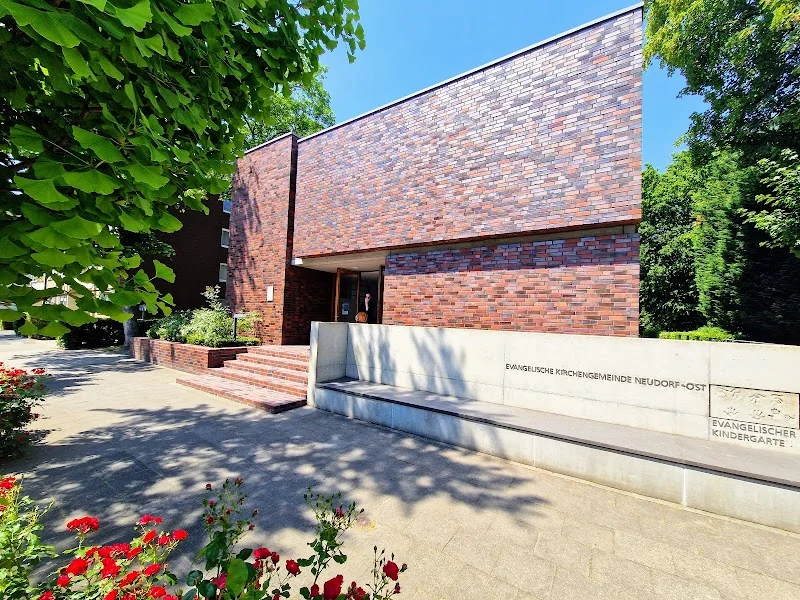
For those interested in photos and architecture, the Community Center Wildstraße 31 offers particularly exciting facts. The architectural documentation describes the renovation and expansion of the Protestant community house in Duisburg as a project from 2004 to 2005. The architect BDA Dipl.-Ing. Jutta Heinze was responsible, and the Evangelical Church Community Duisburg Neudorf-East is named as the client. The building is described as a strong cube in a heterogeneous environment, which orients itself to an opposite residential area from the 1920s and thereby makes the special function of the community house in urban space visible for the first time. This description is important for the external effect because it explains why the building has a clear presence despite its modest location. The façades are clearly structured, the internal structure is readable from the outside, and a forecourt with an outdoor bench forms a waiting area for the community, kindergarten, and youth center. Such details are what make the house interesting in image searches and on photo pages. The first impression is not monumental but clear, friendly, and functional. Inside, this attitude continues. The building is designed for maximum flexibility, works with two floors, and has a large foyer on the ground floor, which can be an extension of the hall or a separate group room depending on needs. A mobile wall connects the community house and church space between the existing and new buildings, so the use can be changed according to the event. The church hall itself reaches up to the ridge, making the visible timber trusses an important spatial element. For people who want to take photos or orient themselves architecturally, this is an exciting contrast: compact on the outside, open and atmospheric on the inside. ([baukunst-nrw.de](https://www.baukunst-nrw.de/objekte/Umbau-und-Erweiterung-des-evangelischen-Gemeindehauses-in-Duisburg--465.htm))
Further special features make the place additionally remarkable. Through a windcatcher, the kitchen and barrier-free WC are accessed, which facilitates the practical everyday life of the house and improves usability for different groups. On the upper floor are the community office, a second group room, toilets, and a cloakroom. This organizes the floor plan so that both liturgical and organizational and communicative tasks have space. The choice of materials also follows a conscious idea: natural, warm materials, white walls, and color accents create a harmonious unity. Particularly symbolic is the integration of existing elements. The blessing stone of Wildstraße was incorporated into the new façade, the foundation stone of the old community house on Bürgerstraße was secured and restored, and altar, lectern, Bible, baptismal bowl, sacred vessels, and the organ were taken from the two houses or newly framed. These details make the building interesting not only architecturally but also biographically because they make the idea of a new beginning visible. The house is therefore not just a modern functional building but a place of memory that brings together several community stories. In 2006, the project received an award for good buildings from the BDA Lower Rhine. For all those looking for a special community center with real architectural quality, Wildstraße 31 is therefore much more than a standard object. It combines spatial flexibility, symbolic power, and utility in a building that is very suitable for photos, location portraits, and architectural SEO content. ([baukunst-nrw.de](https://www.baukunst-nrw.de/objekte/Umbau-und-Erweiterung-des-evangelischen-Gemeindehauses-in-Duisburg--465.htm))
Directions, Transport Service, and Parking at Wildstraße 31
For practical searches, directions, parking, and contact are among the most important questions. The official address is clear: Wildstraße 31, 47057 Duisburg. In the community materials, the community center is clearly named as the Neudorf service location, and the community refers to this address for its events and offerings. Particularly important for visitor planning is also the mentioned transport service. Those who wish to use the transport service to the services or the forest service should register with Mrs. Gräfe at 0179 50 50 750 by Friday, according to the community newsletter. This is a clear, very practical service that can be especially helpful for older community members or people with limited mobility. Additionally, various contact points are mentioned in the community newsletter, including the community office Wildstraße 31 with its own phone number. This is useful for seekers because it makes Wildstraße visible not only as a place but also as an actively managed community address. When it comes to parking, it is important to be honest: the published community and architectural documents mainly describe the address, the transport service, and the function of the house, but a dedicated official visitor parking lot is not indicated there. Therefore, the best first step is always the exact directions via Wildstraße 31 and orientation on site. Those arriving by car should check the surrounding area and local street areas instead of relying on undocumented parking information. This may be less spectacular for SEO but is serious and helpful for visitors. At the same time, the location in a densely populated neighborhood suggests that arriving with the exact address and possibly the transport service is particularly sensible. Thus, the topic of parking does not become a promotional promise but a reliable orientation aid. ([kirche-duisburg.de](https://kirche-duisburg.de/inhalt/hochfeld-neudorf/))
The connection between directions and building use is also remarkable. The architectural source describes a forecourt that serves as a waiting area for the community, kindergarten, and youth center. This is not a classic parking hint, but a very good sign that access for different user groups has been consciously organized. For visitors, this means: The house is designed so that one does not arrive in an anonymous functional building but at a place that has been thought of in the everyday life of the neighborhood. Those bringing children, attending a rehearsal, visiting a service, or having an appointment in the community office enter a place whose outdoor area is designed for encounters. That is why the keyword directions is so closely linked to the specific address Wildstraße 31. Those searching for photos will also quickly associate the location with the building, as the documented exterior views show the cubic structure, the clear façade, and the small forecourt as part of the overall impression. Together with the free or subsidized use of transport services and community paths, a place is created that remains easily accessible even for people without their own navigation knowledge. The most important practical recommendation is therefore: note the address, register for the transport service in advance if needed, and check the immediate surroundings for parking because the official materials do not mention a dedicated parking facility. ([baukunst-nrw.de](https://www.baukunst-nrw.de/objekte/Umbau-und-Erweiterung-des-evangelischen-Gemeindehauses-in-Duisburg--465.htm))
Kindergarten, Youth, and Social Offers
The Community Center Duisburg Hochfeld-Neudorf is not only relevant for services and music but also for the social infrastructure of the district. The official overview of the community mentions not only the Protestant Community Center Neudorf at Wildstraße 31 but also the Protestant Kindergarten Neudorf and a reference to youth work. This is a strong indication that the location is deliberately designed as a multi-generational place. In the architectural text, the rear kindergarten and youth center are even directly mentioned when it comes to forecourt, waiting area, and spatial organization. This makes it clear that Wildstraße 31 does not exist in isolation for a single purpose but is embedded in a larger community concept. For parents, children, and young people, this means a short distance between care, community life, and culture. For older people, it is also interesting that the community organizes senior singing and other offers for various age groups according to the community newsletter. This creates a broad spectrum that ranges from the daycare center to youth and families to the senior sector. The address thus becomes a real hub of community work. Additionally, the community newsletter mentions a free transport service not only for services but also for other events. This indicates a conscious attention to participation and accessibility. The open church hall with foyer and group room fits perfectly into this profile: the building is not fixed to a single use but is oriented towards changing groups, dates, and life phases. Those looking for a community center in Duisburg that is socially well-positioned will find exactly this mix here. In SEO terms, therefore, not only church or service are relevant but also family, youth, seniors, encounters, and education. ([kirche-duisburg.de](https://kirche-duisburg.de/inhalt/hochfeld-neudorf/))
Particularly valuable is the fact that the community lists many concrete contacts, dates, and places side by side in the community newsletter. This shows how strongly life in Hochfeld-Neudorf is networked. Neudorf has a fixed location for services and many musical formats with Wildstraße 31, while there are also other community locations for additional offers. For visitors, this is helpful because they recognize that the community center is not an isolated event house but part of a larger church structure with counseling, educational, and encounter offers. This is exactly what makes search terms like community center, social offers, kindergarten, and youth center so meaningful. For everyday life on site, it means that different life situations come together at Wildstraße 31: families with small children, young people, older people, and musically active community members. The house supports this diversity through its spatial logic and flexible equipment. Even the foyer not only serves as an access function but can also be used as a group room or extension of the hall. This makes social offers fit very well into the architecture. For people who want to inform themselves, this is an important signal: This is not just a mere address but a lively place where community becomes concrete. So, anyone looking for a community center in Duisburg that can do more than just Sunday services will find at Wildstraße 31 a convincing combination of religious, educational, and social profiles. ([kirche-duisburg.de](https://kirche-duisburg.de/inhalt/hochfeld-neudorf/))
History, Identity, and Special Details of Wildstraße
The history of the community center is closely linked to a conscious new beginning. The renovation and expansion took place in 2004 and 2005, and the architectural text describes that commonalities from both community houses can be found in the new house. This makes Wildstraße 31 a place that was not simply reinvented from scratch but carries on and visibly brings together traditions. The handling of the adopted elements is particularly illustrative: the blessing stone of Wildstraße was integrated into the façade, the foundation stone of the former community house on Bürgerstraße was secured and restored, and central liturgical items such as altar, lectern, Bible, baptismal bowl, and organ were adopted or newly combined. This is very important for the identity of the house because it connects the past and present rather than opposing them. The architectural language supports this message. The building structure appears as a strong cube, the façade is clearly structured, and the interior is flexibly organized. This makes the house present in the urban landscape without being intrusive. The surroundings are heterogeneous according to the source and relate to an opposite residential area from the 1920s. In such an environment, the clear form language is helpful because it conveys orientation and dignity. Therefore, those searching for photos will find not just any community house but a building with a very conscious attitude towards its own history and its own place in the neighborhood. This is often the reason why seekers engage more closely with the place: it appears modern and reliable, but it also has a recognizable biographical depth. ([baukunst-nrw.de](https://www.baukunst-nrw.de/objekte/Umbau-und-Erweiterung-des-evangelischen-Gemeindehauses-in-Duisburg--465.htm))
This identity is also reflected in community life. The house is a place for music, services, meetings, devotions, and open formats. The community communicates the location clearly because it occupies a fixed function in Hochfeld-Neudorf. Those visiting Wildstraße 31 therefore experience not just a building but a certain attitude of community: communal, flexible, open to different age groups and cultural forms. The award for good buildings in 2006 further underscores the architectural ambition and makes the address interesting even for people who might not otherwise be interested in church but are enthusiastic about good architecture. For SEO, this dual role is valuable: the house is simultaneously a religious place, a cultural meeting point, and an architecturally documented object. This explains why search terms like community center, photos, directions, services, and architecture fit very well together here. Especially when describing it on the internet, it is worthwhile to make this diversity visible rather than just using a short standard formulation. Wildstraße 31 stands for a community center that has learned from history and created a modern, well-usable house from it. It is a place where liturgical use, everyday function, and design ambition mutually reinforce each other. For visitors, this is the actual added value: one does not enter a mere functional space but a house with attitude, memory, and future. ([baukunst-nrw.de](https://www.baukunst-nrw.de/objekte/Umbau-und-Erweiterung-des-evangelischen-Gemeindehauses-in-Duisburg--465.htm))
Sources:
- Protestant Church District Duisburg – Hochfeld-Neudorf. ([kirche-duisburg.de](https://kirche-duisburg.de/inhalt/hochfeld-neudorf/))
- Protestant Church District Duisburg – Music and Word for Holy Week / Easter in Neudorf and Hochfeld. ([kirche-duisburg.de](https://kirche-duisburg.de/aktuelles/nachrichtenueberblick-35751))
- baukunst-nrw – Renovation and Expansion of the Protestant Community House in Duisburg. ([baukunst-nrw.de](https://www.baukunst-nrw.de/objekte/Umbau-und-Erweiterung-des-evangelischen-Gemeindehauses-in-Duisburg--465.htm))
- Community Newsletter Hochfeld-Neudorf. ([hochfeld-neudorf.de](https://www.hochfeld-neudorf.de/uploads/7zOVNsIm/GemeindebriefJunibisAugust.pdf))
Show moreShow less
Community Center Duisburg Hochfeld-Neudorf | Services & Photos
The Community Center Duisburg Hochfeld-Neudorf at Wildstraße 31 is a building with a clear function and at the same time with surprisingly much life. Officially, it belongs to the churches and community houses of the Protestant Community Duisburg Hochfeld-Neudorf, and practically it is a place where services, music, counseling, children's work, senior meetings, and everyday encounters overlap. This mixture makes the address interesting for many people who are looking not only for a church but for a vibrant community place. The building complex is not a static monument to be admired, but a flexible house that has been consciously designed for different uses. The architectural documentation describes it as a converted and expanded community house with a forecourt, striking façade, large foyer, and a church hall that responds to different forms of community. At the same time, the location in Neudorf is an important building block in the network of Protestant work in Duisburg, as families, children, young people, and older people can come together here. So, anyone looking for a community center, services, photos, program, or directions will find at Wildstraße 31 a place that visibly bundles the church life of the district. ([kirche-duisburg.de](https://kirche-duisburg.de/inhalt/hochfeld-neudorf/))
Services at the Community Center Wildstraße 31
The most important search topic around Wildstraße 31 is the services, and this is exactly where the official community communication starts. The community newsletter explicitly points out that the services in Neudorf take place at the Community Center Wildstraße 31. This information is particularly helpful for visitors because the community is active at several locations, and one must quickly distinguish the Neudorf location from the Hochfeld location. Therefore, for search queries such as program, service, schedule, or today, the community center is a clear anchor point. The published dates also show that the house is not only used for Sunday services but also for special liturgical times such as Holy Week, Maundy Thursday, and Good Friday. In the current Easter communication, the Neudorf community center is mentioned as a place for communion services and other festive services, while the community also resorts to Pauluskirche or the community meadow on other holidays. This makes it clear: Wildstraße 31 is not just any side room, but a central liturgical space that regularly plays a significant role in the church year. Particularly interesting for visitors is the combination of word, music, and atmosphere. For the beginning of Holy Week, an event with music from the Baroque and Romantic periods as well as texts for the Passion season is announced in the Neudorf community hall Wildstraße 31. This makes the place tangible as a space for devotion and cultural design. The community itself also describes its service locations so clearly that orientation is easy: Hochfeld in Pauluskirche, Neudorf in the Community Center Wildstraße 31. This clarity is as important for SEO as it is for the real visitor situation, as it leads seekers directly to the right place. ([hochfeld-neudorf.de](https://www.hochfeld-neudorf.de/uploads/7zOVNsIm/GemeindebriefJunibisAugust.pdf))
The mix of regular services and special holidays shows that the community center is not only intended for the Sunday rhythm but for an open community calendar. Especially in the Easter texts, it becomes apparent how flexible the house is integrated into liturgical life: once as a place for a quiet Passion event, then as a space for the communion service, and then again as a celebration place on Easter Sunday. The official information also mentions a service with the Spanish-speaking community, which is celebrated together with Pauluskirche. This points to the ecumenical and intercultural openness of the community, which does not remain with a single language or a single form. For visitors, this means: Those who see the Community Center Wildstraße 31 on the calendar can expect a lively, diverse, and well-prepared service culture. The house is therefore not just a place to sit and listen, but a place where liturgical forms are consciously changed, supplemented, and tailored to different target groups. The official mention of communion services, Passion devotions, and musical formats also shows that the community understands the house as a real community focal point. That is precisely why the combination of place, program, and spiritual use is such a strong search signal for all those who want to learn about the community center. ([kirche-duisburg.de](https://kirche-duisburg.de/aktuelles/nachrichtenueberblick-35751))
Music, Choirs, and Events at the Community Center
A second major topic that clearly emerges from the sources is music. The Community Center Wildstraße 31 is not only a place for services but also a musical meeting point. The community newsletter mentions several fixed groups that rehearse or meet there: Senior singing on Monday, the choir Friends of Thomas Tallis on Tuesday in the foyer, the recorder ensemble, the gospel choir Praise Together on Thursday in the community center, and other musical formats that regularly use the house. Thus, the building fulfills a typical but particularly intensely lived function of Protestant community houses: it is a stage, rehearsal room, meeting space, and spiritual resonance space at the same time. Especially the combination of choral music and community work shapes the impression that here not only is managed but audibly lived. The musical profile is also made visible through events such as the Duisburg Night of Choirs, where the community is represented with several ensembles and it is explicitly pointed out that snacks and drinks are also offered. This connection of music and hospitality makes the house attractive for both visitors and participants. So, anyone looking for events, choir, concert, or church music will find at Wildstraße 31 more than just a pure sacred space: it is a place where culture and community intertwine. In addition, special formats such as Emporeo, a gallery concert with the recorder ensemble, are explicitly mentioned in community work. Such formats are important for the perception of the house because they show that the community center is also a cultural address in the neighborhood outside of classical service times. The official language of the community repeatedly indicates that music here is not an accessory but a fundamental form of communal life. ([hochfeld-neudorf.de](https://www.hochfeld-neudorf.de/uploads/7zOVNsIm/GemeindebriefJunibisAugust.pdf))
Especially for search queries such as photos, program, or events, this musical use is a strong feature. The house appears on the published pages as a place with recurring soundscapes: choir rehearsals, spiritual music, senior singing, recorder sounds, gospel, and liturgical music alternate. The spectrum ranges from classical formats to more modern, groovy services. The community newsletter announces a gospel church, where well-known and new songs come together for listening and singing along. This is also typical of the profile of the house: it connects tradition and present without losing the spiritual core. That the community visibly names its musical groups also shows how strongly the community center functions as a home for different generations. Senior singing, choirs, and ensemble work address different target groups but remain spatially and thematically under one roof. For visitors, this is attractive because an event here does not feel isolated but is embedded in a larger culture of participation. Especially for families or people looking for first contact points with the community, such a house is low-threshold and open. Music creates access, and the recurring dates provide orientation. That is why the Community Center Wildstraße 31 is a good SEO meeting point for all keywords related to choir, service, culture, and photos. ([hochfeld-neudorf.de](https://www.hochfeld-neudorf.de/uploads/7zOVNsIm/GemeindebriefJunibisAugust.pdf))
Architecture, Foyer, and Flexible Spaces
For those interested in photos and architecture, the Community Center Wildstraße 31 offers particularly exciting facts. The architectural documentation describes the renovation and expansion of the Protestant community house in Duisburg as a project from 2004 to 2005. The architect BDA Dipl.-Ing. Jutta Heinze was responsible, and the Evangelical Church Community Duisburg Neudorf-East is named as the client. The building is described as a strong cube in a heterogeneous environment, which orients itself to an opposite residential area from the 1920s and thereby makes the special function of the community house in urban space visible for the first time. This description is important for the external effect because it explains why the building has a clear presence despite its modest location. The façades are clearly structured, the internal structure is readable from the outside, and a forecourt with an outdoor bench forms a waiting area for the community, kindergarten, and youth center. Such details are what make the house interesting in image searches and on photo pages. The first impression is not monumental but clear, friendly, and functional. Inside, this attitude continues. The building is designed for maximum flexibility, works with two floors, and has a large foyer on the ground floor, which can be an extension of the hall or a separate group room depending on needs. A mobile wall connects the community house and church space between the existing and new buildings, so the use can be changed according to the event. The church hall itself reaches up to the ridge, making the visible timber trusses an important spatial element. For people who want to take photos or orient themselves architecturally, this is an exciting contrast: compact on the outside, open and atmospheric on the inside. ([baukunst-nrw.de](https://www.baukunst-nrw.de/objekte/Umbau-und-Erweiterung-des-evangelischen-Gemeindehauses-in-Duisburg--465.htm))
Further special features make the place additionally remarkable. Through a windcatcher, the kitchen and barrier-free WC are accessed, which facilitates the practical everyday life of the house and improves usability for different groups. On the upper floor are the community office, a second group room, toilets, and a cloakroom. This organizes the floor plan so that both liturgical and organizational and communicative tasks have space. The choice of materials also follows a conscious idea: natural, warm materials, white walls, and color accents create a harmonious unity. Particularly symbolic is the integration of existing elements. The blessing stone of Wildstraße was incorporated into the new façade, the foundation stone of the old community house on Bürgerstraße was secured and restored, and altar, lectern, Bible, baptismal bowl, sacred vessels, and the organ were taken from the two houses or newly framed. These details make the building interesting not only architecturally but also biographically because they make the idea of a new beginning visible. The house is therefore not just a modern functional building but a place of memory that brings together several community stories. In 2006, the project received an award for good buildings from the BDA Lower Rhine. For all those looking for a special community center with real architectural quality, Wildstraße 31 is therefore much more than a standard object. It combines spatial flexibility, symbolic power, and utility in a building that is very suitable for photos, location portraits, and architectural SEO content. ([baukunst-nrw.de](https://www.baukunst-nrw.de/objekte/Umbau-und-Erweiterung-des-evangelischen-Gemeindehauses-in-Duisburg--465.htm))
Directions, Transport Service, and Parking at Wildstraße 31
For practical searches, directions, parking, and contact are among the most important questions. The official address is clear: Wildstraße 31, 47057 Duisburg. In the community materials, the community center is clearly named as the Neudorf service location, and the community refers to this address for its events and offerings. Particularly important for visitor planning is also the mentioned transport service. Those who wish to use the transport service to the services or the forest service should register with Mrs. Gräfe at 0179 50 50 750 by Friday, according to the community newsletter. This is a clear, very practical service that can be especially helpful for older community members or people with limited mobility. Additionally, various contact points are mentioned in the community newsletter, including the community office Wildstraße 31 with its own phone number. This is useful for seekers because it makes Wildstraße visible not only as a place but also as an actively managed community address. When it comes to parking, it is important to be honest: the published community and architectural documents mainly describe the address, the transport service, and the function of the house, but a dedicated official visitor parking lot is not indicated there. Therefore, the best first step is always the exact directions via Wildstraße 31 and orientation on site. Those arriving by car should check the surrounding area and local street areas instead of relying on undocumented parking information. This may be less spectacular for SEO but is serious and helpful for visitors. At the same time, the location in a densely populated neighborhood suggests that arriving with the exact address and possibly the transport service is particularly sensible. Thus, the topic of parking does not become a promotional promise but a reliable orientation aid. ([kirche-duisburg.de](https://kirche-duisburg.de/inhalt/hochfeld-neudorf/))
The connection between directions and building use is also remarkable. The architectural source describes a forecourt that serves as a waiting area for the community, kindergarten, and youth center. This is not a classic parking hint, but a very good sign that access for different user groups has been consciously organized. For visitors, this means: The house is designed so that one does not arrive in an anonymous functional building but at a place that has been thought of in the everyday life of the neighborhood. Those bringing children, attending a rehearsal, visiting a service, or having an appointment in the community office enter a place whose outdoor area is designed for encounters. That is why the keyword directions is so closely linked to the specific address Wildstraße 31. Those searching for photos will also quickly associate the location with the building, as the documented exterior views show the cubic structure, the clear façade, and the small forecourt as part of the overall impression. Together with the free or subsidized use of transport services and community paths, a place is created that remains easily accessible even for people without their own navigation knowledge. The most important practical recommendation is therefore: note the address, register for the transport service in advance if needed, and check the immediate surroundings for parking because the official materials do not mention a dedicated parking facility. ([baukunst-nrw.de](https://www.baukunst-nrw.de/objekte/Umbau-und-Erweiterung-des-evangelischen-Gemeindehauses-in-Duisburg--465.htm))
Kindergarten, Youth, and Social Offers
The Community Center Duisburg Hochfeld-Neudorf is not only relevant for services and music but also for the social infrastructure of the district. The official overview of the community mentions not only the Protestant Community Center Neudorf at Wildstraße 31 but also the Protestant Kindergarten Neudorf and a reference to youth work. This is a strong indication that the location is deliberately designed as a multi-generational place. In the architectural text, the rear kindergarten and youth center are even directly mentioned when it comes to forecourt, waiting area, and spatial organization. This makes it clear that Wildstraße 31 does not exist in isolation for a single purpose but is embedded in a larger community concept. For parents, children, and young people, this means a short distance between care, community life, and culture. For older people, it is also interesting that the community organizes senior singing and other offers for various age groups according to the community newsletter. This creates a broad spectrum that ranges from the daycare center to youth and families to the senior sector. The address thus becomes a real hub of community work. Additionally, the community newsletter mentions a free transport service not only for services but also for other events. This indicates a conscious attention to participation and accessibility. The open church hall with foyer and group room fits perfectly into this profile: the building is not fixed to a single use but is oriented towards changing groups, dates, and life phases. Those looking for a community center in Duisburg that is socially well-positioned will find exactly this mix here. In SEO terms, therefore, not only church or service are relevant but also family, youth, seniors, encounters, and education. ([kirche-duisburg.de](https://kirche-duisburg.de/inhalt/hochfeld-neudorf/))
Particularly valuable is the fact that the community lists many concrete contacts, dates, and places side by side in the community newsletter. This shows how strongly life in Hochfeld-Neudorf is networked. Neudorf has a fixed location for services and many musical formats with Wildstraße 31, while there are also other community locations for additional offers. For visitors, this is helpful because they recognize that the community center is not an isolated event house but part of a larger church structure with counseling, educational, and encounter offers. This is exactly what makes search terms like community center, social offers, kindergarten, and youth center so meaningful. For everyday life on site, it means that different life situations come together at Wildstraße 31: families with small children, young people, older people, and musically active community members. The house supports this diversity through its spatial logic and flexible equipment. Even the foyer not only serves as an access function but can also be used as a group room or extension of the hall. This makes social offers fit very well into the architecture. For people who want to inform themselves, this is an important signal: This is not just a mere address but a lively place where community becomes concrete. So, anyone looking for a community center in Duisburg that can do more than just Sunday services will find at Wildstraße 31 a convincing combination of religious, educational, and social profiles. ([kirche-duisburg.de](https://kirche-duisburg.de/inhalt/hochfeld-neudorf/))
History, Identity, and Special Details of Wildstraße
The history of the community center is closely linked to a conscious new beginning. The renovation and expansion took place in 2004 and 2005, and the architectural text describes that commonalities from both community houses can be found in the new house. This makes Wildstraße 31 a place that was not simply reinvented from scratch but carries on and visibly brings together traditions. The handling of the adopted elements is particularly illustrative: the blessing stone of Wildstraße was integrated into the façade, the foundation stone of the former community house on Bürgerstraße was secured and restored, and central liturgical items such as altar, lectern, Bible, baptismal bowl, and organ were adopted or newly combined. This is very important for the identity of the house because it connects the past and present rather than opposing them. The architectural language supports this message. The building structure appears as a strong cube, the façade is clearly structured, and the interior is flexibly organized. This makes the house present in the urban landscape without being intrusive. The surroundings are heterogeneous according to the source and relate to an opposite residential area from the 1920s. In such an environment, the clear form language is helpful because it conveys orientation and dignity. Therefore, those searching for photos will find not just any community house but a building with a very conscious attitude towards its own history and its own place in the neighborhood. This is often the reason why seekers engage more closely with the place: it appears modern and reliable, but it also has a recognizable biographical depth. ([baukunst-nrw.de](https://www.baukunst-nrw.de/objekte/Umbau-und-Erweiterung-des-evangelischen-Gemeindehauses-in-Duisburg--465.htm))
This identity is also reflected in community life. The house is a place for music, services, meetings, devotions, and open formats. The community communicates the location clearly because it occupies a fixed function in Hochfeld-Neudorf. Those visiting Wildstraße 31 therefore experience not just a building but a certain attitude of community: communal, flexible, open to different age groups and cultural forms. The award for good buildings in 2006 further underscores the architectural ambition and makes the address interesting even for people who might not otherwise be interested in church but are enthusiastic about good architecture. For SEO, this dual role is valuable: the house is simultaneously a religious place, a cultural meeting point, and an architecturally documented object. This explains why search terms like community center, photos, directions, services, and architecture fit very well together here. Especially when describing it on the internet, it is worthwhile to make this diversity visible rather than just using a short standard formulation. Wildstraße 31 stands for a community center that has learned from history and created a modern, well-usable house from it. It is a place where liturgical use, everyday function, and design ambition mutually reinforce each other. For visitors, this is the actual added value: one does not enter a mere functional space but a house with attitude, memory, and future. ([baukunst-nrw.de](https://www.baukunst-nrw.de/objekte/Umbau-und-Erweiterung-des-evangelischen-Gemeindehauses-in-Duisburg--465.htm))
Sources:
- Protestant Church District Duisburg – Hochfeld-Neudorf. ([kirche-duisburg.de](https://kirche-duisburg.de/inhalt/hochfeld-neudorf/))
- Protestant Church District Duisburg – Music and Word for Holy Week / Easter in Neudorf and Hochfeld. ([kirche-duisburg.de](https://kirche-duisburg.de/aktuelles/nachrichtenueberblick-35751))
- baukunst-nrw – Renovation and Expansion of the Protestant Community House in Duisburg. ([baukunst-nrw.de](https://www.baukunst-nrw.de/objekte/Umbau-und-Erweiterung-des-evangelischen-Gemeindehauses-in-Duisburg--465.htm))
- Community Newsletter Hochfeld-Neudorf. ([hochfeld-neudorf.de](https://www.hochfeld-neudorf.de/uploads/7zOVNsIm/GemeindebriefJunibisAugust.pdf))
Community Center Duisburg Hochfeld-Neudorf | Services & Photos
The Community Center Duisburg Hochfeld-Neudorf at Wildstraße 31 is a building with a clear function and at the same time with surprisingly much life. Officially, it belongs to the churches and community houses of the Protestant Community Duisburg Hochfeld-Neudorf, and practically it is a place where services, music, counseling, children's work, senior meetings, and everyday encounters overlap. This mixture makes the address interesting for many people who are looking not only for a church but for a vibrant community place. The building complex is not a static monument to be admired, but a flexible house that has been consciously designed for different uses. The architectural documentation describes it as a converted and expanded community house with a forecourt, striking façade, large foyer, and a church hall that responds to different forms of community. At the same time, the location in Neudorf is an important building block in the network of Protestant work in Duisburg, as families, children, young people, and older people can come together here. So, anyone looking for a community center, services, photos, program, or directions will find at Wildstraße 31 a place that visibly bundles the church life of the district. ([kirche-duisburg.de](https://kirche-duisburg.de/inhalt/hochfeld-neudorf/))
Services at the Community Center Wildstraße 31
The most important search topic around Wildstraße 31 is the services, and this is exactly where the official community communication starts. The community newsletter explicitly points out that the services in Neudorf take place at the Community Center Wildstraße 31. This information is particularly helpful for visitors because the community is active at several locations, and one must quickly distinguish the Neudorf location from the Hochfeld location. Therefore, for search queries such as program, service, schedule, or today, the community center is a clear anchor point. The published dates also show that the house is not only used for Sunday services but also for special liturgical times such as Holy Week, Maundy Thursday, and Good Friday. In the current Easter communication, the Neudorf community center is mentioned as a place for communion services and other festive services, while the community also resorts to Pauluskirche or the community meadow on other holidays. This makes it clear: Wildstraße 31 is not just any side room, but a central liturgical space that regularly plays a significant role in the church year. Particularly interesting for visitors is the combination of word, music, and atmosphere. For the beginning of Holy Week, an event with music from the Baroque and Romantic periods as well as texts for the Passion season is announced in the Neudorf community hall Wildstraße 31. This makes the place tangible as a space for devotion and cultural design. The community itself also describes its service locations so clearly that orientation is easy: Hochfeld in Pauluskirche, Neudorf in the Community Center Wildstraße 31. This clarity is as important for SEO as it is for the real visitor situation, as it leads seekers directly to the right place. ([hochfeld-neudorf.de](https://www.hochfeld-neudorf.de/uploads/7zOVNsIm/GemeindebriefJunibisAugust.pdf))
The mix of regular services and special holidays shows that the community center is not only intended for the Sunday rhythm but for an open community calendar. Especially in the Easter texts, it becomes apparent how flexible the house is integrated into liturgical life: once as a place for a quiet Passion event, then as a space for the communion service, and then again as a celebration place on Easter Sunday. The official information also mentions a service with the Spanish-speaking community, which is celebrated together with Pauluskirche. This points to the ecumenical and intercultural openness of the community, which does not remain with a single language or a single form. For visitors, this means: Those who see the Community Center Wildstraße 31 on the calendar can expect a lively, diverse, and well-prepared service culture. The house is therefore not just a place to sit and listen, but a place where liturgical forms are consciously changed, supplemented, and tailored to different target groups. The official mention of communion services, Passion devotions, and musical formats also shows that the community understands the house as a real community focal point. That is precisely why the combination of place, program, and spiritual use is such a strong search signal for all those who want to learn about the community center. ([kirche-duisburg.de](https://kirche-duisburg.de/aktuelles/nachrichtenueberblick-35751))
Music, Choirs, and Events at the Community Center
A second major topic that clearly emerges from the sources is music. The Community Center Wildstraße 31 is not only a place for services but also a musical meeting point. The community newsletter mentions several fixed groups that rehearse or meet there: Senior singing on Monday, the choir Friends of Thomas Tallis on Tuesday in the foyer, the recorder ensemble, the gospel choir Praise Together on Thursday in the community center, and other musical formats that regularly use the house. Thus, the building fulfills a typical but particularly intensely lived function of Protestant community houses: it is a stage, rehearsal room, meeting space, and spiritual resonance space at the same time. Especially the combination of choral music and community work shapes the impression that here not only is managed but audibly lived. The musical profile is also made visible through events such as the Duisburg Night of Choirs, where the community is represented with several ensembles and it is explicitly pointed out that snacks and drinks are also offered. This connection of music and hospitality makes the house attractive for both visitors and participants. So, anyone looking for events, choir, concert, or church music will find at Wildstraße 31 more than just a pure sacred space: it is a place where culture and community intertwine. In addition, special formats such as Emporeo, a gallery concert with the recorder ensemble, are explicitly mentioned in community work. Such formats are important for the perception of the house because they show that the community center is also a cultural address in the neighborhood outside of classical service times. The official language of the community repeatedly indicates that music here is not an accessory but a fundamental form of communal life. ([hochfeld-neudorf.de](https://www.hochfeld-neudorf.de/uploads/7zOVNsIm/GemeindebriefJunibisAugust.pdf))
Especially for search queries such as photos, program, or events, this musical use is a strong feature. The house appears on the published pages as a place with recurring soundscapes: choir rehearsals, spiritual music, senior singing, recorder sounds, gospel, and liturgical music alternate. The spectrum ranges from classical formats to more modern, groovy services. The community newsletter announces a gospel church, where well-known and new songs come together for listening and singing along. This is also typical of the profile of the house: it connects tradition and present without losing the spiritual core. That the community visibly names its musical groups also shows how strongly the community center functions as a home for different generations. Senior singing, choirs, and ensemble work address different target groups but remain spatially and thematically under one roof. For visitors, this is attractive because an event here does not feel isolated but is embedded in a larger culture of participation. Especially for families or people looking for first contact points with the community, such a house is low-threshold and open. Music creates access, and the recurring dates provide orientation. That is why the Community Center Wildstraße 31 is a good SEO meeting point for all keywords related to choir, service, culture, and photos. ([hochfeld-neudorf.de](https://www.hochfeld-neudorf.de/uploads/7zOVNsIm/GemeindebriefJunibisAugust.pdf))
Architecture, Foyer, and Flexible Spaces
For those interested in photos and architecture, the Community Center Wildstraße 31 offers particularly exciting facts. The architectural documentation describes the renovation and expansion of the Protestant community house in Duisburg as a project from 2004 to 2005. The architect BDA Dipl.-Ing. Jutta Heinze was responsible, and the Evangelical Church Community Duisburg Neudorf-East is named as the client. The building is described as a strong cube in a heterogeneous environment, which orients itself to an opposite residential area from the 1920s and thereby makes the special function of the community house in urban space visible for the first time. This description is important for the external effect because it explains why the building has a clear presence despite its modest location. The façades are clearly structured, the internal structure is readable from the outside, and a forecourt with an outdoor bench forms a waiting area for the community, kindergarten, and youth center. Such details are what make the house interesting in image searches and on photo pages. The first impression is not monumental but clear, friendly, and functional. Inside, this attitude continues. The building is designed for maximum flexibility, works with two floors, and has a large foyer on the ground floor, which can be an extension of the hall or a separate group room depending on needs. A mobile wall connects the community house and church space between the existing and new buildings, so the use can be changed according to the event. The church hall itself reaches up to the ridge, making the visible timber trusses an important spatial element. For people who want to take photos or orient themselves architecturally, this is an exciting contrast: compact on the outside, open and atmospheric on the inside. ([baukunst-nrw.de](https://www.baukunst-nrw.de/objekte/Umbau-und-Erweiterung-des-evangelischen-Gemeindehauses-in-Duisburg--465.htm))
Further special features make the place additionally remarkable. Through a windcatcher, the kitchen and barrier-free WC are accessed, which facilitates the practical everyday life of the house and improves usability for different groups. On the upper floor are the community office, a second group room, toilets, and a cloakroom. This organizes the floor plan so that both liturgical and organizational and communicative tasks have space. The choice of materials also follows a conscious idea: natural, warm materials, white walls, and color accents create a harmonious unity. Particularly symbolic is the integration of existing elements. The blessing stone of Wildstraße was incorporated into the new façade, the foundation stone of the old community house on Bürgerstraße was secured and restored, and altar, lectern, Bible, baptismal bowl, sacred vessels, and the organ were taken from the two houses or newly framed. These details make the building interesting not only architecturally but also biographically because they make the idea of a new beginning visible. The house is therefore not just a modern functional building but a place of memory that brings together several community stories. In 2006, the project received an award for good buildings from the BDA Lower Rhine. For all those looking for a special community center with real architectural quality, Wildstraße 31 is therefore much more than a standard object. It combines spatial flexibility, symbolic power, and utility in a building that is very suitable for photos, location portraits, and architectural SEO content. ([baukunst-nrw.de](https://www.baukunst-nrw.de/objekte/Umbau-und-Erweiterung-des-evangelischen-Gemeindehauses-in-Duisburg--465.htm))
Directions, Transport Service, and Parking at Wildstraße 31
For practical searches, directions, parking, and contact are among the most important questions. The official address is clear: Wildstraße 31, 47057 Duisburg. In the community materials, the community center is clearly named as the Neudorf service location, and the community refers to this address for its events and offerings. Particularly important for visitor planning is also the mentioned transport service. Those who wish to use the transport service to the services or the forest service should register with Mrs. Gräfe at 0179 50 50 750 by Friday, according to the community newsletter. This is a clear, very practical service that can be especially helpful for older community members or people with limited mobility. Additionally, various contact points are mentioned in the community newsletter, including the community office Wildstraße 31 with its own phone number. This is useful for seekers because it makes Wildstraße visible not only as a place but also as an actively managed community address. When it comes to parking, it is important to be honest: the published community and architectural documents mainly describe the address, the transport service, and the function of the house, but a dedicated official visitor parking lot is not indicated there. Therefore, the best first step is always the exact directions via Wildstraße 31 and orientation on site. Those arriving by car should check the surrounding area and local street areas instead of relying on undocumented parking information. This may be less spectacular for SEO but is serious and helpful for visitors. At the same time, the location in a densely populated neighborhood suggests that arriving with the exact address and possibly the transport service is particularly sensible. Thus, the topic of parking does not become a promotional promise but a reliable orientation aid. ([kirche-duisburg.de](https://kirche-duisburg.de/inhalt/hochfeld-neudorf/))
The connection between directions and building use is also remarkable. The architectural source describes a forecourt that serves as a waiting area for the community, kindergarten, and youth center. This is not a classic parking hint, but a very good sign that access for different user groups has been consciously organized. For visitors, this means: The house is designed so that one does not arrive in an anonymous functional building but at a place that has been thought of in the everyday life of the neighborhood. Those bringing children, attending a rehearsal, visiting a service, or having an appointment in the community office enter a place whose outdoor area is designed for encounters. That is why the keyword directions is so closely linked to the specific address Wildstraße 31. Those searching for photos will also quickly associate the location with the building, as the documented exterior views show the cubic structure, the clear façade, and the small forecourt as part of the overall impression. Together with the free or subsidized use of transport services and community paths, a place is created that remains easily accessible even for people without their own navigation knowledge. The most important practical recommendation is therefore: note the address, register for the transport service in advance if needed, and check the immediate surroundings for parking because the official materials do not mention a dedicated parking facility. ([baukunst-nrw.de](https://www.baukunst-nrw.de/objekte/Umbau-und-Erweiterung-des-evangelischen-Gemeindehauses-in-Duisburg--465.htm))
Kindergarten, Youth, and Social Offers
The Community Center Duisburg Hochfeld-Neudorf is not only relevant for services and music but also for the social infrastructure of the district. The official overview of the community mentions not only the Protestant Community Center Neudorf at Wildstraße 31 but also the Protestant Kindergarten Neudorf and a reference to youth work. This is a strong indication that the location is deliberately designed as a multi-generational place. In the architectural text, the rear kindergarten and youth center are even directly mentioned when it comes to forecourt, waiting area, and spatial organization. This makes it clear that Wildstraße 31 does not exist in isolation for a single purpose but is embedded in a larger community concept. For parents, children, and young people, this means a short distance between care, community life, and culture. For older people, it is also interesting that the community organizes senior singing and other offers for various age groups according to the community newsletter. This creates a broad spectrum that ranges from the daycare center to youth and families to the senior sector. The address thus becomes a real hub of community work. Additionally, the community newsletter mentions a free transport service not only for services but also for other events. This indicates a conscious attention to participation and accessibility. The open church hall with foyer and group room fits perfectly into this profile: the building is not fixed to a single use but is oriented towards changing groups, dates, and life phases. Those looking for a community center in Duisburg that is socially well-positioned will find exactly this mix here. In SEO terms, therefore, not only church or service are relevant but also family, youth, seniors, encounters, and education. ([kirche-duisburg.de](https://kirche-duisburg.de/inhalt/hochfeld-neudorf/))
Particularly valuable is the fact that the community lists many concrete contacts, dates, and places side by side in the community newsletter. This shows how strongly life in Hochfeld-Neudorf is networked. Neudorf has a fixed location for services and many musical formats with Wildstraße 31, while there are also other community locations for additional offers. For visitors, this is helpful because they recognize that the community center is not an isolated event house but part of a larger church structure with counseling, educational, and encounter offers. This is exactly what makes search terms like community center, social offers, kindergarten, and youth center so meaningful. For everyday life on site, it means that different life situations come together at Wildstraße 31: families with small children, young people, older people, and musically active community members. The house supports this diversity through its spatial logic and flexible equipment. Even the foyer not only serves as an access function but can also be used as a group room or extension of the hall. This makes social offers fit very well into the architecture. For people who want to inform themselves, this is an important signal: This is not just a mere address but a lively place where community becomes concrete. So, anyone looking for a community center in Duisburg that can do more than just Sunday services will find at Wildstraße 31 a convincing combination of religious, educational, and social profiles. ([kirche-duisburg.de](https://kirche-duisburg.de/inhalt/hochfeld-neudorf/))
History, Identity, and Special Details of Wildstraße
The history of the community center is closely linked to a conscious new beginning. The renovation and expansion took place in 2004 and 2005, and the architectural text describes that commonalities from both community houses can be found in the new house. This makes Wildstraße 31 a place that was not simply reinvented from scratch but carries on and visibly brings together traditions. The handling of the adopted elements is particularly illustrative: the blessing stone of Wildstraße was integrated into the façade, the foundation stone of the former community house on Bürgerstraße was secured and restored, and central liturgical items such as altar, lectern, Bible, baptismal bowl, and organ were adopted or newly combined. This is very important for the identity of the house because it connects the past and present rather than opposing them. The architectural language supports this message. The building structure appears as a strong cube, the façade is clearly structured, and the interior is flexibly organized. This makes the house present in the urban landscape without being intrusive. The surroundings are heterogeneous according to the source and relate to an opposite residential area from the 1920s. In such an environment, the clear form language is helpful because it conveys orientation and dignity. Therefore, those searching for photos will find not just any community house but a building with a very conscious attitude towards its own history and its own place in the neighborhood. This is often the reason why seekers engage more closely with the place: it appears modern and reliable, but it also has a recognizable biographical depth. ([baukunst-nrw.de](https://www.baukunst-nrw.de/objekte/Umbau-und-Erweiterung-des-evangelischen-Gemeindehauses-in-Duisburg--465.htm))
This identity is also reflected in community life. The house is a place for music, services, meetings, devotions, and open formats. The community communicates the location clearly because it occupies a fixed function in Hochfeld-Neudorf. Those visiting Wildstraße 31 therefore experience not just a building but a certain attitude of community: communal, flexible, open to different age groups and cultural forms. The award for good buildings in 2006 further underscores the architectural ambition and makes the address interesting even for people who might not otherwise be interested in church but are enthusiastic about good architecture. For SEO, this dual role is valuable: the house is simultaneously a religious place, a cultural meeting point, and an architecturally documented object. This explains why search terms like community center, photos, directions, services, and architecture fit very well together here. Especially when describing it on the internet, it is worthwhile to make this diversity visible rather than just using a short standard formulation. Wildstraße 31 stands for a community center that has learned from history and created a modern, well-usable house from it. It is a place where liturgical use, everyday function, and design ambition mutually reinforce each other. For visitors, this is the actual added value: one does not enter a mere functional space but a house with attitude, memory, and future. ([baukunst-nrw.de](https://www.baukunst-nrw.de/objekte/Umbau-und-Erweiterung-des-evangelischen-Gemeindehauses-in-Duisburg--465.htm))
Sources:
- Protestant Church District Duisburg – Hochfeld-Neudorf. ([kirche-duisburg.de](https://kirche-duisburg.de/inhalt/hochfeld-neudorf/))
- Protestant Church District Duisburg – Music and Word for Holy Week / Easter in Neudorf and Hochfeld. ([kirche-duisburg.de](https://kirche-duisburg.de/aktuelles/nachrichtenueberblick-35751))
- baukunst-nrw – Renovation and Expansion of the Protestant Community House in Duisburg. ([baukunst-nrw.de](https://www.baukunst-nrw.de/objekte/Umbau-und-Erweiterung-des-evangelischen-Gemeindehauses-in-Duisburg--465.htm))
- Community Newsletter Hochfeld-Neudorf. ([hochfeld-neudorf.de](https://www.hochfeld-neudorf.de/uploads/7zOVNsIm/GemeindebriefJunibisAugust.pdf))
Upcoming Events
No events found
Frequently Asked Questions
Reviews
Sabine Tyrasek
20. November 2023
I attended the benefit concert that took place there on November 17th. The venue was very nice, and it was a successful concert in a great atmosphere.
Lexa
5. September 2024
Super friendly atmosphere and nice staff! I felt very welcome.
Dieter Otto
11. November 2022
The EV community center is a meeting point, among others for the German ILCO group. It's for someone with an artificial (stoma) side exit. We meet once a month for those affected and their partners, women or men. I myself am affected. We also do a lot with our group, like trips to the Duisburg Zoo or cozy get-togethers. Specialists also hold lectures. A summer festival. Best regards, a affected Dieter Otto.
Thomas Salewsky
5. August 2024
A lovely classic meeting place, it's great that it exists.
Peter Gräfe
11. April 2025
Friendly staff, I really enjoy being at the community center.