
Rheinstraße 16, Homberg-Ruhrort-Baerl
Rheinstraße 16, 47198 Duisburg, Germany
Free Columbarium Rheinkirche | Photos & Reviews
The Free Columbarium Rheinkirche in Duisburg-Homberg is a special place that meets several needs in many inquiries: people want to see photos, read reviews, check opening hours, understand how to get there, and get an idea of how this place is used today. This is exactly what makes the Rheinkirche so interesting. The former Protestant church at Rheinstraße 16 is not only historically significant but also an example of how burial culture, architecture, and memory culture can combine to create a quiet, dignified overall experience. The official website describes the building as cosmopolitan, free, and close to life. Visitors can come here to find peace, get informed, take a guided tour, or simply let the space and the garden of thoughts affect them. With its clear architectural language, bright atmosphere, and special use as a columbarium, the place has a character that is simultaneously spiritual, cultural, and practical. For seekers looking for a cemetery with a special atmosphere, an individual urn location, or a place for encounter and farewell, the Rheinkirche offers an unusually clear answer. ([kolumbarium-rheinkirche.de](https://www.kolumbarium-rheinkirche.de/))
Photos, Atmosphere, and Architecture of the Rheinkirche
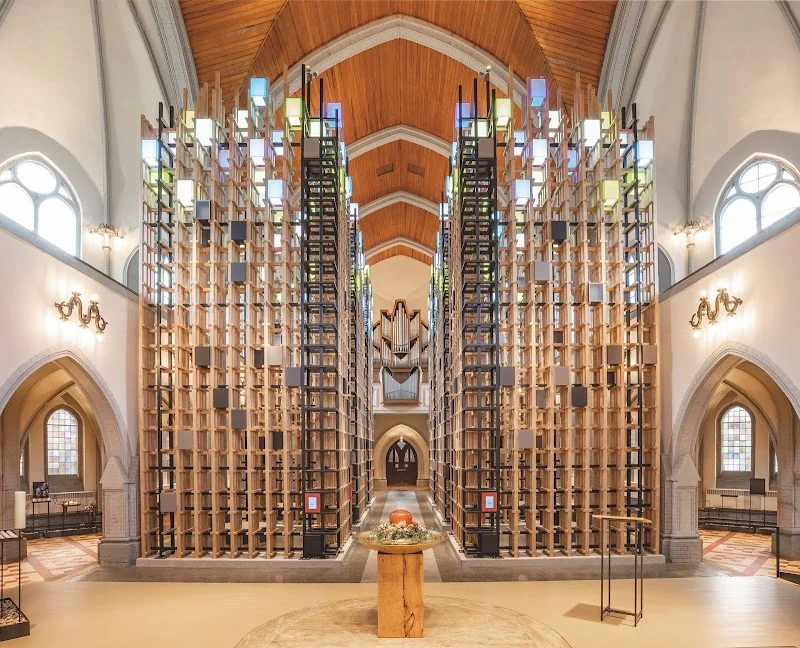
Those looking for photos of the Free Columbarium Rheinkirche usually expect more than just a quick exterior view. This is where the strength of the place lies: the effect arises from the interplay of building, light, material, and room height. The house is located in a neo-Gothic church building in close proximity to the Rhine. According to the official description, a clear architectural structure, an extraordinary wooden ceiling, and large-format side windows shape the interior effect. Together, they create a warm space that does not feel cold or technical but allows for calm and concentration. Particularly striking is the landscape of steles made of high-quality oak, where the urns rest and which dissolves into a light, almost floating structure as it rises. The website describes this construction as being up to ten meters high; the memorial portrait of the site refers to an oak wood frame that is up to nine meters high. Both descriptions make it clear that urns are not simply stored here, but that the architecture itself becomes part of the memory. ([kolumbarium-rheinkirche.de](https://www.kolumbarium-rheinkirche.de/))
Especially in the context of the keywords photos, Rheinkirche, and Free Columbarium, it is important what images show here: not a sober functional area, but a sacred space with a special light mood. The large side windows make the interior appear open and friendly, while the steles, the wooden surfaces, and the quiet retreat areas create a concentrated atmosphere. The website mentions that eight spherical retreat areas are created in the light of the side windows. This formulation shows that the design is consciously aimed at encounters, but also at protected zones for mourners. Therefore, those looking at photos should not only pay attention to the urn locations but also to the overall effect of the space: the height, the width, the materiality, and the light guidance. This is the real difference from many other burial sites. Here, architecture becomes the framework for silence, farewell, and personal memory. ([kolumbarium-rheinkirche.de](https://www.kolumbarium-rheinkirche.de/))
The special atmosphere also includes the outdoor area. The approximately 1,500 square meter garden of thoughts is not just an additional green space but an independent part of the concept. According to the website, this area has been newly created and planted; after the resting period, the final resting place takes place there. This makes it clear that the design does not end at the church space but is conceived as a cohesive landscape of memory both inside and outside. For visitors looking for photos, this is important because it expands the image of the place: inside the silence of the church, outside the garden as a place of pause. In the reviews, this mixture is repeatedly described as impressive. This makes the Rheinkirche a place that is perceived not only informatively but also emotionally. ([kolumbarium-rheinkirche.de](https://www.kolumbarium-rheinkirche.de/))
Opening Hours, Visits, and Tours
A central keyword around the Rheinkirche is the opening hours, as many visitors want to get to know the place not only online but also in advance or spontaneously. The contact page provides a clear structure for this: it is closed on Mondays. On Tuesdays and Thursdays, it is open from 11:00 AM to 6:00 PM, on Wednesdays, Fridays, Saturdays, and Sundays from 11:00 AM to 4:00 PM; there may be exceptions on public holidays. These times are important for a visitation site because they show that the Free Columbarium is regularly accessible and can be experienced not only on special occasions. Visitors are also asked to observe burial dates, as these are reserved for relatives. This makes it clear that while the place is open, the funeral service takes precedence during special moments. ([kolumbarium-rheinkirche.de](https://www.kolumbarium-rheinkirche.de/kontakt))
The Rheinkirche can also be visited without prior registration. The official website explicitly states this and invites visitors to simply come by during opening hours. Those who wish can take a guided tour of the Free Columbarium or first let the space affect them in silence. Additionally, there is the option to arrange an individual desired date for a tour. According to the website, a tour lasts about 30 minutes; it can also be organized for groups, and those who wish can clarify questions afterwards or stay for a coffee. This mixture of openness and personal accompaniment is crucial for the user experience because it makes the Rheinkirche appear not as a rigid object but as an approachable place. ([kolumbarium-rheinkirche.de](https://www.kolumbarium-rheinkirche.de/))
Moreover, there is a clear cultural aspect: the columbarium is not just a visitation site but also an event space. The website contains numerous references to concerts, sing-along concerts, readings, lectures, exhibitions, meditation, and tours. The current encounter program for January to April 2026 is linked on the homepage, and the past dates show how regularly the place is used for cultural formats. This makes it understandable why so many people search for programs, tours, or photos: the Rheinkirche is not a silent museum but a lively place where mourning, music, conversation, and reflection come together. This multiple use makes the visit particularly interesting because it gives the place both dignity and presence. ([kolumbarium-rheinkirche.de](https://www.kolumbarium-rheinkirche.de/))
Directions, Public Transport, and Location in Duisburg-Homberg
For directions, the official address is clear: Free Columbarium Rheinkirche, Rheinstraße 16, 47198 Duisburg. The contact page focuses primarily on the connection with public transport. The stop Goetheplatz in Ruhrorter Straße in DU-Homberg is mentioned. From there, it is about 350 meters to the columbarium. Particularly helpful is the note that this stop is the first stop after the Rhine bridge coming from Ruhrort. The website also mentions bus lines 911, 916, 917, 922, and 929. So, those who want to reach the columbarium easily will find a very clear orientation for the last stretch. ([kolumbarium-rheinkirche.de](https://www.kolumbarium-rheinkirche.de/kontakt))
The location in the Duisburg district of Homberg also contributes to the uniqueness of the place. The Rheinkirche is situated in an area characterized by the Rhine, the urban fringe, and the proximity to Ruhrort. For visitors, this means: one does not reach an anonymous functional building but a historic building with strong local ties. This can be particularly helpful when looking for a place for farewell or provision and when not only practical but also atmospheric criteria are important. Since the website emphasizes public transport on its contact page, planning with bus and a short walk is particularly straightforward. For drivers, it is advisable to look closely at the surroundings in advance and to plan personal travel in good time, as the official site clearly places public transport in the foreground. ([kolumbarium-rheinkirche.de](https://www.kolumbarium-rheinkirche.de/kontakt))
Those planning the route from Ruhrort benefit from a very simple landmark: only after the Rhine bridge is the Goetheplatz stop, and from there the location can be reached in a few minutes. This type of direction is particularly valuable for seekers because it makes a concrete orientation out of an address. The keyword combinations Rheinstraße, Homberg, Ruhrort, and Baerl also show that many users want to geographically locate the area. The official contact page is the best starting point for this: it connects address, stop, and lines in a compact hint package. Thus, a search query for directions and parking becomes a realistic visit planning. ([kolumbarium-rheinkirche.de](https://www.kolumbarium-rheinkirche.de/kontakt))
Types of Burials, Urn Chambers, and Reservation
The Free Columbarium Rheinkirche is not a classic event venue but a cemetery in a special form. Therefore, the topics of types of burials, reservations, and costs are among the most important search terms. The official website first explains the basic principle: a columbarium is usually an above-ground structure for the storage of urns. In Duisburg-Homberg, both individual burial sites with urn chambers and simple urn locations in communal rooms can be chosen. This is an essential point because the place thus covers various needs: personal design, communal burial, and different financial possibilities. The rooms on the upper floor are secluded but open to the columbarium's activities, heated, and moodily lit. People of all faiths and beliefs can be buried here, as the place is open-minded and non-denominational. ([kolumbarium-rheinkirche.de](https://www.kolumbarium-rheinkirche.de/))
Particularly individual is the design of the urn chambers. According to the website, desired locations in the stele construction can be freely chosen, and the front of the chamber can also be designed according to personal ideas. There are single, partner, and family places; double chambers are available for couples, and up to four single chambers can be combined as a family urn site. Additionally, the website mentions various equipment options such as different fronts, semi-transparent acrylic glass, brass coating, brass balcony for flowers, pictures, or LED candles, additional colors, layouts for graphics and poems, and even an engraving for a QR code that refers to images or a film. This is relevant for seekers looking for a place with space and dignity but also wanting to know how personally a burial site can be designed. ([kolumbarium-rheinkirche.de](https://www.kolumbarium-rheinkirche.de/))
There are also clear answers to practical questions. The basic resting period is 12 years and can be extended at any time. Places can be reserved during one's lifetime, also as part of a burial provision. The website mentions desired places or urn row places; for the current fee schedule, it refers to the respective valid documents so that interested parties should always inquire or check the latest overview. Flowers, wreaths, or greetings can be placed at the burial and later at designated memorial sites; there is also the possibility of using LED candles. These details are important because they show that the Rheinkirche is not only managed but individually accompanied. The place is thus not just a storage facility but a customizable space for memory with clearly regulated but humanly formulated possibilities. ([kolumbarium-rheinkirche.de](https://www.kolumbarium-rheinkirche.de/))
History of the Rheinkirche and the Transformation into a Columbarium
The history of the Rheinkirche is a central part of its current character. The official website describes a long development: after the laying of the foundation stone in 1893, the Rheinkirche Duisburg-Homberg was completed in 1895 in the neo-Gothic style and put into operation as a Protestant church. During World War II, the building was significantly damaged, reopened in 1948 after extensive renovations, and revised again in the 1960s. Since 1994, the church has only been used for special occasions, with the last service taking place on November 20, 2016. After that, the building was deconsecrated; in April 2022, it was handed over to its new purpose. The memorial portrait of the Open Monument Day adds to this timeline with the information that the Free Columbarium was opened after several years of renovation. ([kolumbarium-rheinkirche.de](https://www.kolumbarium-rheinkirche.de/))
This development makes the Rheinkirche so remarkable. From a sacred building, it has not become an empty remnant but a place with a new cultural and societal task. The repurposing respects the historical substance and simultaneously carries it forward. This is also architecturally visible: the neo-Gothic church building remains as a dignified shell, while the interior is newly interpreted with a modern landscape of steles, clear sight lines, and the garden of thoughts. Thus, there is no break but a transition. The place preserves its history while simultaneously opening up to a contemporary burial culture that connects individuality, community, and memory more strongly. For many visitors, it is precisely this connection between past and present that is why they find the Rheinkirche to be special. ([kolumbarium-rheinkirche.de](https://www.kolumbarium-rheinkirche.de/))
The events of the early usage phase also tell something about the character of the house. In 2022 and 2023, exhibitions, concerts, and spoken word events were held there, including formats such as organ and sax, Christmas concerts, lectures, or meditations. This shows that the new use is not only thought of as static. Rather, the Rheinkirche remains a space where sound, silence, and encounter belong together. This supports the SEO focus on keywords like Rheinkirche, history, photos, and tours: many people want not only to see the place but also to understand why it has the effect it does today. The answer lies in its biography. A building that has experienced more than a century carries its past visibly forward. ([kolumbarium-rheinkirche.de](https://www.kolumbarium-rheinkirche.de/))
Reviews, Encounters, and Why the Place Moves So Many Visitors
The existing reviews of the Free Columbarium Rheinkirche are extremely positive. With 4.7 stars from 9 reviews, it is already evident at first glance that the place is very well received by visitors. The content mainly praises the special atmosphere. One review describes the place as incredibly beautiful and highlights that the visit took place as part of training in palliative care. Another review refers to the columbarium in a desecrated church and emphasizes that a place of encounter has been created through concerts, workshops, and seminars. Another voice speaks of an overwhelming mood, of silence and pleasant peace, and shares that their own mother has also found her place there. These impressions make it clear why inquiries about reviews and photos are so frequent: people want to know before a visit whether a place radiates trust, dignity, and calm.
The ratings fit well with what the official website says about the house. It emphasizes that the columbarium is not only a place for final rest but also a place to pause, linger, meet, and exchange. This dual function explains why the house is often described as a place of encounter. Those who come here experience not only a burial site but also a space for culture and conversation. This aligns with the program of recent years: tours, sing-along concerts, readings, exhibitions, and meditative formats show that the place is thought of beyond classical cemetery use. For many visitors, this is precisely the difference from other offerings. They are not only looking for a place for final rest but a framework in which memory, community, and beauty come together. ([kolumbarium-rheinkirche.de](https://www.kolumbarium-rheinkirche.de/))
So why is a visit worthwhile? Because the Rheinkirche addresses several levels at once. Those interested in history find a listed building with a clear biography. Those looking for photos find strong images of light, wood, and height. Those planning a visit receive clear times and tours. Those dealing with the topic of provision find individual urn chambers, reservation options, and a comprehensible structure. And those reading reviews recognize that many people experience the place as peaceful, beautiful, and comforting. In this combination lies the actual strength of the Columbarium Rheinkirche: it is well-organized in a factual sense and emotionally accessible at the same time. That is why it remains so present in search inquiries. ([kolumbarium-rheinkirche.de](https://www.kolumbarium-rheinkirche.de/kontakt))
Sources:
- Official website of the Free Columbarium Rheinkirche with description, FAQs, history, and visitor information. ([kolumbarium-rheinkirche.de](https://www.kolumbarium-rheinkirche.de/))
- Open Monument Day with information on the opening in 2022 and details about the renovation. ([tag-des-offenen-denkmals.de](https://www.tag-des-offenen-denkmals.de/denkmal/2252f79d-b67f-11ec-956a-960000a15311))
- Contact page with current opening hours, address, and public transport connection via Goetheplatz. ([kolumbarium-rheinkirche.de](https://www.kolumbarium-rheinkirche.de/kontakt))
- Fee schedule and information on current documents and cemetery regulations. ([kolumbarium-rheinkirche.de](https://www.kolumbarium-rheinkirche.de/gebuhrenordnung))
Show moreShow less
Free Columbarium Rheinkirche | Photos & Reviews
The Free Columbarium Rheinkirche in Duisburg-Homberg is a special place that meets several needs in many inquiries: people want to see photos, read reviews, check opening hours, understand how to get there, and get an idea of how this place is used today. This is exactly what makes the Rheinkirche so interesting. The former Protestant church at Rheinstraße 16 is not only historically significant but also an example of how burial culture, architecture, and memory culture can combine to create a quiet, dignified overall experience. The official website describes the building as cosmopolitan, free, and close to life. Visitors can come here to find peace, get informed, take a guided tour, or simply let the space and the garden of thoughts affect them. With its clear architectural language, bright atmosphere, and special use as a columbarium, the place has a character that is simultaneously spiritual, cultural, and practical. For seekers looking for a cemetery with a special atmosphere, an individual urn location, or a place for encounter and farewell, the Rheinkirche offers an unusually clear answer. ([kolumbarium-rheinkirche.de](https://www.kolumbarium-rheinkirche.de/))
Photos, Atmosphere, and Architecture of the Rheinkirche
Those looking for photos of the Free Columbarium Rheinkirche usually expect more than just a quick exterior view. This is where the strength of the place lies: the effect arises from the interplay of building, light, material, and room height. The house is located in a neo-Gothic church building in close proximity to the Rhine. According to the official description, a clear architectural structure, an extraordinary wooden ceiling, and large-format side windows shape the interior effect. Together, they create a warm space that does not feel cold or technical but allows for calm and concentration. Particularly striking is the landscape of steles made of high-quality oak, where the urns rest and which dissolves into a light, almost floating structure as it rises. The website describes this construction as being up to ten meters high; the memorial portrait of the site refers to an oak wood frame that is up to nine meters high. Both descriptions make it clear that urns are not simply stored here, but that the architecture itself becomes part of the memory. ([kolumbarium-rheinkirche.de](https://www.kolumbarium-rheinkirche.de/))
Especially in the context of the keywords photos, Rheinkirche, and Free Columbarium, it is important what images show here: not a sober functional area, but a sacred space with a special light mood. The large side windows make the interior appear open and friendly, while the steles, the wooden surfaces, and the quiet retreat areas create a concentrated atmosphere. The website mentions that eight spherical retreat areas are created in the light of the side windows. This formulation shows that the design is consciously aimed at encounters, but also at protected zones for mourners. Therefore, those looking at photos should not only pay attention to the urn locations but also to the overall effect of the space: the height, the width, the materiality, and the light guidance. This is the real difference from many other burial sites. Here, architecture becomes the framework for silence, farewell, and personal memory. ([kolumbarium-rheinkirche.de](https://www.kolumbarium-rheinkirche.de/))
The special atmosphere also includes the outdoor area. The approximately 1,500 square meter garden of thoughts is not just an additional green space but an independent part of the concept. According to the website, this area has been newly created and planted; after the resting period, the final resting place takes place there. This makes it clear that the design does not end at the church space but is conceived as a cohesive landscape of memory both inside and outside. For visitors looking for photos, this is important because it expands the image of the place: inside the silence of the church, outside the garden as a place of pause. In the reviews, this mixture is repeatedly described as impressive. This makes the Rheinkirche a place that is perceived not only informatively but also emotionally. ([kolumbarium-rheinkirche.de](https://www.kolumbarium-rheinkirche.de/))
Opening Hours, Visits, and Tours
A central keyword around the Rheinkirche is the opening hours, as many visitors want to get to know the place not only online but also in advance or spontaneously. The contact page provides a clear structure for this: it is closed on Mondays. On Tuesdays and Thursdays, it is open from 11:00 AM to 6:00 PM, on Wednesdays, Fridays, Saturdays, and Sundays from 11:00 AM to 4:00 PM; there may be exceptions on public holidays. These times are important for a visitation site because they show that the Free Columbarium is regularly accessible and can be experienced not only on special occasions. Visitors are also asked to observe burial dates, as these are reserved for relatives. This makes it clear that while the place is open, the funeral service takes precedence during special moments. ([kolumbarium-rheinkirche.de](https://www.kolumbarium-rheinkirche.de/kontakt))
The Rheinkirche can also be visited without prior registration. The official website explicitly states this and invites visitors to simply come by during opening hours. Those who wish can take a guided tour of the Free Columbarium or first let the space affect them in silence. Additionally, there is the option to arrange an individual desired date for a tour. According to the website, a tour lasts about 30 minutes; it can also be organized for groups, and those who wish can clarify questions afterwards or stay for a coffee. This mixture of openness and personal accompaniment is crucial for the user experience because it makes the Rheinkirche appear not as a rigid object but as an approachable place. ([kolumbarium-rheinkirche.de](https://www.kolumbarium-rheinkirche.de/))
Moreover, there is a clear cultural aspect: the columbarium is not just a visitation site but also an event space. The website contains numerous references to concerts, sing-along concerts, readings, lectures, exhibitions, meditation, and tours. The current encounter program for January to April 2026 is linked on the homepage, and the past dates show how regularly the place is used for cultural formats. This makes it understandable why so many people search for programs, tours, or photos: the Rheinkirche is not a silent museum but a lively place where mourning, music, conversation, and reflection come together. This multiple use makes the visit particularly interesting because it gives the place both dignity and presence. ([kolumbarium-rheinkirche.de](https://www.kolumbarium-rheinkirche.de/))
Directions, Public Transport, and Location in Duisburg-Homberg
For directions, the official address is clear: Free Columbarium Rheinkirche, Rheinstraße 16, 47198 Duisburg. The contact page focuses primarily on the connection with public transport. The stop Goetheplatz in Ruhrorter Straße in DU-Homberg is mentioned. From there, it is about 350 meters to the columbarium. Particularly helpful is the note that this stop is the first stop after the Rhine bridge coming from Ruhrort. The website also mentions bus lines 911, 916, 917, 922, and 929. So, those who want to reach the columbarium easily will find a very clear orientation for the last stretch. ([kolumbarium-rheinkirche.de](https://www.kolumbarium-rheinkirche.de/kontakt))
The location in the Duisburg district of Homberg also contributes to the uniqueness of the place. The Rheinkirche is situated in an area characterized by the Rhine, the urban fringe, and the proximity to Ruhrort. For visitors, this means: one does not reach an anonymous functional building but a historic building with strong local ties. This can be particularly helpful when looking for a place for farewell or provision and when not only practical but also atmospheric criteria are important. Since the website emphasizes public transport on its contact page, planning with bus and a short walk is particularly straightforward. For drivers, it is advisable to look closely at the surroundings in advance and to plan personal travel in good time, as the official site clearly places public transport in the foreground. ([kolumbarium-rheinkirche.de](https://www.kolumbarium-rheinkirche.de/kontakt))
Those planning the route from Ruhrort benefit from a very simple landmark: only after the Rhine bridge is the Goetheplatz stop, and from there the location can be reached in a few minutes. This type of direction is particularly valuable for seekers because it makes a concrete orientation out of an address. The keyword combinations Rheinstraße, Homberg, Ruhrort, and Baerl also show that many users want to geographically locate the area. The official contact page is the best starting point for this: it connects address, stop, and lines in a compact hint package. Thus, a search query for directions and parking becomes a realistic visit planning. ([kolumbarium-rheinkirche.de](https://www.kolumbarium-rheinkirche.de/kontakt))
Types of Burials, Urn Chambers, and Reservation
The Free Columbarium Rheinkirche is not a classic event venue but a cemetery in a special form. Therefore, the topics of types of burials, reservations, and costs are among the most important search terms. The official website first explains the basic principle: a columbarium is usually an above-ground structure for the storage of urns. In Duisburg-Homberg, both individual burial sites with urn chambers and simple urn locations in communal rooms can be chosen. This is an essential point because the place thus covers various needs: personal design, communal burial, and different financial possibilities. The rooms on the upper floor are secluded but open to the columbarium's activities, heated, and moodily lit. People of all faiths and beliefs can be buried here, as the place is open-minded and non-denominational. ([kolumbarium-rheinkirche.de](https://www.kolumbarium-rheinkirche.de/))
Particularly individual is the design of the urn chambers. According to the website, desired locations in the stele construction can be freely chosen, and the front of the chamber can also be designed according to personal ideas. There are single, partner, and family places; double chambers are available for couples, and up to four single chambers can be combined as a family urn site. Additionally, the website mentions various equipment options such as different fronts, semi-transparent acrylic glass, brass coating, brass balcony for flowers, pictures, or LED candles, additional colors, layouts for graphics and poems, and even an engraving for a QR code that refers to images or a film. This is relevant for seekers looking for a place with space and dignity but also wanting to know how personally a burial site can be designed. ([kolumbarium-rheinkirche.de](https://www.kolumbarium-rheinkirche.de/))
There are also clear answers to practical questions. The basic resting period is 12 years and can be extended at any time. Places can be reserved during one's lifetime, also as part of a burial provision. The website mentions desired places or urn row places; for the current fee schedule, it refers to the respective valid documents so that interested parties should always inquire or check the latest overview. Flowers, wreaths, or greetings can be placed at the burial and later at designated memorial sites; there is also the possibility of using LED candles. These details are important because they show that the Rheinkirche is not only managed but individually accompanied. The place is thus not just a storage facility but a customizable space for memory with clearly regulated but humanly formulated possibilities. ([kolumbarium-rheinkirche.de](https://www.kolumbarium-rheinkirche.de/))
History of the Rheinkirche and the Transformation into a Columbarium
The history of the Rheinkirche is a central part of its current character. The official website describes a long development: after the laying of the foundation stone in 1893, the Rheinkirche Duisburg-Homberg was completed in 1895 in the neo-Gothic style and put into operation as a Protestant church. During World War II, the building was significantly damaged, reopened in 1948 after extensive renovations, and revised again in the 1960s. Since 1994, the church has only been used for special occasions, with the last service taking place on November 20, 2016. After that, the building was deconsecrated; in April 2022, it was handed over to its new purpose. The memorial portrait of the Open Monument Day adds to this timeline with the information that the Free Columbarium was opened after several years of renovation. ([kolumbarium-rheinkirche.de](https://www.kolumbarium-rheinkirche.de/))
This development makes the Rheinkirche so remarkable. From a sacred building, it has not become an empty remnant but a place with a new cultural and societal task. The repurposing respects the historical substance and simultaneously carries it forward. This is also architecturally visible: the neo-Gothic church building remains as a dignified shell, while the interior is newly interpreted with a modern landscape of steles, clear sight lines, and the garden of thoughts. Thus, there is no break but a transition. The place preserves its history while simultaneously opening up to a contemporary burial culture that connects individuality, community, and memory more strongly. For many visitors, it is precisely this connection between past and present that is why they find the Rheinkirche to be special. ([kolumbarium-rheinkirche.de](https://www.kolumbarium-rheinkirche.de/))
The events of the early usage phase also tell something about the character of the house. In 2022 and 2023, exhibitions, concerts, and spoken word events were held there, including formats such as organ and sax, Christmas concerts, lectures, or meditations. This shows that the new use is not only thought of as static. Rather, the Rheinkirche remains a space where sound, silence, and encounter belong together. This supports the SEO focus on keywords like Rheinkirche, history, photos, and tours: many people want not only to see the place but also to understand why it has the effect it does today. The answer lies in its biography. A building that has experienced more than a century carries its past visibly forward. ([kolumbarium-rheinkirche.de](https://www.kolumbarium-rheinkirche.de/))
Reviews, Encounters, and Why the Place Moves So Many Visitors
The existing reviews of the Free Columbarium Rheinkirche are extremely positive. With 4.7 stars from 9 reviews, it is already evident at first glance that the place is very well received by visitors. The content mainly praises the special atmosphere. One review describes the place as incredibly beautiful and highlights that the visit took place as part of training in palliative care. Another review refers to the columbarium in a desecrated church and emphasizes that a place of encounter has been created through concerts, workshops, and seminars. Another voice speaks of an overwhelming mood, of silence and pleasant peace, and shares that their own mother has also found her place there. These impressions make it clear why inquiries about reviews and photos are so frequent: people want to know before a visit whether a place radiates trust, dignity, and calm.
The ratings fit well with what the official website says about the house. It emphasizes that the columbarium is not only a place for final rest but also a place to pause, linger, meet, and exchange. This dual function explains why the house is often described as a place of encounter. Those who come here experience not only a burial site but also a space for culture and conversation. This aligns with the program of recent years: tours, sing-along concerts, readings, exhibitions, and meditative formats show that the place is thought of beyond classical cemetery use. For many visitors, this is precisely the difference from other offerings. They are not only looking for a place for final rest but a framework in which memory, community, and beauty come together. ([kolumbarium-rheinkirche.de](https://www.kolumbarium-rheinkirche.de/))
So why is a visit worthwhile? Because the Rheinkirche addresses several levels at once. Those interested in history find a listed building with a clear biography. Those looking for photos find strong images of light, wood, and height. Those planning a visit receive clear times and tours. Those dealing with the topic of provision find individual urn chambers, reservation options, and a comprehensible structure. And those reading reviews recognize that many people experience the place as peaceful, beautiful, and comforting. In this combination lies the actual strength of the Columbarium Rheinkirche: it is well-organized in a factual sense and emotionally accessible at the same time. That is why it remains so present in search inquiries. ([kolumbarium-rheinkirche.de](https://www.kolumbarium-rheinkirche.de/kontakt))
Sources:
- Official website of the Free Columbarium Rheinkirche with description, FAQs, history, and visitor information. ([kolumbarium-rheinkirche.de](https://www.kolumbarium-rheinkirche.de/))
- Open Monument Day with information on the opening in 2022 and details about the renovation. ([tag-des-offenen-denkmals.de](https://www.tag-des-offenen-denkmals.de/denkmal/2252f79d-b67f-11ec-956a-960000a15311))
- Contact page with current opening hours, address, and public transport connection via Goetheplatz. ([kolumbarium-rheinkirche.de](https://www.kolumbarium-rheinkirche.de/kontakt))
- Fee schedule and information on current documents and cemetery regulations. ([kolumbarium-rheinkirche.de](https://www.kolumbarium-rheinkirche.de/gebuhrenordnung))
Free Columbarium Rheinkirche | Photos & Reviews
The Free Columbarium Rheinkirche in Duisburg-Homberg is a special place that meets several needs in many inquiries: people want to see photos, read reviews, check opening hours, understand how to get there, and get an idea of how this place is used today. This is exactly what makes the Rheinkirche so interesting. The former Protestant church at Rheinstraße 16 is not only historically significant but also an example of how burial culture, architecture, and memory culture can combine to create a quiet, dignified overall experience. The official website describes the building as cosmopolitan, free, and close to life. Visitors can come here to find peace, get informed, take a guided tour, or simply let the space and the garden of thoughts affect them. With its clear architectural language, bright atmosphere, and special use as a columbarium, the place has a character that is simultaneously spiritual, cultural, and practical. For seekers looking for a cemetery with a special atmosphere, an individual urn location, or a place for encounter and farewell, the Rheinkirche offers an unusually clear answer. ([kolumbarium-rheinkirche.de](https://www.kolumbarium-rheinkirche.de/))
Photos, Atmosphere, and Architecture of the Rheinkirche
Those looking for photos of the Free Columbarium Rheinkirche usually expect more than just a quick exterior view. This is where the strength of the place lies: the effect arises from the interplay of building, light, material, and room height. The house is located in a neo-Gothic church building in close proximity to the Rhine. According to the official description, a clear architectural structure, an extraordinary wooden ceiling, and large-format side windows shape the interior effect. Together, they create a warm space that does not feel cold or technical but allows for calm and concentration. Particularly striking is the landscape of steles made of high-quality oak, where the urns rest and which dissolves into a light, almost floating structure as it rises. The website describes this construction as being up to ten meters high; the memorial portrait of the site refers to an oak wood frame that is up to nine meters high. Both descriptions make it clear that urns are not simply stored here, but that the architecture itself becomes part of the memory. ([kolumbarium-rheinkirche.de](https://www.kolumbarium-rheinkirche.de/))
Especially in the context of the keywords photos, Rheinkirche, and Free Columbarium, it is important what images show here: not a sober functional area, but a sacred space with a special light mood. The large side windows make the interior appear open and friendly, while the steles, the wooden surfaces, and the quiet retreat areas create a concentrated atmosphere. The website mentions that eight spherical retreat areas are created in the light of the side windows. This formulation shows that the design is consciously aimed at encounters, but also at protected zones for mourners. Therefore, those looking at photos should not only pay attention to the urn locations but also to the overall effect of the space: the height, the width, the materiality, and the light guidance. This is the real difference from many other burial sites. Here, architecture becomes the framework for silence, farewell, and personal memory. ([kolumbarium-rheinkirche.de](https://www.kolumbarium-rheinkirche.de/))
The special atmosphere also includes the outdoor area. The approximately 1,500 square meter garden of thoughts is not just an additional green space but an independent part of the concept. According to the website, this area has been newly created and planted; after the resting period, the final resting place takes place there. This makes it clear that the design does not end at the church space but is conceived as a cohesive landscape of memory both inside and outside. For visitors looking for photos, this is important because it expands the image of the place: inside the silence of the church, outside the garden as a place of pause. In the reviews, this mixture is repeatedly described as impressive. This makes the Rheinkirche a place that is perceived not only informatively but also emotionally. ([kolumbarium-rheinkirche.de](https://www.kolumbarium-rheinkirche.de/))
Opening Hours, Visits, and Tours
A central keyword around the Rheinkirche is the opening hours, as many visitors want to get to know the place not only online but also in advance or spontaneously. The contact page provides a clear structure for this: it is closed on Mondays. On Tuesdays and Thursdays, it is open from 11:00 AM to 6:00 PM, on Wednesdays, Fridays, Saturdays, and Sundays from 11:00 AM to 4:00 PM; there may be exceptions on public holidays. These times are important for a visitation site because they show that the Free Columbarium is regularly accessible and can be experienced not only on special occasions. Visitors are also asked to observe burial dates, as these are reserved for relatives. This makes it clear that while the place is open, the funeral service takes precedence during special moments. ([kolumbarium-rheinkirche.de](https://www.kolumbarium-rheinkirche.de/kontakt))
The Rheinkirche can also be visited without prior registration. The official website explicitly states this and invites visitors to simply come by during opening hours. Those who wish can take a guided tour of the Free Columbarium or first let the space affect them in silence. Additionally, there is the option to arrange an individual desired date for a tour. According to the website, a tour lasts about 30 minutes; it can also be organized for groups, and those who wish can clarify questions afterwards or stay for a coffee. This mixture of openness and personal accompaniment is crucial for the user experience because it makes the Rheinkirche appear not as a rigid object but as an approachable place. ([kolumbarium-rheinkirche.de](https://www.kolumbarium-rheinkirche.de/))
Moreover, there is a clear cultural aspect: the columbarium is not just a visitation site but also an event space. The website contains numerous references to concerts, sing-along concerts, readings, lectures, exhibitions, meditation, and tours. The current encounter program for January to April 2026 is linked on the homepage, and the past dates show how regularly the place is used for cultural formats. This makes it understandable why so many people search for programs, tours, or photos: the Rheinkirche is not a silent museum but a lively place where mourning, music, conversation, and reflection come together. This multiple use makes the visit particularly interesting because it gives the place both dignity and presence. ([kolumbarium-rheinkirche.de](https://www.kolumbarium-rheinkirche.de/))
Directions, Public Transport, and Location in Duisburg-Homberg
For directions, the official address is clear: Free Columbarium Rheinkirche, Rheinstraße 16, 47198 Duisburg. The contact page focuses primarily on the connection with public transport. The stop Goetheplatz in Ruhrorter Straße in DU-Homberg is mentioned. From there, it is about 350 meters to the columbarium. Particularly helpful is the note that this stop is the first stop after the Rhine bridge coming from Ruhrort. The website also mentions bus lines 911, 916, 917, 922, and 929. So, those who want to reach the columbarium easily will find a very clear orientation for the last stretch. ([kolumbarium-rheinkirche.de](https://www.kolumbarium-rheinkirche.de/kontakt))
The location in the Duisburg district of Homberg also contributes to the uniqueness of the place. The Rheinkirche is situated in an area characterized by the Rhine, the urban fringe, and the proximity to Ruhrort. For visitors, this means: one does not reach an anonymous functional building but a historic building with strong local ties. This can be particularly helpful when looking for a place for farewell or provision and when not only practical but also atmospheric criteria are important. Since the website emphasizes public transport on its contact page, planning with bus and a short walk is particularly straightforward. For drivers, it is advisable to look closely at the surroundings in advance and to plan personal travel in good time, as the official site clearly places public transport in the foreground. ([kolumbarium-rheinkirche.de](https://www.kolumbarium-rheinkirche.de/kontakt))
Those planning the route from Ruhrort benefit from a very simple landmark: only after the Rhine bridge is the Goetheplatz stop, and from there the location can be reached in a few minutes. This type of direction is particularly valuable for seekers because it makes a concrete orientation out of an address. The keyword combinations Rheinstraße, Homberg, Ruhrort, and Baerl also show that many users want to geographically locate the area. The official contact page is the best starting point for this: it connects address, stop, and lines in a compact hint package. Thus, a search query for directions and parking becomes a realistic visit planning. ([kolumbarium-rheinkirche.de](https://www.kolumbarium-rheinkirche.de/kontakt))
Types of Burials, Urn Chambers, and Reservation
The Free Columbarium Rheinkirche is not a classic event venue but a cemetery in a special form. Therefore, the topics of types of burials, reservations, and costs are among the most important search terms. The official website first explains the basic principle: a columbarium is usually an above-ground structure for the storage of urns. In Duisburg-Homberg, both individual burial sites with urn chambers and simple urn locations in communal rooms can be chosen. This is an essential point because the place thus covers various needs: personal design, communal burial, and different financial possibilities. The rooms on the upper floor are secluded but open to the columbarium's activities, heated, and moodily lit. People of all faiths and beliefs can be buried here, as the place is open-minded and non-denominational. ([kolumbarium-rheinkirche.de](https://www.kolumbarium-rheinkirche.de/))
Particularly individual is the design of the urn chambers. According to the website, desired locations in the stele construction can be freely chosen, and the front of the chamber can also be designed according to personal ideas. There are single, partner, and family places; double chambers are available for couples, and up to four single chambers can be combined as a family urn site. Additionally, the website mentions various equipment options such as different fronts, semi-transparent acrylic glass, brass coating, brass balcony for flowers, pictures, or LED candles, additional colors, layouts for graphics and poems, and even an engraving for a QR code that refers to images or a film. This is relevant for seekers looking for a place with space and dignity but also wanting to know how personally a burial site can be designed. ([kolumbarium-rheinkirche.de](https://www.kolumbarium-rheinkirche.de/))
There are also clear answers to practical questions. The basic resting period is 12 years and can be extended at any time. Places can be reserved during one's lifetime, also as part of a burial provision. The website mentions desired places or urn row places; for the current fee schedule, it refers to the respective valid documents so that interested parties should always inquire or check the latest overview. Flowers, wreaths, or greetings can be placed at the burial and later at designated memorial sites; there is also the possibility of using LED candles. These details are important because they show that the Rheinkirche is not only managed but individually accompanied. The place is thus not just a storage facility but a customizable space for memory with clearly regulated but humanly formulated possibilities. ([kolumbarium-rheinkirche.de](https://www.kolumbarium-rheinkirche.de/))
History of the Rheinkirche and the Transformation into a Columbarium
The history of the Rheinkirche is a central part of its current character. The official website describes a long development: after the laying of the foundation stone in 1893, the Rheinkirche Duisburg-Homberg was completed in 1895 in the neo-Gothic style and put into operation as a Protestant church. During World War II, the building was significantly damaged, reopened in 1948 after extensive renovations, and revised again in the 1960s. Since 1994, the church has only been used for special occasions, with the last service taking place on November 20, 2016. After that, the building was deconsecrated; in April 2022, it was handed over to its new purpose. The memorial portrait of the Open Monument Day adds to this timeline with the information that the Free Columbarium was opened after several years of renovation. ([kolumbarium-rheinkirche.de](https://www.kolumbarium-rheinkirche.de/))
This development makes the Rheinkirche so remarkable. From a sacred building, it has not become an empty remnant but a place with a new cultural and societal task. The repurposing respects the historical substance and simultaneously carries it forward. This is also architecturally visible: the neo-Gothic church building remains as a dignified shell, while the interior is newly interpreted with a modern landscape of steles, clear sight lines, and the garden of thoughts. Thus, there is no break but a transition. The place preserves its history while simultaneously opening up to a contemporary burial culture that connects individuality, community, and memory more strongly. For many visitors, it is precisely this connection between past and present that is why they find the Rheinkirche to be special. ([kolumbarium-rheinkirche.de](https://www.kolumbarium-rheinkirche.de/))
The events of the early usage phase also tell something about the character of the house. In 2022 and 2023, exhibitions, concerts, and spoken word events were held there, including formats such as organ and sax, Christmas concerts, lectures, or meditations. This shows that the new use is not only thought of as static. Rather, the Rheinkirche remains a space where sound, silence, and encounter belong together. This supports the SEO focus on keywords like Rheinkirche, history, photos, and tours: many people want not only to see the place but also to understand why it has the effect it does today. The answer lies in its biography. A building that has experienced more than a century carries its past visibly forward. ([kolumbarium-rheinkirche.de](https://www.kolumbarium-rheinkirche.de/))
Reviews, Encounters, and Why the Place Moves So Many Visitors
The existing reviews of the Free Columbarium Rheinkirche are extremely positive. With 4.7 stars from 9 reviews, it is already evident at first glance that the place is very well received by visitors. The content mainly praises the special atmosphere. One review describes the place as incredibly beautiful and highlights that the visit took place as part of training in palliative care. Another review refers to the columbarium in a desecrated church and emphasizes that a place of encounter has been created through concerts, workshops, and seminars. Another voice speaks of an overwhelming mood, of silence and pleasant peace, and shares that their own mother has also found her place there. These impressions make it clear why inquiries about reviews and photos are so frequent: people want to know before a visit whether a place radiates trust, dignity, and calm.
The ratings fit well with what the official website says about the house. It emphasizes that the columbarium is not only a place for final rest but also a place to pause, linger, meet, and exchange. This dual function explains why the house is often described as a place of encounter. Those who come here experience not only a burial site but also a space for culture and conversation. This aligns with the program of recent years: tours, sing-along concerts, readings, exhibitions, and meditative formats show that the place is thought of beyond classical cemetery use. For many visitors, this is precisely the difference from other offerings. They are not only looking for a place for final rest but a framework in which memory, community, and beauty come together. ([kolumbarium-rheinkirche.de](https://www.kolumbarium-rheinkirche.de/))
So why is a visit worthwhile? Because the Rheinkirche addresses several levels at once. Those interested in history find a listed building with a clear biography. Those looking for photos find strong images of light, wood, and height. Those planning a visit receive clear times and tours. Those dealing with the topic of provision find individual urn chambers, reservation options, and a comprehensible structure. And those reading reviews recognize that many people experience the place as peaceful, beautiful, and comforting. In this combination lies the actual strength of the Columbarium Rheinkirche: it is well-organized in a factual sense and emotionally accessible at the same time. That is why it remains so present in search inquiries. ([kolumbarium-rheinkirche.de](https://www.kolumbarium-rheinkirche.de/kontakt))
Sources:
- Official website of the Free Columbarium Rheinkirche with description, FAQs, history, and visitor information. ([kolumbarium-rheinkirche.de](https://www.kolumbarium-rheinkirche.de/))
- Open Monument Day with information on the opening in 2022 and details about the renovation. ([tag-des-offenen-denkmals.de](https://www.tag-des-offenen-denkmals.de/denkmal/2252f79d-b67f-11ec-956a-960000a15311))
- Contact page with current opening hours, address, and public transport connection via Goetheplatz. ([kolumbarium-rheinkirche.de](https://www.kolumbarium-rheinkirche.de/kontakt))
- Fee schedule and information on current documents and cemetery regulations. ([kolumbarium-rheinkirche.de](https://www.kolumbarium-rheinkirche.de/gebuhrenordnung))
Upcoming Events
No events found
Frequently Asked Questions
Reviews
Nikolett Wiesinger
26. August 2025
An incredibly beautiful place that we were able to visit as part of our end-of-life care training. Many thanks to Ms. Josting and her team.
Tatjana Freitag
14. December 2025
A columbarium in a deconsecrated church. Through concerts, workshops, and seminars, a place of encounter has been created.
Monika
1. December 2024
I am always overwhelmed by this atmosphere. This stillness, this pleasant peace. All the urns there have found a special place. My mother has also found her place. I love coming here.
Bianca Stecker
6. October 2024
A different way to preserve a church for the future. The church as a final resting place. I think it's beautifully done.
Marco Pietschmann
26. March 2022
Unfortunately, it was closed.