
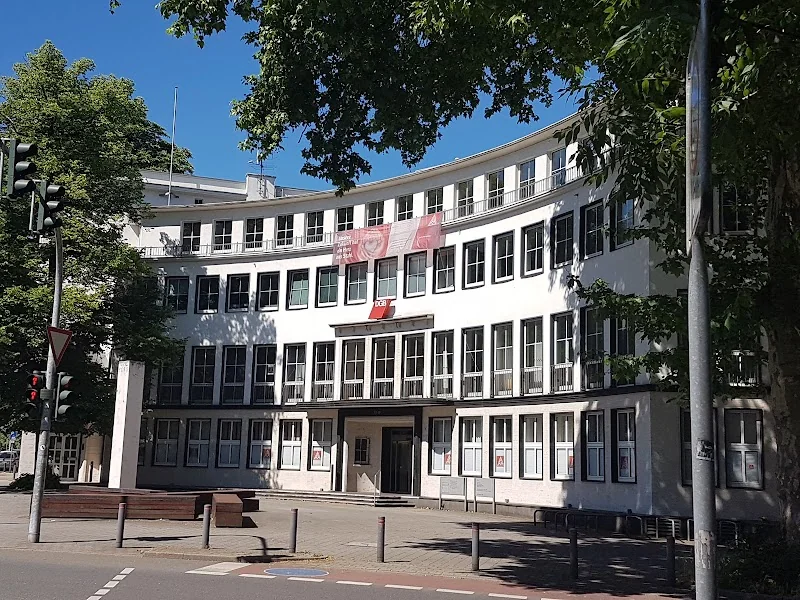
Stapeltor 17-19, Duisburg
Stapeltor 17-19, 47051 Duisburg, Germany
German Trade Union Confederation Region Lower Rhine | Photos & NRW
The German Trade Union Confederation Region Lower Rhine is not established in Duisburg as a classic event hall, but rather as a regional center for trade union work. The official DGB page names the location in Duisburg and assigns the region to the cities and districts of Duisburg, Kleve, and Wesel. This is why this address is interesting for people searching for photos, images, contact details, legal protection, advice, or the term DGB NRW. It is about a place where full-time and voluntary structures converge, where everyday issues of employees are bundled, and where trade union interests are brought to the local public. The location at Stapeltor 17-19 connects the site with the Duisburg old town, which is a historic and very central part of the city. Therefore, anyone wanting to get an impression of the DGB Lower Rhine is looking not just at a building, but at a hub of advice, organization, remembrance, and community presence. This makes the location relevant for both search queries and practical orientation in Duisburg. ([nrw.dgb.de](https://nrw.dgb.de/ueber-uns/regionen-mit-stadt-und-kreisverbaenden/niederrhein/))
Photos, Images, and the DGB House at Stapeltor
Those searching for photos or images of the DGB Region Lower Rhine are primarily looking for a place with a clear visual identity. The most striking motif is the DGB House at Stapeltor itself, a location that stands out not only functionally but also urbanistically in the Duisburg old town. According to the city of Duisburg, the old town forms the core and beginning of the city; it is not a decorative open-air museum, but a historically grown urban space with the town hall, Salvatorkirche, city wall, inner harbor, and other notable places. This context also gives the DGB location a strong visual language: administration, trade union work, and remembrance meet an urban background that is particularly attractive for search queries with the word photos. The urban culture page also documents the memorial at the DGB House as an independent artwork. This is important for visual search patterns because here not only a building is created, but a coherent field of motifs: the house, the memorial, the old town, and the historical center of Duisburg. This makes the location suitable for people who are looking for images not just as documentation, but as guidance. This also applies to editorial content, as the visual character can be clearly connected with terms like Region Lower Rhine, DGB Duisburg, trade union house, and old town, without artificially elevating the location. ([duisburg.de](https://www.duisburg.de/microsites/kulturbuero-duisburg/kunstwerke-im-oeffentlichen-raum/mitte/Mahnmal-am-DGB-Haus.php))
The photographic impact of the place is particularly strong because it does not appear as a neutral office location, but as a house with a public statement. The memorial at the DGB House by Dani Karavan is central to this. The city of Duisburg describes the work as part of a series of objects by the artist that are meant to commemorate the resistance against tyranny and the suffering of the Jewish population. At the same time, the artwork refers to the trade union movement and commemorates four Duisburg trade unionists who were murdered by the Nazis on May 2, 1933. For image seekers, this results in a double motif: on one hand, the modern trade union house within the urban fabric, and on the other hand, the memorial with its clear, symbolic character. Therefore, anyone creating content about the DGB Region Lower Rhine, the DGB House Duisburg, or the Stapeltor should not reduce the motif to a mere address photo. The location is visually interesting because it brings together present and memory and because it can be connected with the historical facets of the old town. This creates added value for photo inquiries, social media, discovery texts, and SEO content with local relevance. ([duisburg.de](https://www.duisburg.de/microsites/kulturbuero-duisburg/kunstwerke-im-oeffentlichen-raum/mitte/Mahnmal-am-DGB-Haus.php))
Contact, Advice, and DGB Legal Protection
For users who are looking for not just images but concrete help, the contact page of the region is particularly important. The official DGB page lists the address for the Duisburg office as Stapeltor 17-19, 47051 Duisburg, along with phone, fax, and email. It also mentions the contacts Angelika Wagner as regional manager, Rouven Zahn and Michael Schneider as organizational secretaries, and Kristina Fünderich and Manuela Ganci as assistants. This shows that the location is not an anonymous administrative object, but a functioning advisory and organizational office with clear responsibilities. Anyone wishing to contact regarding labor law, membership, trade union participation, or regional issues will find a concrete point of contact here. Particularly relevant is that the NRW page of the DGB additionally lists the Duisburg office of the DGB Legal Protection GmbH at the same address. The institution describes its mission as providing competent help directly on-site for members of the DGB trade unions in legal matters. This combination of regional office and legal protection makes the location professionally strong. For SEO, this is valuable because search queries often target not only the name of the region but also terms like advice, legal protection, trade union, or contact in Duisburg. ([nrw.dgb.de](https://nrw.dgb.de/ueber-uns/regionen-mit-stadt-und-kreisverbaenden/niederrhein/))
The tone of the location is also noteworthy: The official page emphasizes proximity, short distances, and personal contact. This is particularly important for people who do not experience trade union representation as a distant institution, but as a tangible point of contact. DGB legal protection in Duisburg is therefore more than just an additional address; it is part of the same trade union infrastructure that comes together at Stapeltor. For content planning, this means that terms like DGB Legal Protection Duisburg, Trade Union House Duisburg, Trade Union Advice Duisburg, and Stapeltor 17-19 should not be treated in isolation. They belong together and describe the same place from different perspectives: legal, organizational, regional, and communicative. This connection is helpful for the user because it facilitates the decision of whether the location is the right point of contact. Therefore, anyone looking for not just a photo but real guidance will find a clear, robust, and official structure at the DGB location in Duisburg that takes both the region and the members' perspective seriously. ([nrw.dgb.de](https://nrw.dgb.de/ueber-uns/regionen-mit-stadt-und-kreisverbaenden/niederrhein/))
The DGB Region Lower Rhine: Duisburg, Kleve, and Wesel
The Region Lower Rhine is clearly defined within the DGB structure. According to the DGB, it represents the interests of employees from the cities and districts of Duisburg, Kleve, and Wesel. This is very important for the content classification because the search terms around DGB NRW, District NRW, and Region Lower Rhine are often mixed together. In fact, there is a concrete regional organization with a seat in Duisburg and an area of activity that extends beyond the city limits. The regional page also describes that besides the DGB city association Duisburg, there are a total of two DGB district associations active, where voluntary colleagues work together, organize events, and address socially important issues. This regional depth is a central feature of the location. It is not just a pure desk job, but a platform for networking, mobilization, and coordination. Therefore, the Region Lower Rhine fits both search queries for contact details and questions about the tasks of the DGB on-site. It is also relevant for visitors that the region is described on the NRW page as part of a larger system of regions. It is explained there that the websites of the regions help to find the responsible district or city association in one's own place of residence and to make contact. ([nrw.dgb.de](https://nrw.dgb.de/ueber-uns/regionen-mit-stadt-und-kreisverbaenden/niederrhein/))
For the perception of the location, this is an important point: The DGB Region Lower Rhine is visible and addressed in Duisburg, but its working radius is consciously thought regionally. This creates a local network that benefits employees in several cities and districts. The DGB page also describes the tasks of the district and city associations very clearly: bringing employee interests into local politics, initiating or collaborating in municipal networks, mobilizing for campaigns and actions on-site, planning and carrying out trade union actions, and conducting local press and public relations work. This official mandate explains why the region frequently appears in search queries for programs, photos, events, or DGB NRW. Users are often looking for not just an address, but a functioning regional structure. Additionally, the NRW architecture of the DGB is important: The page presents the DGB regions in North Rhine-Westphalia, and it states that the eight DGB trade unions in NRW organize around 1.3 million members. This places the Duisburg location within a much larger network without taking away its local identity. This connection of regional proximity and statewide structure makes the DGB Lower Rhine an attractive topic. ([nrw.dgb.de](https://nrw.dgb.de/ueber-uns/regionen-mit-stadt-und-kreisverbaenden/niederrhein/))
Tasks, Actions, and Trade Union Networking On-Site
The DGB Region Lower Rhine is primarily a place for work on topics that directly affect many employees. The official regional page lists several core tasks: bringing employee interests into local politics, creating or strengthening networks at the municipal level, organizing trade union campaigns on-site, planning and carrying out actions, and taking over local press and public relations work. This makes it clear why this location responds to search queries for German Trade Union Confederation, NRW, District NRW, or Region Lower Rhine. Behind the name is not just an administrative apparatus, but a political and social actor. The house at Stapeltor is therefore not just an address, but a workplace for topics such as employment, social justice, co-determination, and trade union presence. The page also emphasizes that in the region, colleagues from the trade unions of the DGB district associations work together to serve the interests of the working population and their families. This sentence is important because it shifts the perspective from the building to the people. The office is only the visible shell; the actual significance lies in the coordination of interests and the interplay of full-time and voluntary work. ([nrw.dgb.de](https://nrw.dgb.de/ueber-uns/regionen-mit-stadt-und-kreisverbaenden/niederrhein/))
This is an exciting aspect, especially for content about photos or images, as trade union locations are often underestimated. They are not purely administrative spaces, but interfaces between the public and the organization. According to the official page, the DGB Region Lower Rhine engages in issues such as privatization of public enterprises, mayoral elections, business settlement, urban development measures, childcare, or social issues. This makes the location thematically broad and explains why it is perceived not only by members but also by media, initiatives, and local actors. Therefore, anyone writing an SEO page for this location should not only mention the address but also convey the character of the place: Here, positions are developed, coordinated, and communicated outward. This is also why terms like Trade Union House Duisburg, DGB Advice, DGB Actions, or trade union networking in the region make sense. The location at Stapeltor stands for active, locally anchored representation of interests that remains visible because it regularly engages in debates and actions. This mixture of political relevance and local presence makes the location permanently interesting. ([nrw.dgb.de](https://nrw.dgb.de/ueber-uns/regionen-mit-stadt-und-kreisverbaenden/niederrhein/))
Duisburg Old Town, Access, and Central Location
The address Stapeltor 17-19 is located in the Duisburg old town, which is the part of the city that the city of Duisburg describes as the core and beginning of Duisburg. This is a strong location advantage because it embeds the DGB location in a historically charged and well-known urban space. The old town is not presented on the city page as a classic romantic old town core, but as a developed area with historical depth. Among other things, there are Burgplatz, town hall, Salvatorkirche, city wall, and other notable places that make the earliest history of Duisburg visible. For visitors, this provides clear orientation: Anyone looking for the DGB House is moving in a central and historically significant part of the city center. This is particularly relevant for search queries with access, Duisburg city center, or old town. At the same time, there is a difference to pure event locations: The DGB House is not a place for show business, but part of an inner-city infrastructure that connects administration, advice, and public presence. The surroundings give the location a clear profile and enhance its recognizability in photos. ([duisburg.de](https://www.duisburg.de/microsites/sieben_bezirke/mitte/altstadt/altstadt.php))
For practical use, the location means proximity to well-known points in the city center. The old town page mentions the town hall area at Burgplatz and the Salvatorkirche as historical reference points. This not only helps with orientation but also with understanding the environment in which the DGB operates. The location is therefore not on the outskirts but in the middle of an area that is symbolically important for the city of Duisburg. Anyone searching for a photo of the DGB Lower Rhine or for directions should therefore think less of a remote business address and more of a central office location in the urban core of the city. This is also useful for editorial content: It underscores the proximity to the public and facilitates the connection of trade union work, city history, and urban everyday life. This mixture of central location, visible integration, and historical surroundings makes Stapeltor a convincing location. The address is therefore not just a contact point but also a cityscape-defining marker that can be quickly placed in Duisburg. ([duisburg.de](https://www.duisburg.de/microsites/sieben_bezirke/mitte/altstadt/altstadt.php))
History, Memorial, and Significance of the Location
The history of the location gives the DGB House at Stapeltor its special depth. On the cultural page of the city of Duisburg, the memorial at the DGB House by Dani Karavan is described. The artwork commemorates the four Duisburg trade unionists Julius Birck, Emil Rentmeister, Michael Rodenstock, and Johann Schlösser, who were murdered by the Nazis on May 2, 1933. Additionally, the city explains that the artwork is part of a series of objects by the artist that are meant to commemorate the victims of the resistance against tyranny and the suffering of the Jewish population. This is enormously important for the location because current trade union work and historical remembrance overlap here. The memorial consists of five pillars made of steel and concrete; originally, there were five steel elements, with one pillar being exchanged for a white concrete pillar from the Garden of Remembrance. These details show that the place is not just an address, but also a space for remembrance. Therefore, those searching for images find not only the exterior view of the house but also a historical and artistic symbol with a clear statement. ([duisburg.de](https://www.duisburg.de/microsites/kulturbuero-duisburg/kunstwerke-im-oeffentlichen-raum/mitte/Mahnmal-am-DGB-Haus.php))
This connection of present and memory makes the location so strong for SEO content and for visitors. The DGB House at Stapeltor does not stand isolated in the urban landscape but in the context of a city that keeps its history visible. The old town is, according to the city of Duisburg, the core and beginning of the city, and the memorial at the DGB House adds a trade union remembrance layer to this history. This gives the location a dual character: it is on one hand a functional office and advisory center, and on the other hand a place of remembrance and public stance. For search queries for photos, images, or the German Trade Union Confederation Region Lower Rhine, this is particularly valuable because users often prefer such places where a strong motif and a clear story connect. The Stapeltor provides an ideal foundation for this. The address is therefore important not only in regional trade union work but also for the perception of Duisburg as a city with a culture of remembrance and visible political history. Understanding this place also means understanding a piece of trade union identity in the Lower Rhine. ([duisburg.de](https://www.duisburg.de/microsites/kulturbuero-duisburg/kunstwerke-im-oeffentlichen-raum/mitte/Mahnmal-am-DGB-Haus.php))
Sources:
- DGB North Rhine-Westphalia - Region Lower Rhine ([nrw.dgb.de](https://nrw.dgb.de/ueber-uns/regionen-mit-stadt-und-kreisverbaenden/niederrhein/))
- DGB North Rhine-Westphalia - Regions and City and District Associations ([nrw.dgb.de](https://nrw.dgb.de/ueber-uns/dgb-region))
- DGB North Rhine-Westphalia - DGB Legal Protection ([nrw.dgb.de](https://nrw.dgb.de/service/weiterer-service/dgb-rechtsschutz/))
- City of Duisburg - Memorial at the DGB House ([duisburg.de](https://www.duisburg.de/microsites/kulturbuero-duisburg/kunstwerke-im-oeffentlichen-raum/mitte/Mahnmal-am-DGB-Haus.php))
- City of Duisburg - Old Town ([duisburg.de](https://www.duisburg.de/microsites/sieben_bezirke/mitte/altstadt/altstadt.php))
Show moreShow less
German Trade Union Confederation Region Lower Rhine | Photos & NRW
The German Trade Union Confederation Region Lower Rhine is not established in Duisburg as a classic event hall, but rather as a regional center for trade union work. The official DGB page names the location in Duisburg and assigns the region to the cities and districts of Duisburg, Kleve, and Wesel. This is why this address is interesting for people searching for photos, images, contact details, legal protection, advice, or the term DGB NRW. It is about a place where full-time and voluntary structures converge, where everyday issues of employees are bundled, and where trade union interests are brought to the local public. The location at Stapeltor 17-19 connects the site with the Duisburg old town, which is a historic and very central part of the city. Therefore, anyone wanting to get an impression of the DGB Lower Rhine is looking not just at a building, but at a hub of advice, organization, remembrance, and community presence. This makes the location relevant for both search queries and practical orientation in Duisburg. ([nrw.dgb.de](https://nrw.dgb.de/ueber-uns/regionen-mit-stadt-und-kreisverbaenden/niederrhein/))
Photos, Images, and the DGB House at Stapeltor
Those searching for photos or images of the DGB Region Lower Rhine are primarily looking for a place with a clear visual identity. The most striking motif is the DGB House at Stapeltor itself, a location that stands out not only functionally but also urbanistically in the Duisburg old town. According to the city of Duisburg, the old town forms the core and beginning of the city; it is not a decorative open-air museum, but a historically grown urban space with the town hall, Salvatorkirche, city wall, inner harbor, and other notable places. This context also gives the DGB location a strong visual language: administration, trade union work, and remembrance meet an urban background that is particularly attractive for search queries with the word photos. The urban culture page also documents the memorial at the DGB House as an independent artwork. This is important for visual search patterns because here not only a building is created, but a coherent field of motifs: the house, the memorial, the old town, and the historical center of Duisburg. This makes the location suitable for people who are looking for images not just as documentation, but as guidance. This also applies to editorial content, as the visual character can be clearly connected with terms like Region Lower Rhine, DGB Duisburg, trade union house, and old town, without artificially elevating the location. ([duisburg.de](https://www.duisburg.de/microsites/kulturbuero-duisburg/kunstwerke-im-oeffentlichen-raum/mitte/Mahnmal-am-DGB-Haus.php))
The photographic impact of the place is particularly strong because it does not appear as a neutral office location, but as a house with a public statement. The memorial at the DGB House by Dani Karavan is central to this. The city of Duisburg describes the work as part of a series of objects by the artist that are meant to commemorate the resistance against tyranny and the suffering of the Jewish population. At the same time, the artwork refers to the trade union movement and commemorates four Duisburg trade unionists who were murdered by the Nazis on May 2, 1933. For image seekers, this results in a double motif: on one hand, the modern trade union house within the urban fabric, and on the other hand, the memorial with its clear, symbolic character. Therefore, anyone creating content about the DGB Region Lower Rhine, the DGB House Duisburg, or the Stapeltor should not reduce the motif to a mere address photo. The location is visually interesting because it brings together present and memory and because it can be connected with the historical facets of the old town. This creates added value for photo inquiries, social media, discovery texts, and SEO content with local relevance. ([duisburg.de](https://www.duisburg.de/microsites/kulturbuero-duisburg/kunstwerke-im-oeffentlichen-raum/mitte/Mahnmal-am-DGB-Haus.php))
Contact, Advice, and DGB Legal Protection
For users who are looking for not just images but concrete help, the contact page of the region is particularly important. The official DGB page lists the address for the Duisburg office as Stapeltor 17-19, 47051 Duisburg, along with phone, fax, and email. It also mentions the contacts Angelika Wagner as regional manager, Rouven Zahn and Michael Schneider as organizational secretaries, and Kristina Fünderich and Manuela Ganci as assistants. This shows that the location is not an anonymous administrative object, but a functioning advisory and organizational office with clear responsibilities. Anyone wishing to contact regarding labor law, membership, trade union participation, or regional issues will find a concrete point of contact here. Particularly relevant is that the NRW page of the DGB additionally lists the Duisburg office of the DGB Legal Protection GmbH at the same address. The institution describes its mission as providing competent help directly on-site for members of the DGB trade unions in legal matters. This combination of regional office and legal protection makes the location professionally strong. For SEO, this is valuable because search queries often target not only the name of the region but also terms like advice, legal protection, trade union, or contact in Duisburg. ([nrw.dgb.de](https://nrw.dgb.de/ueber-uns/regionen-mit-stadt-und-kreisverbaenden/niederrhein/))
The tone of the location is also noteworthy: The official page emphasizes proximity, short distances, and personal contact. This is particularly important for people who do not experience trade union representation as a distant institution, but as a tangible point of contact. DGB legal protection in Duisburg is therefore more than just an additional address; it is part of the same trade union infrastructure that comes together at Stapeltor. For content planning, this means that terms like DGB Legal Protection Duisburg, Trade Union House Duisburg, Trade Union Advice Duisburg, and Stapeltor 17-19 should not be treated in isolation. They belong together and describe the same place from different perspectives: legal, organizational, regional, and communicative. This connection is helpful for the user because it facilitates the decision of whether the location is the right point of contact. Therefore, anyone looking for not just a photo but real guidance will find a clear, robust, and official structure at the DGB location in Duisburg that takes both the region and the members' perspective seriously. ([nrw.dgb.de](https://nrw.dgb.de/ueber-uns/regionen-mit-stadt-und-kreisverbaenden/niederrhein/))
The DGB Region Lower Rhine: Duisburg, Kleve, and Wesel
The Region Lower Rhine is clearly defined within the DGB structure. According to the DGB, it represents the interests of employees from the cities and districts of Duisburg, Kleve, and Wesel. This is very important for the content classification because the search terms around DGB NRW, District NRW, and Region Lower Rhine are often mixed together. In fact, there is a concrete regional organization with a seat in Duisburg and an area of activity that extends beyond the city limits. The regional page also describes that besides the DGB city association Duisburg, there are a total of two DGB district associations active, where voluntary colleagues work together, organize events, and address socially important issues. This regional depth is a central feature of the location. It is not just a pure desk job, but a platform for networking, mobilization, and coordination. Therefore, the Region Lower Rhine fits both search queries for contact details and questions about the tasks of the DGB on-site. It is also relevant for visitors that the region is described on the NRW page as part of a larger system of regions. It is explained there that the websites of the regions help to find the responsible district or city association in one's own place of residence and to make contact. ([nrw.dgb.de](https://nrw.dgb.de/ueber-uns/regionen-mit-stadt-und-kreisverbaenden/niederrhein/))
For the perception of the location, this is an important point: The DGB Region Lower Rhine is visible and addressed in Duisburg, but its working radius is consciously thought regionally. This creates a local network that benefits employees in several cities and districts. The DGB page also describes the tasks of the district and city associations very clearly: bringing employee interests into local politics, initiating or collaborating in municipal networks, mobilizing for campaigns and actions on-site, planning and carrying out trade union actions, and conducting local press and public relations work. This official mandate explains why the region frequently appears in search queries for programs, photos, events, or DGB NRW. Users are often looking for not just an address, but a functioning regional structure. Additionally, the NRW architecture of the DGB is important: The page presents the DGB regions in North Rhine-Westphalia, and it states that the eight DGB trade unions in NRW organize around 1.3 million members. This places the Duisburg location within a much larger network without taking away its local identity. This connection of regional proximity and statewide structure makes the DGB Lower Rhine an attractive topic. ([nrw.dgb.de](https://nrw.dgb.de/ueber-uns/regionen-mit-stadt-und-kreisverbaenden/niederrhein/))
Tasks, Actions, and Trade Union Networking On-Site
The DGB Region Lower Rhine is primarily a place for work on topics that directly affect many employees. The official regional page lists several core tasks: bringing employee interests into local politics, creating or strengthening networks at the municipal level, organizing trade union campaigns on-site, planning and carrying out actions, and taking over local press and public relations work. This makes it clear why this location responds to search queries for German Trade Union Confederation, NRW, District NRW, or Region Lower Rhine. Behind the name is not just an administrative apparatus, but a political and social actor. The house at Stapeltor is therefore not just an address, but a workplace for topics such as employment, social justice, co-determination, and trade union presence. The page also emphasizes that in the region, colleagues from the trade unions of the DGB district associations work together to serve the interests of the working population and their families. This sentence is important because it shifts the perspective from the building to the people. The office is only the visible shell; the actual significance lies in the coordination of interests and the interplay of full-time and voluntary work. ([nrw.dgb.de](https://nrw.dgb.de/ueber-uns/regionen-mit-stadt-und-kreisverbaenden/niederrhein/))
This is an exciting aspect, especially for content about photos or images, as trade union locations are often underestimated. They are not purely administrative spaces, but interfaces between the public and the organization. According to the official page, the DGB Region Lower Rhine engages in issues such as privatization of public enterprises, mayoral elections, business settlement, urban development measures, childcare, or social issues. This makes the location thematically broad and explains why it is perceived not only by members but also by media, initiatives, and local actors. Therefore, anyone writing an SEO page for this location should not only mention the address but also convey the character of the place: Here, positions are developed, coordinated, and communicated outward. This is also why terms like Trade Union House Duisburg, DGB Advice, DGB Actions, or trade union networking in the region make sense. The location at Stapeltor stands for active, locally anchored representation of interests that remains visible because it regularly engages in debates and actions. This mixture of political relevance and local presence makes the location permanently interesting. ([nrw.dgb.de](https://nrw.dgb.de/ueber-uns/regionen-mit-stadt-und-kreisverbaenden/niederrhein/))
Duisburg Old Town, Access, and Central Location
The address Stapeltor 17-19 is located in the Duisburg old town, which is the part of the city that the city of Duisburg describes as the core and beginning of Duisburg. This is a strong location advantage because it embeds the DGB location in a historically charged and well-known urban space. The old town is not presented on the city page as a classic romantic old town core, but as a developed area with historical depth. Among other things, there are Burgplatz, town hall, Salvatorkirche, city wall, and other notable places that make the earliest history of Duisburg visible. For visitors, this provides clear orientation: Anyone looking for the DGB House is moving in a central and historically significant part of the city center. This is particularly relevant for search queries with access, Duisburg city center, or old town. At the same time, there is a difference to pure event locations: The DGB House is not a place for show business, but part of an inner-city infrastructure that connects administration, advice, and public presence. The surroundings give the location a clear profile and enhance its recognizability in photos. ([duisburg.de](https://www.duisburg.de/microsites/sieben_bezirke/mitte/altstadt/altstadt.php))
For practical use, the location means proximity to well-known points in the city center. The old town page mentions the town hall area at Burgplatz and the Salvatorkirche as historical reference points. This not only helps with orientation but also with understanding the environment in which the DGB operates. The location is therefore not on the outskirts but in the middle of an area that is symbolically important for the city of Duisburg. Anyone searching for a photo of the DGB Lower Rhine or for directions should therefore think less of a remote business address and more of a central office location in the urban core of the city. This is also useful for editorial content: It underscores the proximity to the public and facilitates the connection of trade union work, city history, and urban everyday life. This mixture of central location, visible integration, and historical surroundings makes Stapeltor a convincing location. The address is therefore not just a contact point but also a cityscape-defining marker that can be quickly placed in Duisburg. ([duisburg.de](https://www.duisburg.de/microsites/sieben_bezirke/mitte/altstadt/altstadt.php))
History, Memorial, and Significance of the Location
The history of the location gives the DGB House at Stapeltor its special depth. On the cultural page of the city of Duisburg, the memorial at the DGB House by Dani Karavan is described. The artwork commemorates the four Duisburg trade unionists Julius Birck, Emil Rentmeister, Michael Rodenstock, and Johann Schlösser, who were murdered by the Nazis on May 2, 1933. Additionally, the city explains that the artwork is part of a series of objects by the artist that are meant to commemorate the victims of the resistance against tyranny and the suffering of the Jewish population. This is enormously important for the location because current trade union work and historical remembrance overlap here. The memorial consists of five pillars made of steel and concrete; originally, there were five steel elements, with one pillar being exchanged for a white concrete pillar from the Garden of Remembrance. These details show that the place is not just an address, but also a space for remembrance. Therefore, those searching for images find not only the exterior view of the house but also a historical and artistic symbol with a clear statement. ([duisburg.de](https://www.duisburg.de/microsites/kulturbuero-duisburg/kunstwerke-im-oeffentlichen-raum/mitte/Mahnmal-am-DGB-Haus.php))
This connection of present and memory makes the location so strong for SEO content and for visitors. The DGB House at Stapeltor does not stand isolated in the urban landscape but in the context of a city that keeps its history visible. The old town is, according to the city of Duisburg, the core and beginning of the city, and the memorial at the DGB House adds a trade union remembrance layer to this history. This gives the location a dual character: it is on one hand a functional office and advisory center, and on the other hand a place of remembrance and public stance. For search queries for photos, images, or the German Trade Union Confederation Region Lower Rhine, this is particularly valuable because users often prefer such places where a strong motif and a clear story connect. The Stapeltor provides an ideal foundation for this. The address is therefore important not only in regional trade union work but also for the perception of Duisburg as a city with a culture of remembrance and visible political history. Understanding this place also means understanding a piece of trade union identity in the Lower Rhine. ([duisburg.de](https://www.duisburg.de/microsites/kulturbuero-duisburg/kunstwerke-im-oeffentlichen-raum/mitte/Mahnmal-am-DGB-Haus.php))
Sources:
- DGB North Rhine-Westphalia - Region Lower Rhine ([nrw.dgb.de](https://nrw.dgb.de/ueber-uns/regionen-mit-stadt-und-kreisverbaenden/niederrhein/))
- DGB North Rhine-Westphalia - Regions and City and District Associations ([nrw.dgb.de](https://nrw.dgb.de/ueber-uns/dgb-region))
- DGB North Rhine-Westphalia - DGB Legal Protection ([nrw.dgb.de](https://nrw.dgb.de/service/weiterer-service/dgb-rechtsschutz/))
- City of Duisburg - Memorial at the DGB House ([duisburg.de](https://www.duisburg.de/microsites/kulturbuero-duisburg/kunstwerke-im-oeffentlichen-raum/mitte/Mahnmal-am-DGB-Haus.php))
- City of Duisburg - Old Town ([duisburg.de](https://www.duisburg.de/microsites/sieben_bezirke/mitte/altstadt/altstadt.php))
German Trade Union Confederation Region Lower Rhine | Photos & NRW
The German Trade Union Confederation Region Lower Rhine is not established in Duisburg as a classic event hall, but rather as a regional center for trade union work. The official DGB page names the location in Duisburg and assigns the region to the cities and districts of Duisburg, Kleve, and Wesel. This is why this address is interesting for people searching for photos, images, contact details, legal protection, advice, or the term DGB NRW. It is about a place where full-time and voluntary structures converge, where everyday issues of employees are bundled, and where trade union interests are brought to the local public. The location at Stapeltor 17-19 connects the site with the Duisburg old town, which is a historic and very central part of the city. Therefore, anyone wanting to get an impression of the DGB Lower Rhine is looking not just at a building, but at a hub of advice, organization, remembrance, and community presence. This makes the location relevant for both search queries and practical orientation in Duisburg. ([nrw.dgb.de](https://nrw.dgb.de/ueber-uns/regionen-mit-stadt-und-kreisverbaenden/niederrhein/))
Photos, Images, and the DGB House at Stapeltor
Those searching for photos or images of the DGB Region Lower Rhine are primarily looking for a place with a clear visual identity. The most striking motif is the DGB House at Stapeltor itself, a location that stands out not only functionally but also urbanistically in the Duisburg old town. According to the city of Duisburg, the old town forms the core and beginning of the city; it is not a decorative open-air museum, but a historically grown urban space with the town hall, Salvatorkirche, city wall, inner harbor, and other notable places. This context also gives the DGB location a strong visual language: administration, trade union work, and remembrance meet an urban background that is particularly attractive for search queries with the word photos. The urban culture page also documents the memorial at the DGB House as an independent artwork. This is important for visual search patterns because here not only a building is created, but a coherent field of motifs: the house, the memorial, the old town, and the historical center of Duisburg. This makes the location suitable for people who are looking for images not just as documentation, but as guidance. This also applies to editorial content, as the visual character can be clearly connected with terms like Region Lower Rhine, DGB Duisburg, trade union house, and old town, without artificially elevating the location. ([duisburg.de](https://www.duisburg.de/microsites/kulturbuero-duisburg/kunstwerke-im-oeffentlichen-raum/mitte/Mahnmal-am-DGB-Haus.php))
The photographic impact of the place is particularly strong because it does not appear as a neutral office location, but as a house with a public statement. The memorial at the DGB House by Dani Karavan is central to this. The city of Duisburg describes the work as part of a series of objects by the artist that are meant to commemorate the resistance against tyranny and the suffering of the Jewish population. At the same time, the artwork refers to the trade union movement and commemorates four Duisburg trade unionists who were murdered by the Nazis on May 2, 1933. For image seekers, this results in a double motif: on one hand, the modern trade union house within the urban fabric, and on the other hand, the memorial with its clear, symbolic character. Therefore, anyone creating content about the DGB Region Lower Rhine, the DGB House Duisburg, or the Stapeltor should not reduce the motif to a mere address photo. The location is visually interesting because it brings together present and memory and because it can be connected with the historical facets of the old town. This creates added value for photo inquiries, social media, discovery texts, and SEO content with local relevance. ([duisburg.de](https://www.duisburg.de/microsites/kulturbuero-duisburg/kunstwerke-im-oeffentlichen-raum/mitte/Mahnmal-am-DGB-Haus.php))
Contact, Advice, and DGB Legal Protection
For users who are looking for not just images but concrete help, the contact page of the region is particularly important. The official DGB page lists the address for the Duisburg office as Stapeltor 17-19, 47051 Duisburg, along with phone, fax, and email. It also mentions the contacts Angelika Wagner as regional manager, Rouven Zahn and Michael Schneider as organizational secretaries, and Kristina Fünderich and Manuela Ganci as assistants. This shows that the location is not an anonymous administrative object, but a functioning advisory and organizational office with clear responsibilities. Anyone wishing to contact regarding labor law, membership, trade union participation, or regional issues will find a concrete point of contact here. Particularly relevant is that the NRW page of the DGB additionally lists the Duisburg office of the DGB Legal Protection GmbH at the same address. The institution describes its mission as providing competent help directly on-site for members of the DGB trade unions in legal matters. This combination of regional office and legal protection makes the location professionally strong. For SEO, this is valuable because search queries often target not only the name of the region but also terms like advice, legal protection, trade union, or contact in Duisburg. ([nrw.dgb.de](https://nrw.dgb.de/ueber-uns/regionen-mit-stadt-und-kreisverbaenden/niederrhein/))
The tone of the location is also noteworthy: The official page emphasizes proximity, short distances, and personal contact. This is particularly important for people who do not experience trade union representation as a distant institution, but as a tangible point of contact. DGB legal protection in Duisburg is therefore more than just an additional address; it is part of the same trade union infrastructure that comes together at Stapeltor. For content planning, this means that terms like DGB Legal Protection Duisburg, Trade Union House Duisburg, Trade Union Advice Duisburg, and Stapeltor 17-19 should not be treated in isolation. They belong together and describe the same place from different perspectives: legal, organizational, regional, and communicative. This connection is helpful for the user because it facilitates the decision of whether the location is the right point of contact. Therefore, anyone looking for not just a photo but real guidance will find a clear, robust, and official structure at the DGB location in Duisburg that takes both the region and the members' perspective seriously. ([nrw.dgb.de](https://nrw.dgb.de/ueber-uns/regionen-mit-stadt-und-kreisverbaenden/niederrhein/))
The DGB Region Lower Rhine: Duisburg, Kleve, and Wesel
The Region Lower Rhine is clearly defined within the DGB structure. According to the DGB, it represents the interests of employees from the cities and districts of Duisburg, Kleve, and Wesel. This is very important for the content classification because the search terms around DGB NRW, District NRW, and Region Lower Rhine are often mixed together. In fact, there is a concrete regional organization with a seat in Duisburg and an area of activity that extends beyond the city limits. The regional page also describes that besides the DGB city association Duisburg, there are a total of two DGB district associations active, where voluntary colleagues work together, organize events, and address socially important issues. This regional depth is a central feature of the location. It is not just a pure desk job, but a platform for networking, mobilization, and coordination. Therefore, the Region Lower Rhine fits both search queries for contact details and questions about the tasks of the DGB on-site. It is also relevant for visitors that the region is described on the NRW page as part of a larger system of regions. It is explained there that the websites of the regions help to find the responsible district or city association in one's own place of residence and to make contact. ([nrw.dgb.de](https://nrw.dgb.de/ueber-uns/regionen-mit-stadt-und-kreisverbaenden/niederrhein/))
For the perception of the location, this is an important point: The DGB Region Lower Rhine is visible and addressed in Duisburg, but its working radius is consciously thought regionally. This creates a local network that benefits employees in several cities and districts. The DGB page also describes the tasks of the district and city associations very clearly: bringing employee interests into local politics, initiating or collaborating in municipal networks, mobilizing for campaigns and actions on-site, planning and carrying out trade union actions, and conducting local press and public relations work. This official mandate explains why the region frequently appears in search queries for programs, photos, events, or DGB NRW. Users are often looking for not just an address, but a functioning regional structure. Additionally, the NRW architecture of the DGB is important: The page presents the DGB regions in North Rhine-Westphalia, and it states that the eight DGB trade unions in NRW organize around 1.3 million members. This places the Duisburg location within a much larger network without taking away its local identity. This connection of regional proximity and statewide structure makes the DGB Lower Rhine an attractive topic. ([nrw.dgb.de](https://nrw.dgb.de/ueber-uns/regionen-mit-stadt-und-kreisverbaenden/niederrhein/))
Tasks, Actions, and Trade Union Networking On-Site
The DGB Region Lower Rhine is primarily a place for work on topics that directly affect many employees. The official regional page lists several core tasks: bringing employee interests into local politics, creating or strengthening networks at the municipal level, organizing trade union campaigns on-site, planning and carrying out actions, and taking over local press and public relations work. This makes it clear why this location responds to search queries for German Trade Union Confederation, NRW, District NRW, or Region Lower Rhine. Behind the name is not just an administrative apparatus, but a political and social actor. The house at Stapeltor is therefore not just an address, but a workplace for topics such as employment, social justice, co-determination, and trade union presence. The page also emphasizes that in the region, colleagues from the trade unions of the DGB district associations work together to serve the interests of the working population and their families. This sentence is important because it shifts the perspective from the building to the people. The office is only the visible shell; the actual significance lies in the coordination of interests and the interplay of full-time and voluntary work. ([nrw.dgb.de](https://nrw.dgb.de/ueber-uns/regionen-mit-stadt-und-kreisverbaenden/niederrhein/))
This is an exciting aspect, especially for content about photos or images, as trade union locations are often underestimated. They are not purely administrative spaces, but interfaces between the public and the organization. According to the official page, the DGB Region Lower Rhine engages in issues such as privatization of public enterprises, mayoral elections, business settlement, urban development measures, childcare, or social issues. This makes the location thematically broad and explains why it is perceived not only by members but also by media, initiatives, and local actors. Therefore, anyone writing an SEO page for this location should not only mention the address but also convey the character of the place: Here, positions are developed, coordinated, and communicated outward. This is also why terms like Trade Union House Duisburg, DGB Advice, DGB Actions, or trade union networking in the region make sense. The location at Stapeltor stands for active, locally anchored representation of interests that remains visible because it regularly engages in debates and actions. This mixture of political relevance and local presence makes the location permanently interesting. ([nrw.dgb.de](https://nrw.dgb.de/ueber-uns/regionen-mit-stadt-und-kreisverbaenden/niederrhein/))
Duisburg Old Town, Access, and Central Location
The address Stapeltor 17-19 is located in the Duisburg old town, which is the part of the city that the city of Duisburg describes as the core and beginning of Duisburg. This is a strong location advantage because it embeds the DGB location in a historically charged and well-known urban space. The old town is not presented on the city page as a classic romantic old town core, but as a developed area with historical depth. Among other things, there are Burgplatz, town hall, Salvatorkirche, city wall, and other notable places that make the earliest history of Duisburg visible. For visitors, this provides clear orientation: Anyone looking for the DGB House is moving in a central and historically significant part of the city center. This is particularly relevant for search queries with access, Duisburg city center, or old town. At the same time, there is a difference to pure event locations: The DGB House is not a place for show business, but part of an inner-city infrastructure that connects administration, advice, and public presence. The surroundings give the location a clear profile and enhance its recognizability in photos. ([duisburg.de](https://www.duisburg.de/microsites/sieben_bezirke/mitte/altstadt/altstadt.php))
For practical use, the location means proximity to well-known points in the city center. The old town page mentions the town hall area at Burgplatz and the Salvatorkirche as historical reference points. This not only helps with orientation but also with understanding the environment in which the DGB operates. The location is therefore not on the outskirts but in the middle of an area that is symbolically important for the city of Duisburg. Anyone searching for a photo of the DGB Lower Rhine or for directions should therefore think less of a remote business address and more of a central office location in the urban core of the city. This is also useful for editorial content: It underscores the proximity to the public and facilitates the connection of trade union work, city history, and urban everyday life. This mixture of central location, visible integration, and historical surroundings makes Stapeltor a convincing location. The address is therefore not just a contact point but also a cityscape-defining marker that can be quickly placed in Duisburg. ([duisburg.de](https://www.duisburg.de/microsites/sieben_bezirke/mitte/altstadt/altstadt.php))
History, Memorial, and Significance of the Location
The history of the location gives the DGB House at Stapeltor its special depth. On the cultural page of the city of Duisburg, the memorial at the DGB House by Dani Karavan is described. The artwork commemorates the four Duisburg trade unionists Julius Birck, Emil Rentmeister, Michael Rodenstock, and Johann Schlösser, who were murdered by the Nazis on May 2, 1933. Additionally, the city explains that the artwork is part of a series of objects by the artist that are meant to commemorate the victims of the resistance against tyranny and the suffering of the Jewish population. This is enormously important for the location because current trade union work and historical remembrance overlap here. The memorial consists of five pillars made of steel and concrete; originally, there were five steel elements, with one pillar being exchanged for a white concrete pillar from the Garden of Remembrance. These details show that the place is not just an address, but also a space for remembrance. Therefore, those searching for images find not only the exterior view of the house but also a historical and artistic symbol with a clear statement. ([duisburg.de](https://www.duisburg.de/microsites/kulturbuero-duisburg/kunstwerke-im-oeffentlichen-raum/mitte/Mahnmal-am-DGB-Haus.php))
This connection of present and memory makes the location so strong for SEO content and for visitors. The DGB House at Stapeltor does not stand isolated in the urban landscape but in the context of a city that keeps its history visible. The old town is, according to the city of Duisburg, the core and beginning of the city, and the memorial at the DGB House adds a trade union remembrance layer to this history. This gives the location a dual character: it is on one hand a functional office and advisory center, and on the other hand a place of remembrance and public stance. For search queries for photos, images, or the German Trade Union Confederation Region Lower Rhine, this is particularly valuable because users often prefer such places where a strong motif and a clear story connect. The Stapeltor provides an ideal foundation for this. The address is therefore important not only in regional trade union work but also for the perception of Duisburg as a city with a culture of remembrance and visible political history. Understanding this place also means understanding a piece of trade union identity in the Lower Rhine. ([duisburg.de](https://www.duisburg.de/microsites/kulturbuero-duisburg/kunstwerke-im-oeffentlichen-raum/mitte/Mahnmal-am-DGB-Haus.php))
Sources:
- DGB North Rhine-Westphalia - Region Lower Rhine ([nrw.dgb.de](https://nrw.dgb.de/ueber-uns/regionen-mit-stadt-und-kreisverbaenden/niederrhein/))
- DGB North Rhine-Westphalia - Regions and City and District Associations ([nrw.dgb.de](https://nrw.dgb.de/ueber-uns/dgb-region))
- DGB North Rhine-Westphalia - DGB Legal Protection ([nrw.dgb.de](https://nrw.dgb.de/service/weiterer-service/dgb-rechtsschutz/))
- City of Duisburg - Memorial at the DGB House ([duisburg.de](https://www.duisburg.de/microsites/kulturbuero-duisburg/kunstwerke-im-oeffentlichen-raum/mitte/Mahnmal-am-DGB-Haus.php))
- City of Duisburg - Old Town ([duisburg.de](https://www.duisburg.de/microsites/sieben_bezirke/mitte/altstadt/altstadt.php))
Upcoming Events
No events found
Frequently Asked Questions
Reviews
T. Silva
27. January 2024
I can only recommend that every employee join a union. Many thanks again to Mr. Pingel, who represented me excellently before the labor court after filing my unfair dismissal claim. I would also like to thank VERDI and the DGB, who always provided me with competent advice and worked together excellently.
Dirk Zweiböhmer
9. January 2021
IG Metall was very helpful and competent. The only problem was parking. Otherwise, they were excellent.
Detlef Raczuhn
17. December 2018
Had a meeting of trust people there.
Norbert Baier
8. September 2021
Specialist group meeting
Rainer Michalke
10. February 2022
Interesting building