
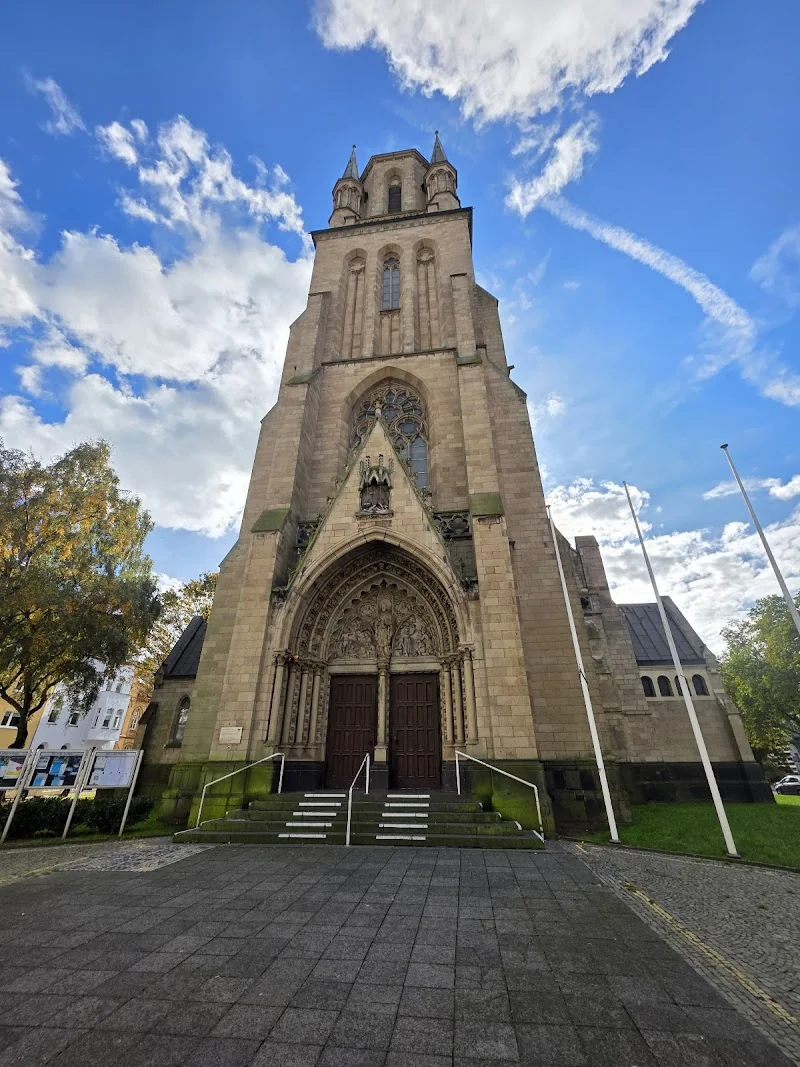
Ludgeripl. 33, Duisburg
Ludgeripl. 33, 47057 Duisburg, Germany
Catholic Community St. Ludger | Services & Organ
The Catholic Community St. Ludger in Duisburg-Neudorf is much more than a church location with a well-known address at Ludgeriplatz. Those looking for a Catholic community with a vibrant daily life, musical profile, and clear identity will find a place here where liturgy, neighborhood, and culture intertwine. The church is part of the parish of Liebfrauen Duisburg and is one of the defining religious sites in the district. At the same time, as a neo-Gothic basilica built in 1897, it is a prominent feature of the Duisburg church landscape. For people searching for St. Ludger, St. Ludger Catholic Church, or the Catholic Church in Duisburg-Neudorf, this location is particularly interesting because it does not pit tradition against the present but connects them: services, online participation, market events, choir singing, organ music, and community offerings complement each other to form a clearly recognizable profile. The result is a location that brings together religious depth, historical substance, and everyday openness. ([duisburglive.de](https://www.duisburglive.de/ort/st-ludger-kirche/?L=2))
Services at St. Ludger: Sunday Mass, Market Mass, and Online Participation
The most important search interest around St. Ludger almost always concerns the services. Here, the community is particularly well-structured. According to the official overview of the parish of Liebfrauen, the Eucharistic celebration is held on Sundays at 9:45 AM at St. Ludger; on the second Sunday of the month, instead of the Eucharist, a Word of God celebration is scheduled. Additionally, there is a Market Mass on Fridays at 9:00 AM, which is a service directly embedded in the dynamics of the weekly market at Ludgeriplatz. Therefore, those searching for “Services St. Ludger” or “Market Mass St. Ludger” will find a community that consciously engages with the daily rhythm of its district and is not only present on Sundays. Additionally, there are foreign-language celebrations of the Polish community, which take place on Sundays at 11:15 AM and Wednesdays at 6:00 PM at St. Ludger. This mix shows that the church is not intended for a single target group but remains part of a diverse pastoral reality. ([pfarrei-liebfrauen-duisburg.de](https://www.pfarrei-liebfrauen-duisburg.de/gottesdienste/regelm%C3%A4%C3%9Fige-gottesdienste/))
For search terms related to “program,” “service times,” or “today,” it is also important that St. Ludger makes its current participation digitally visible. The community refers to its YouTube channel and explicitly invites people to follow services online. This is practical for visitors who want to get a sense of the liturgical style first, and it also strengthens the reach of the church beyond the district. Additionally, recurring formats such as the church café, liturgy circle, and various festivals are announced on the community's homepage. This creates a plausible overall picture: St. Ludger is not a silent sacred space disconnected from everyday life, but a community where liturgy, digital accessibility, and lived community visibly belong together. For SEO-relevant search queries like “st ludger duisburg,” “church neudorf,” or “services online,” this combination of reliable times and open communication is a strong argument. ([pfarrei-liebfrauen-duisburg.de](https://www.pfarrei-liebfrauen-duisburg.de/gemeinden/st-ludger/))
Church Music, Market Music, and Duisburg's Largest Church Organ
Those interested in St. Ludger quickly find themselves in the realm of church music. This is no coincidence, as the parish of Liebfrauen explicitly describes a long church music tradition, and the St. Ludger choir has a broad history according to official accounts. The choir has been led by cantor Gregor Brück since 2019 and consists of 28 active singers as of 2026. He sees his role in the musical design and participation in the Eucharist during major festivals; the repertoire includes masses from the Romantic period and motets. Additionally, there is another ensemble, the Frosty Choir, which has its rehearsal location directly at the St. Ludger rectory. This choral landscape makes the church a true music venue. Those searching for “Church Music St. Ludger,” “Choir Duisburg Neudorf,” or similar terms will find here not only liturgical accompaniment but a permanent musical ecosystem. ([pfarrei-liebfrauen-duisburg.de](https://www.pfarrei-liebfrauen-duisburg.de/gemeindeleben/kirchenmusik/))
The absolute highlight is the organ. In current contributions from the parish, the Seifert organ of St. Ludger is described as the largest church organ in Duisburg with 64 registers on III-Ped. Its origins lie in an instrument from 1938, which was rebuilt after the war; some registers even date back to 1919. The organ was renovated in 2024 and equipped with a setter. At the same time, its sound profile is described as romantically influenced, with additional colorful registers from the organ movement and electric or electropneumatic action. These details are particularly valuable for search queries like “organ St. Ludger,” “Seifert organ Duisburg,” or “largest church organ in Duisburg,” as they demonstrate why the church is a fixed address in musician circles and among concert audiences. The regular market music on Friday mornings, usually featuring organ music, complements this profile ideally: it takes place during the weekly market at Ludgeriplatz, is free of charge, and offers visitors a short, open cultural break in the middle of the week. In this way, St. Ludger connects liturgical music, concert culture, and urban everyday proximity in an unusually harmonious manner. ([pfarrei-liebfrauen-duisburg.de](https://www.pfarrei-liebfrauen-duisburg.de/2025/12/29/konzerte-januar-2026/?utm_source=openai))
Church Café, Mourning Café, and Voluntary Community Life
Another central focus of interest is the community life itself. St. Ludger does not present itself as a mere Sunday church but as an open meeting point with recurring formats that bring people into contact with each other. The church café takes place on the last Sunday of every month directly after the mass and is thus a low-threshold place for encounter, conversation, and reflection. Particularly noteworthy is the voluntary leadership structure: since April 2021, St. Ludger has been led by a voluntary leadership team. The community explicitly describes this as a conscious step towards a church that is lively, open, and accessible to many people. This form of participation is not only organizationally exciting but also relevant for the content perception, as it shows that St. Ludger relies on co-creation. Those searching for “Community St. Ludger,” “Volunteering,” or “Church Café Duisburg” will encounter a community that consciously shares responsibility and is not exclusively hierarchically organized. ([pfarrei-liebfrauen-duisburg.de](https://www.pfarrei-liebfrauen-duisburg.de/gemeinden/st-ludger/))
Additionally, the mourning café is particularly strong. The community describes it as an offer for mourners of all ages, regardless of nationality and denomination, without registration and free of charge. This is important in content because it makes the social character of the church visible: St. Ludger is not only a place for celebration, sound, and festivity but also a space for accompaniment, silence, and conversation. This fits with the liturgy circle, which, according to the community, has already implemented new forms of service design, such as structured adoration before Sunday masses during Lent or a joint devotion hour before a seasonal festival. Such offerings are interesting for users looking for a lively Catholic community in Duisburg where participation is explicitly welcomed. For SEO topics like “Mourning Café St. Ludger,” “Church Café Duisburg,” or “voluntary community,” the church thus provides surprisingly strong depth. Last but not least, it becomes clear here that the community derives its center not only from architecture but from relationships, rituals, and the willingness to try new forms. ([pfarrei-liebfrauen-duisburg.de](https://www.pfarrei-liebfrauen-duisburg.de/gemeinden/st-ludger/))
History and Architecture of the Neo-Gothic Basilica at Ludgeriplatz
Historically, St. Ludger is closely linked to the development of Duisburg. The official historical page of the parish of Liebfrauen makes it clear that new churches had to be built due to industrialization starting in 1870, as the population was rapidly increasing. St. Ludger, along with St. Bonifatius and St. Joseph, was among the first daughter parishes of the old Liebfrauen parish; from 1892, these communities became independent. The community thus exists in a time when Duisburg was transforming from a relatively small town into an industrial center. For search queries like “St. Ludgerus Duisburg,” “History St. Ludger,” or “Catholic Church Neudorf,” this historical context is crucial because it explains why the church is not only a religious but also an urban marker. After the merger of the communities in 2006, the entire deanery Mitte was rejoined to the parish of Liebfrauen. St. Ludger remained as a church location with its own profile and is now visibly part of the vibrant network of the parish. ([pfarrei-liebfrauen-duisburg.de](https://www.pfarrei-liebfrauen-duisburg.de/historisches/))
The architecture is also clearly identifiable. The church St. Ludger in Duisburg-Neudorf was built in 1897 by Dietrich Hofferek as a neo-Gothic basilica. This information is mentioned in the local Duisburg representation as well as the address Ludgeriplatz 33, 47057 Duisburg. The term basilica here often simply stands for a large church in many everyday search queries, but in connection with St. Ludger, it refers to an architecturally significant sacred building with a strong external impact. The church is thus a very typical example of that construction phase in which new Catholic centers emerged in the Ruhr area, consciously opting for representative forms. That the church also gained attention beyond the region is evidenced by the ZDF broadcast of a service from St. Ludger in 2016. In the diocese announcement, the church is described as a place that was built in the neo-Gothic style nearly 120 years ago and plays an important role as part of the large parish of Liebfrauen. This underscores: St. Ludger is not only locally known but also a church location with media visibility and historical significance. ([duisburglive.de](https://www.duisburglive.de/ort/st-ludger-kirche/?L=2))
Directions, Address, and Practical Information for Your Visit
Practically, St. Ludger is very easy to find: The official address is Ludgeriplatz 33, 47057 Duisburg. For search terms like “Ludgeriplatz 33,” “Directions St. Ludger,” or “St. Ludger Duisburg Neudorf,” this clear address is an important conversion factor as it immediately facilitates orientation. The community itself focuses on content related to services, music, and community; however, a dedicated parking lot for the church is not indicated on the official pages. Those with organizational questions will find the central contact point of the parish of Liebfrauen at Wieberplatz 2 in Duisburg. The FAQ also mentions that parking is available behind the building at the Innenhafen. While this is not the same information as a parking lot directly at St. Ludger, it helps with general administrative matters and shows how the parish consolidates its infrastructure. Therefore, a simple strategy is recommended for a church visit: check current times on the community website, note the address at Ludgeriplatz, and inquire through the parish office or the provided contacts if necessary. ([duisburglive.de](https://www.duisburglive.de/ort/st-ludger-kirche/?L=2))
Especially for visitors who are getting to know St. Ludger for the first time, this combination of historical church and active community is valuable. On-site, there are regular services, digital participation, musical formats, a church café, a mourning café, and changing community events. The official communication is thus deliberately low-threshold: those who cannot come in person can participate online; those who are only looking for specific information can find it on the community or parish page; those who want to experience the church as a cultural or concert venue will encounter a location with real profile formation. This mix makes the location strong for SEO as it serves multiple search intents simultaneously: religious orientation, practical visit information, musical highlights, and a sense of lived community. St. Ludger is thus a place that convinces both functionally and emotionally in Duisburg-Neudorf. ([pfarrei-liebfrauen-duisburg.de](https://www.pfarrei-liebfrauen-duisburg.de/gemeinden/st-ludger/))
Sources:
- Parish of Liebfrauen Duisburg - Welcome to St. Ludger
- Parish of Liebfrauen Duisburg - Regular Services
- Parish of Liebfrauen Duisburg - Historical
- Parish of Liebfrauen Duisburg - Church Music
- Parish of Liebfrauen Duisburg - FAQ
- Parish of Liebfrauen Duisburg - Concert on Sunday | 01.02.26
- Duisburg Live - St. Ludger Church
- Diocese of Essen - ZDF broadcasts service from St. Ludger in Duisburg-Neudorf
Show moreShow less
Catholic Community St. Ludger | Services & Organ
The Catholic Community St. Ludger in Duisburg-Neudorf is much more than a church location with a well-known address at Ludgeriplatz. Those looking for a Catholic community with a vibrant daily life, musical profile, and clear identity will find a place here where liturgy, neighborhood, and culture intertwine. The church is part of the parish of Liebfrauen Duisburg and is one of the defining religious sites in the district. At the same time, as a neo-Gothic basilica built in 1897, it is a prominent feature of the Duisburg church landscape. For people searching for St. Ludger, St. Ludger Catholic Church, or the Catholic Church in Duisburg-Neudorf, this location is particularly interesting because it does not pit tradition against the present but connects them: services, online participation, market events, choir singing, organ music, and community offerings complement each other to form a clearly recognizable profile. The result is a location that brings together religious depth, historical substance, and everyday openness. ([duisburglive.de](https://www.duisburglive.de/ort/st-ludger-kirche/?L=2))
Services at St. Ludger: Sunday Mass, Market Mass, and Online Participation
The most important search interest around St. Ludger almost always concerns the services. Here, the community is particularly well-structured. According to the official overview of the parish of Liebfrauen, the Eucharistic celebration is held on Sundays at 9:45 AM at St. Ludger; on the second Sunday of the month, instead of the Eucharist, a Word of God celebration is scheduled. Additionally, there is a Market Mass on Fridays at 9:00 AM, which is a service directly embedded in the dynamics of the weekly market at Ludgeriplatz. Therefore, those searching for “Services St. Ludger” or “Market Mass St. Ludger” will find a community that consciously engages with the daily rhythm of its district and is not only present on Sundays. Additionally, there are foreign-language celebrations of the Polish community, which take place on Sundays at 11:15 AM and Wednesdays at 6:00 PM at St. Ludger. This mix shows that the church is not intended for a single target group but remains part of a diverse pastoral reality. ([pfarrei-liebfrauen-duisburg.de](https://www.pfarrei-liebfrauen-duisburg.de/gottesdienste/regelm%C3%A4%C3%9Fige-gottesdienste/))
For search terms related to “program,” “service times,” or “today,” it is also important that St. Ludger makes its current participation digitally visible. The community refers to its YouTube channel and explicitly invites people to follow services online. This is practical for visitors who want to get a sense of the liturgical style first, and it also strengthens the reach of the church beyond the district. Additionally, recurring formats such as the church café, liturgy circle, and various festivals are announced on the community's homepage. This creates a plausible overall picture: St. Ludger is not a silent sacred space disconnected from everyday life, but a community where liturgy, digital accessibility, and lived community visibly belong together. For SEO-relevant search queries like “st ludger duisburg,” “church neudorf,” or “services online,” this combination of reliable times and open communication is a strong argument. ([pfarrei-liebfrauen-duisburg.de](https://www.pfarrei-liebfrauen-duisburg.de/gemeinden/st-ludger/))
Church Music, Market Music, and Duisburg's Largest Church Organ
Those interested in St. Ludger quickly find themselves in the realm of church music. This is no coincidence, as the parish of Liebfrauen explicitly describes a long church music tradition, and the St. Ludger choir has a broad history according to official accounts. The choir has been led by cantor Gregor Brück since 2019 and consists of 28 active singers as of 2026. He sees his role in the musical design and participation in the Eucharist during major festivals; the repertoire includes masses from the Romantic period and motets. Additionally, there is another ensemble, the Frosty Choir, which has its rehearsal location directly at the St. Ludger rectory. This choral landscape makes the church a true music venue. Those searching for “Church Music St. Ludger,” “Choir Duisburg Neudorf,” or similar terms will find here not only liturgical accompaniment but a permanent musical ecosystem. ([pfarrei-liebfrauen-duisburg.de](https://www.pfarrei-liebfrauen-duisburg.de/gemeindeleben/kirchenmusik/))
The absolute highlight is the organ. In current contributions from the parish, the Seifert organ of St. Ludger is described as the largest church organ in Duisburg with 64 registers on III-Ped. Its origins lie in an instrument from 1938, which was rebuilt after the war; some registers even date back to 1919. The organ was renovated in 2024 and equipped with a setter. At the same time, its sound profile is described as romantically influenced, with additional colorful registers from the organ movement and electric or electropneumatic action. These details are particularly valuable for search queries like “organ St. Ludger,” “Seifert organ Duisburg,” or “largest church organ in Duisburg,” as they demonstrate why the church is a fixed address in musician circles and among concert audiences. The regular market music on Friday mornings, usually featuring organ music, complements this profile ideally: it takes place during the weekly market at Ludgeriplatz, is free of charge, and offers visitors a short, open cultural break in the middle of the week. In this way, St. Ludger connects liturgical music, concert culture, and urban everyday proximity in an unusually harmonious manner. ([pfarrei-liebfrauen-duisburg.de](https://www.pfarrei-liebfrauen-duisburg.de/2025/12/29/konzerte-januar-2026/?utm_source=openai))
Church Café, Mourning Café, and Voluntary Community Life
Another central focus of interest is the community life itself. St. Ludger does not present itself as a mere Sunday church but as an open meeting point with recurring formats that bring people into contact with each other. The church café takes place on the last Sunday of every month directly after the mass and is thus a low-threshold place for encounter, conversation, and reflection. Particularly noteworthy is the voluntary leadership structure: since April 2021, St. Ludger has been led by a voluntary leadership team. The community explicitly describes this as a conscious step towards a church that is lively, open, and accessible to many people. This form of participation is not only organizationally exciting but also relevant for the content perception, as it shows that St. Ludger relies on co-creation. Those searching for “Community St. Ludger,” “Volunteering,” or “Church Café Duisburg” will encounter a community that consciously shares responsibility and is not exclusively hierarchically organized. ([pfarrei-liebfrauen-duisburg.de](https://www.pfarrei-liebfrauen-duisburg.de/gemeinden/st-ludger/))
Additionally, the mourning café is particularly strong. The community describes it as an offer for mourners of all ages, regardless of nationality and denomination, without registration and free of charge. This is important in content because it makes the social character of the church visible: St. Ludger is not only a place for celebration, sound, and festivity but also a space for accompaniment, silence, and conversation. This fits with the liturgy circle, which, according to the community, has already implemented new forms of service design, such as structured adoration before Sunday masses during Lent or a joint devotion hour before a seasonal festival. Such offerings are interesting for users looking for a lively Catholic community in Duisburg where participation is explicitly welcomed. For SEO topics like “Mourning Café St. Ludger,” “Church Café Duisburg,” or “voluntary community,” the church thus provides surprisingly strong depth. Last but not least, it becomes clear here that the community derives its center not only from architecture but from relationships, rituals, and the willingness to try new forms. ([pfarrei-liebfrauen-duisburg.de](https://www.pfarrei-liebfrauen-duisburg.de/gemeinden/st-ludger/))
History and Architecture of the Neo-Gothic Basilica at Ludgeriplatz
Historically, St. Ludger is closely linked to the development of Duisburg. The official historical page of the parish of Liebfrauen makes it clear that new churches had to be built due to industrialization starting in 1870, as the population was rapidly increasing. St. Ludger, along with St. Bonifatius and St. Joseph, was among the first daughter parishes of the old Liebfrauen parish; from 1892, these communities became independent. The community thus exists in a time when Duisburg was transforming from a relatively small town into an industrial center. For search queries like “St. Ludgerus Duisburg,” “History St. Ludger,” or “Catholic Church Neudorf,” this historical context is crucial because it explains why the church is not only a religious but also an urban marker. After the merger of the communities in 2006, the entire deanery Mitte was rejoined to the parish of Liebfrauen. St. Ludger remained as a church location with its own profile and is now visibly part of the vibrant network of the parish. ([pfarrei-liebfrauen-duisburg.de](https://www.pfarrei-liebfrauen-duisburg.de/historisches/))
The architecture is also clearly identifiable. The church St. Ludger in Duisburg-Neudorf was built in 1897 by Dietrich Hofferek as a neo-Gothic basilica. This information is mentioned in the local Duisburg representation as well as the address Ludgeriplatz 33, 47057 Duisburg. The term basilica here often simply stands for a large church in many everyday search queries, but in connection with St. Ludger, it refers to an architecturally significant sacred building with a strong external impact. The church is thus a very typical example of that construction phase in which new Catholic centers emerged in the Ruhr area, consciously opting for representative forms. That the church also gained attention beyond the region is evidenced by the ZDF broadcast of a service from St. Ludger in 2016. In the diocese announcement, the church is described as a place that was built in the neo-Gothic style nearly 120 years ago and plays an important role as part of the large parish of Liebfrauen. This underscores: St. Ludger is not only locally known but also a church location with media visibility and historical significance. ([duisburglive.de](https://www.duisburglive.de/ort/st-ludger-kirche/?L=2))
Directions, Address, and Practical Information for Your Visit
Practically, St. Ludger is very easy to find: The official address is Ludgeriplatz 33, 47057 Duisburg. For search terms like “Ludgeriplatz 33,” “Directions St. Ludger,” or “St. Ludger Duisburg Neudorf,” this clear address is an important conversion factor as it immediately facilitates orientation. The community itself focuses on content related to services, music, and community; however, a dedicated parking lot for the church is not indicated on the official pages. Those with organizational questions will find the central contact point of the parish of Liebfrauen at Wieberplatz 2 in Duisburg. The FAQ also mentions that parking is available behind the building at the Innenhafen. While this is not the same information as a parking lot directly at St. Ludger, it helps with general administrative matters and shows how the parish consolidates its infrastructure. Therefore, a simple strategy is recommended for a church visit: check current times on the community website, note the address at Ludgeriplatz, and inquire through the parish office or the provided contacts if necessary. ([duisburglive.de](https://www.duisburglive.de/ort/st-ludger-kirche/?L=2))
Especially for visitors who are getting to know St. Ludger for the first time, this combination of historical church and active community is valuable. On-site, there are regular services, digital participation, musical formats, a church café, a mourning café, and changing community events. The official communication is thus deliberately low-threshold: those who cannot come in person can participate online; those who are only looking for specific information can find it on the community or parish page; those who want to experience the church as a cultural or concert venue will encounter a location with real profile formation. This mix makes the location strong for SEO as it serves multiple search intents simultaneously: religious orientation, practical visit information, musical highlights, and a sense of lived community. St. Ludger is thus a place that convinces both functionally and emotionally in Duisburg-Neudorf. ([pfarrei-liebfrauen-duisburg.de](https://www.pfarrei-liebfrauen-duisburg.de/gemeinden/st-ludger/))
Sources:
- Parish of Liebfrauen Duisburg - Welcome to St. Ludger
- Parish of Liebfrauen Duisburg - Regular Services
- Parish of Liebfrauen Duisburg - Historical
- Parish of Liebfrauen Duisburg - Church Music
- Parish of Liebfrauen Duisburg - FAQ
- Parish of Liebfrauen Duisburg - Concert on Sunday | 01.02.26
- Duisburg Live - St. Ludger Church
- Diocese of Essen - ZDF broadcasts service from St. Ludger in Duisburg-Neudorf
Catholic Community St. Ludger | Services & Organ
The Catholic Community St. Ludger in Duisburg-Neudorf is much more than a church location with a well-known address at Ludgeriplatz. Those looking for a Catholic community with a vibrant daily life, musical profile, and clear identity will find a place here where liturgy, neighborhood, and culture intertwine. The church is part of the parish of Liebfrauen Duisburg and is one of the defining religious sites in the district. At the same time, as a neo-Gothic basilica built in 1897, it is a prominent feature of the Duisburg church landscape. For people searching for St. Ludger, St. Ludger Catholic Church, or the Catholic Church in Duisburg-Neudorf, this location is particularly interesting because it does not pit tradition against the present but connects them: services, online participation, market events, choir singing, organ music, and community offerings complement each other to form a clearly recognizable profile. The result is a location that brings together religious depth, historical substance, and everyday openness. ([duisburglive.de](https://www.duisburglive.de/ort/st-ludger-kirche/?L=2))
Services at St. Ludger: Sunday Mass, Market Mass, and Online Participation
The most important search interest around St. Ludger almost always concerns the services. Here, the community is particularly well-structured. According to the official overview of the parish of Liebfrauen, the Eucharistic celebration is held on Sundays at 9:45 AM at St. Ludger; on the second Sunday of the month, instead of the Eucharist, a Word of God celebration is scheduled. Additionally, there is a Market Mass on Fridays at 9:00 AM, which is a service directly embedded in the dynamics of the weekly market at Ludgeriplatz. Therefore, those searching for “Services St. Ludger” or “Market Mass St. Ludger” will find a community that consciously engages with the daily rhythm of its district and is not only present on Sundays. Additionally, there are foreign-language celebrations of the Polish community, which take place on Sundays at 11:15 AM and Wednesdays at 6:00 PM at St. Ludger. This mix shows that the church is not intended for a single target group but remains part of a diverse pastoral reality. ([pfarrei-liebfrauen-duisburg.de](https://www.pfarrei-liebfrauen-duisburg.de/gottesdienste/regelm%C3%A4%C3%9Fige-gottesdienste/))
For search terms related to “program,” “service times,” or “today,” it is also important that St. Ludger makes its current participation digitally visible. The community refers to its YouTube channel and explicitly invites people to follow services online. This is practical for visitors who want to get a sense of the liturgical style first, and it also strengthens the reach of the church beyond the district. Additionally, recurring formats such as the church café, liturgy circle, and various festivals are announced on the community's homepage. This creates a plausible overall picture: St. Ludger is not a silent sacred space disconnected from everyday life, but a community where liturgy, digital accessibility, and lived community visibly belong together. For SEO-relevant search queries like “st ludger duisburg,” “church neudorf,” or “services online,” this combination of reliable times and open communication is a strong argument. ([pfarrei-liebfrauen-duisburg.de](https://www.pfarrei-liebfrauen-duisburg.de/gemeinden/st-ludger/))
Church Music, Market Music, and Duisburg's Largest Church Organ
Those interested in St. Ludger quickly find themselves in the realm of church music. This is no coincidence, as the parish of Liebfrauen explicitly describes a long church music tradition, and the St. Ludger choir has a broad history according to official accounts. The choir has been led by cantor Gregor Brück since 2019 and consists of 28 active singers as of 2026. He sees his role in the musical design and participation in the Eucharist during major festivals; the repertoire includes masses from the Romantic period and motets. Additionally, there is another ensemble, the Frosty Choir, which has its rehearsal location directly at the St. Ludger rectory. This choral landscape makes the church a true music venue. Those searching for “Church Music St. Ludger,” “Choir Duisburg Neudorf,” or similar terms will find here not only liturgical accompaniment but a permanent musical ecosystem. ([pfarrei-liebfrauen-duisburg.de](https://www.pfarrei-liebfrauen-duisburg.de/gemeindeleben/kirchenmusik/))
The absolute highlight is the organ. In current contributions from the parish, the Seifert organ of St. Ludger is described as the largest church organ in Duisburg with 64 registers on III-Ped. Its origins lie in an instrument from 1938, which was rebuilt after the war; some registers even date back to 1919. The organ was renovated in 2024 and equipped with a setter. At the same time, its sound profile is described as romantically influenced, with additional colorful registers from the organ movement and electric or electropneumatic action. These details are particularly valuable for search queries like “organ St. Ludger,” “Seifert organ Duisburg,” or “largest church organ in Duisburg,” as they demonstrate why the church is a fixed address in musician circles and among concert audiences. The regular market music on Friday mornings, usually featuring organ music, complements this profile ideally: it takes place during the weekly market at Ludgeriplatz, is free of charge, and offers visitors a short, open cultural break in the middle of the week. In this way, St. Ludger connects liturgical music, concert culture, and urban everyday proximity in an unusually harmonious manner. ([pfarrei-liebfrauen-duisburg.de](https://www.pfarrei-liebfrauen-duisburg.de/2025/12/29/konzerte-januar-2026/?utm_source=openai))
Church Café, Mourning Café, and Voluntary Community Life
Another central focus of interest is the community life itself. St. Ludger does not present itself as a mere Sunday church but as an open meeting point with recurring formats that bring people into contact with each other. The church café takes place on the last Sunday of every month directly after the mass and is thus a low-threshold place for encounter, conversation, and reflection. Particularly noteworthy is the voluntary leadership structure: since April 2021, St. Ludger has been led by a voluntary leadership team. The community explicitly describes this as a conscious step towards a church that is lively, open, and accessible to many people. This form of participation is not only organizationally exciting but also relevant for the content perception, as it shows that St. Ludger relies on co-creation. Those searching for “Community St. Ludger,” “Volunteering,” or “Church Café Duisburg” will encounter a community that consciously shares responsibility and is not exclusively hierarchically organized. ([pfarrei-liebfrauen-duisburg.de](https://www.pfarrei-liebfrauen-duisburg.de/gemeinden/st-ludger/))
Additionally, the mourning café is particularly strong. The community describes it as an offer for mourners of all ages, regardless of nationality and denomination, without registration and free of charge. This is important in content because it makes the social character of the church visible: St. Ludger is not only a place for celebration, sound, and festivity but also a space for accompaniment, silence, and conversation. This fits with the liturgy circle, which, according to the community, has already implemented new forms of service design, such as structured adoration before Sunday masses during Lent or a joint devotion hour before a seasonal festival. Such offerings are interesting for users looking for a lively Catholic community in Duisburg where participation is explicitly welcomed. For SEO topics like “Mourning Café St. Ludger,” “Church Café Duisburg,” or “voluntary community,” the church thus provides surprisingly strong depth. Last but not least, it becomes clear here that the community derives its center not only from architecture but from relationships, rituals, and the willingness to try new forms. ([pfarrei-liebfrauen-duisburg.de](https://www.pfarrei-liebfrauen-duisburg.de/gemeinden/st-ludger/))
History and Architecture of the Neo-Gothic Basilica at Ludgeriplatz
Historically, St. Ludger is closely linked to the development of Duisburg. The official historical page of the parish of Liebfrauen makes it clear that new churches had to be built due to industrialization starting in 1870, as the population was rapidly increasing. St. Ludger, along with St. Bonifatius and St. Joseph, was among the first daughter parishes of the old Liebfrauen parish; from 1892, these communities became independent. The community thus exists in a time when Duisburg was transforming from a relatively small town into an industrial center. For search queries like “St. Ludgerus Duisburg,” “History St. Ludger,” or “Catholic Church Neudorf,” this historical context is crucial because it explains why the church is not only a religious but also an urban marker. After the merger of the communities in 2006, the entire deanery Mitte was rejoined to the parish of Liebfrauen. St. Ludger remained as a church location with its own profile and is now visibly part of the vibrant network of the parish. ([pfarrei-liebfrauen-duisburg.de](https://www.pfarrei-liebfrauen-duisburg.de/historisches/))
The architecture is also clearly identifiable. The church St. Ludger in Duisburg-Neudorf was built in 1897 by Dietrich Hofferek as a neo-Gothic basilica. This information is mentioned in the local Duisburg representation as well as the address Ludgeriplatz 33, 47057 Duisburg. The term basilica here often simply stands for a large church in many everyday search queries, but in connection with St. Ludger, it refers to an architecturally significant sacred building with a strong external impact. The church is thus a very typical example of that construction phase in which new Catholic centers emerged in the Ruhr area, consciously opting for representative forms. That the church also gained attention beyond the region is evidenced by the ZDF broadcast of a service from St. Ludger in 2016. In the diocese announcement, the church is described as a place that was built in the neo-Gothic style nearly 120 years ago and plays an important role as part of the large parish of Liebfrauen. This underscores: St. Ludger is not only locally known but also a church location with media visibility and historical significance. ([duisburglive.de](https://www.duisburglive.de/ort/st-ludger-kirche/?L=2))
Directions, Address, and Practical Information for Your Visit
Practically, St. Ludger is very easy to find: The official address is Ludgeriplatz 33, 47057 Duisburg. For search terms like “Ludgeriplatz 33,” “Directions St. Ludger,” or “St. Ludger Duisburg Neudorf,” this clear address is an important conversion factor as it immediately facilitates orientation. The community itself focuses on content related to services, music, and community; however, a dedicated parking lot for the church is not indicated on the official pages. Those with organizational questions will find the central contact point of the parish of Liebfrauen at Wieberplatz 2 in Duisburg. The FAQ also mentions that parking is available behind the building at the Innenhafen. While this is not the same information as a parking lot directly at St. Ludger, it helps with general administrative matters and shows how the parish consolidates its infrastructure. Therefore, a simple strategy is recommended for a church visit: check current times on the community website, note the address at Ludgeriplatz, and inquire through the parish office or the provided contacts if necessary. ([duisburglive.de](https://www.duisburglive.de/ort/st-ludger-kirche/?L=2))
Especially for visitors who are getting to know St. Ludger for the first time, this combination of historical church and active community is valuable. On-site, there are regular services, digital participation, musical formats, a church café, a mourning café, and changing community events. The official communication is thus deliberately low-threshold: those who cannot come in person can participate online; those who are only looking for specific information can find it on the community or parish page; those who want to experience the church as a cultural or concert venue will encounter a location with real profile formation. This mix makes the location strong for SEO as it serves multiple search intents simultaneously: religious orientation, practical visit information, musical highlights, and a sense of lived community. St. Ludger is thus a place that convinces both functionally and emotionally in Duisburg-Neudorf. ([pfarrei-liebfrauen-duisburg.de](https://www.pfarrei-liebfrauen-duisburg.de/gemeinden/st-ludger/))
Sources:
- Parish of Liebfrauen Duisburg - Welcome to St. Ludger
- Parish of Liebfrauen Duisburg - Regular Services
- Parish of Liebfrauen Duisburg - Historical
- Parish of Liebfrauen Duisburg - Church Music
- Parish of Liebfrauen Duisburg - FAQ
- Parish of Liebfrauen Duisburg - Concert on Sunday | 01.02.26
- Duisburg Live - St. Ludger Church
- Diocese of Essen - ZDF broadcasts service from St. Ludger in Duisburg-Neudorf
Upcoming Events
No events found
Frequently Asked Questions
Reviews
Mari Antohi
3. June 2019
I liked it very much! ❤❤
Chika Henrietta
23. February 2020
Please when is the service time?
MIMETIC STUDIO LTD
10. July 2022
Good ambience
karin patten
23. February 2018
Ok
kurt terstegen
12. March 2025
A beautiful church in the Neo-Gothic style, dating from 1897. I received my First Holy Communion in this parish in 1957, a time when four services were still held every Sunday. My involvement in children's and youth ministry, with group meetings, summer camps, and retreats on Ameland or Hinterglemm in Austria, also enriched my life in this parish. Sadly, that's all in the past, but it remains a very fond memory.