
Marina Abramović
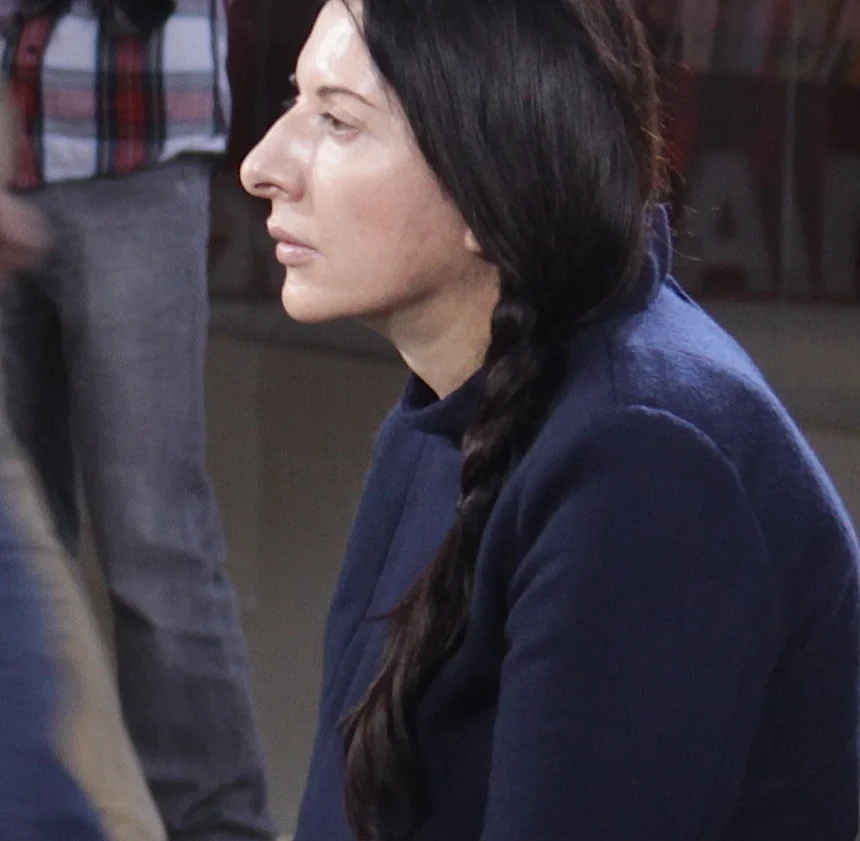
Image from Wikipedia
Image from Wikipedia
Marina Abramović – The Great Architect of Performance Art
An artist who made the body an instrument, the stage a crucible, and the audience's perception the actual event
Marina Abramović is one of the most influential performance and conceptual artists of our time. Born on November 30, 1946, in Belgrade, she grew up in what was then Yugoslavia in a political and disciplined environment that would profoundly shape her art later on. Early on, she developed a radical approach to the body as a medium, as a boundary between pain, presence, ritual, and mental concentration. Her biography is closely linked to an artistic practice that focuses not on decoration but on intensity, endurance, and immediate experience. (marinaabramovic.com)
Biographical Roots: Belgrade, Strictness, and the Birth of a Radical Aesthetic
The early years in Belgrade provided not only the geographical origin but also the psychological foundation of her work. Abramović began her career in the early 1970s in Yugoslavia after studying at the Academy of Fine Arts in Belgrade. Even in this phase, her interest in the limits of physical and psychological endurance, in simple actions, and in the condensation of time was evident. In her art, the body was not merely represented but utilized: as material, as statement, and as a site of existential testing. (marinaabramovic.com)
The official biography describes her as one of the defining figures of a generation that includes Bruce Nauman, Vito Acconci, and Chris Burden. This context firmly establishes Abramović in the history of international performance art, which sought new forms of immediate artistic experience in the 1970s. Her works early on questioned how much a body can endure, how the audience relinquishes control, and how art becomes an experience that must not just be observed but lived through. Precisely therein lies her historical significance: she shifted the boundaries between work, action, and spectator role. (marinaabramovic.com)
The Breakthrough: Performance as a Boundary Experience
The decisive artistic breakthrough arose from works that directed the audience's attention to fundamental questions: What happens when an artist exposes her own vulnerability? What occurs when rules are lifted and responsibility is handed over to the spectators? Works like Rhythm 0 and early series from the 1970s made Abramović internationally known because they illuminated the relationship between power, risk, and collective participation with unsettling clarity. Her work was never purely provocative but always analytical as well: it explored the mechanics of violence, compassion, and escalation. (en.wikipedia.org)
Particularly striking is the consistency with which Abramović incorporated pain, exhaustion, and danger into her work. According to the official artist biography, the pursuit of emotional and spiritual transformation was at the core; the body became the benchmark of consciousness. This radicality not only drew attention in the art world but also sparked lasting discussions about the role of the audience in performance art. Marina Abramović transformed the viewer from a passive consumer into a co-responsible participant in the space. (marinaabramovic.com)
The Collaboration with Ulay: Two Bodies, One Artistic System
Between 1975 and 1988, Abramović collaborated with the German artist Ulay; together they developed some of the most significant works in the history of performance. This phase was characterized by duality, synchronicity, and confrontation. The dialogue of two bodies became a compositional principle that simultaneously made closeness and distance, trust and friction, partnership and conflict visible. Their joint performances are now considered canonical works of body art. (marinaabramovic.com)
The collaboration with Ulay ended in 1988, and Abramović returned to solo performances in 1989. However, the years of joint practice remained stylistically formative: they sharpened her understanding of rhythmic repetition, physical presence, and the dramaturgy of direct contact. Works like The Lovers on the Great Wall of China or earlier relational performances illustrate how deeply Abramović understood the relationship of two bodies as an artistic instrument. This phase also gave rise to an important model for her later work: art as a situation, not as an object. (marinaabramovic.com)
Solo Career and International Recognition
After her breakup with Ulay, Abramović developed an exceptionally independent solo career. Her works were exhibited in leading museums and institutions, including the Centre Pompidou in Paris, the Neue Nationalgalerie in Berlin, and the Museum of Modern Art in Oxford. She was also represented at the Venice Biennale and the documenta in Kassel. These venues not only mark institutional recognition but also her lasting relevance in the discourse surrounding time-based art. (marinaabramovic.com)
The focus of her later works lies in the condensation of time and concentration. Projects like The House with the Ocean View, Seven Easy Pieces, The Artist Is Present, and 512 Hours made Abramović internationally renowned and solidified her reputation as an artist who transforms duration into experience. Especially The Artist Is Present became a cultural reference point as it made presence itself the artwork. The silent encounter, the endurance of gazes, and the control over one's own presence turned a performance into a media and societal event. (marinaabramovic.com)
Work, Sound, and Materiality: An Aesthetic Language Beyond Classical Formats
Although Marina Abramović is not a musician in the strict sense, sound, voice, and rhythmic structure play an important role in her work. The official overview of her work lists not only performance but also video, photography, sculpture, and sound as central forms of expression. Works like Balkan Baroque particularly show how strongly acoustic and visual layers can be intertwined. There, noise, song, material, and image converge into a disturbing, politically charged composition. (marinaabramovic.com)
Balkan Baroque is the clearest example of this. The work, created in 1997, uses sound, water, bones, and a performative washing as an image of a destroyed historical space. In doing so, Abramović responded to the disintegration of her homeland and the violence of the Yugoslav wars. The official work description explicitly names the elements used and underscores how inextricably materiality and symbolism are connected in her art. Here, performance becomes a political memory, a bodily allegory, and an emotional archive. (marinaabramovic.com)
Cultural Influence, Reception, and Authority in the Art World
Marina Abramović has not only expanded performance art but has also anchored it in the awareness of a broad public. Her work has been repeatedly addressed by museums, international exhibitions, and art critical debates. The press has referred to her as one of the most important performance artists in the world; in a German assessment, she was even described as the most famous performance artist in the world. This authority derives less from a single work than from the consistency of an entire artistic attitude. (journals.ub.uni-heidelberg.de)
Current projects also demonstrate that Abramović does not remain a mere icon of the past. In 2025 and 2026, Balkan Erotic Epic is set to be presented and discussed as a large-scale new work in international contexts; reports reference an elaborate production with a large ensemble and a subsequent German premiere as part of the Ruhrtriennale 2026. This ongoing activity highlights her continued relevance: Abramović continues to work on formats that connect ritual, body, music, movement, and collective experience. Her art thus remains not museum-like, but present, intense, and publicly impactful. (elpais.com)
Current Projects and New Works
Among current focuses is the large-scale work Balkan Erotic Epic, which is understood by the press and institutions as a new, immersive piece with historical and ritual dimensions. Reports speak of a production involving numerous participants and a consciously physical, communal experience. Thus, Abramović continues her long-term investigation into how collective presence can be translated into performance. The audience is to become part of a controlled, intense space rather than observing from a distance. (elpais.com)
At the same time, the Marina Abramović Institute remains a central place for her work. The official website describes MAI as a platform that supports, researches, and presents performance. It is also where the Abramović Method she developed continues, a series of exercises that have evolved over decades to align body and mind for concentration and perception. In this connection of artistic practice, research, and mediation lies her long-term cultural reach. (marinaabramovic.com)
Conclusion: Why Marina Abramović Continues to Fascinate Today
Marina Abramović is captivating because she understands art not as a surface but as an experience. Her performances are tests of attention, endurance, and emotional truthfulness. Those engaging with her work encounter an artist who has redefined the body as a historical, social, and spiritual stage. This is precisely why her oeuvre remains so important in the present: it demands, disturbs, and clarifies simultaneously. Anyone who has the chance to experience Abramović live or in an immersive presentation encounters not just an artist but an entire school of presence. (marinaabramovic.com)
Official Channels of Marina Abramović:
- Instagram: no official profile found
- Facebook: no official profile found
- YouTube: no official profile found
- Spotify: no official profile found
- TikTok: no official profile found
Sources:
- Marina Abramović – Biography
- Marina Abramović – Solo Works
- Marina Abramović – Works with Ulay
- Marina Abramović – MAI
- Marina Abramović – Home / Artwork / Biography / Links
- Wikipedia – Marina Abramović
- Ruhrtriennale – Press Release for Balkan Erotic Epic
- NME – Current Reporting on MARINA
- MoMA – Marina Abramović: Balkan Baroque
- Wikipedia – Balkan Baroque
Upcoming Events
Balkan Erotic Epic | Ruhrtriennale 2026
In Conversation | Ruhrtriennale 2026
Balkan Erotic Epic | Ruhrtriennale 2026
Balkan Erotic Epic | Ruhrtriennale 2026
Balkan Erotic Epic | Ruhrtriennale 2026
Balkan Erotic Epic | Ruhrtriennale 2026
Balkan Erotic Epic | Ruhrtriennale 2026