
Joseph Beuys
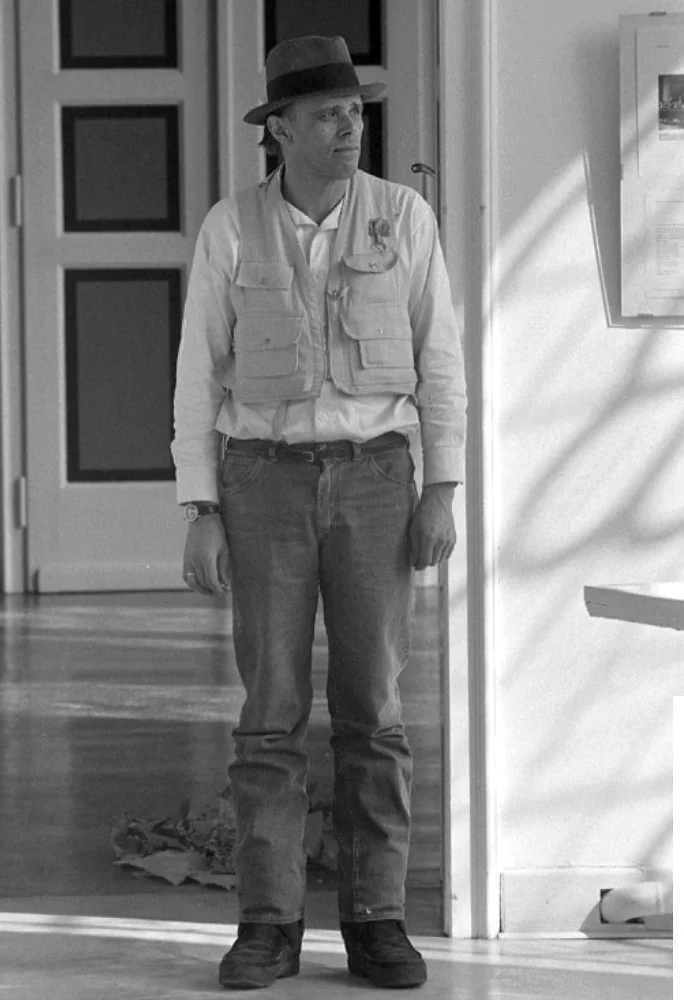
Image from Wikipedia
Image from Wikipedia
Joseph Beuys: The Radical Visionary Between Art, Politics, and the Idea of a Changed Society
An artist who transformed the expanded concept of art into a cultural provocation
Joseph Beuys was one of the most influential performance artists of the 20th century and at the same time a thinker who understood art not as a finished object but as a societal force. Born on May 12, 1921, in Krefeld and died on January 23, 1986, in Düsseldorf, he developed an artistic language that intertwined sculpture, drawing, action, theory, and political intervention. His works sparked admiration, controversy, and ongoing debates because he radically shifted the framework of art and gave it a social mission. (britannica.com)
Biographical Origins and Artistic Breakthrough
After World War II, Beuys studied at the Kunstakademie Düsseldorf and early on immersed himself in an environment that was searching for new forms of expression. His career evolved from visual artistic practice, but it soon became clear that he did not only want to create objects, but rather spaces for thought and action. In the post-war years, he participated in group exhibitions, worked with drawings and watercolors, and found an artistic stance that transcended the classical concept of art. (de.wikipedia.org)
Beuys gained international recognition primarily through his actions, his teaching, and his theoretical writings. Art criticism describes him as an avant-garde sculptor and performance artist whose works were characterized by unorthodox materials and ritualistic actions. This mixture of material rigor and symbolic elevation made him one of the most influential figures in post-war art. (britannica.com)
The Expanded Concept of Art: When Thinking Becomes Artistic Practice
At the center of Beuys’ work is the idea of the "expanded concept of art." For him, art did not only mean the finished work in a museum, but a process in which perception, language, society, and politics intertwine. With this attitude, he formulated an artistic worldview that incorporated humanism, social philosophy, and anthroposophy and condensed them into his own theory. (britannica.com)
Particularly powerful became the idea of "Social Plastic." Beuys understood society as a malleable material and demanded that every individual could contribute to its shaping. This radical democratization of aesthetics made him a key figure not only in art history but also in cultural-political and socio-theoretical debates to the present day. (de.wikipedia.org)
Actions, Materials, and the Power of Symbols
Beuys’ actions are among the most prominent contributions to performance art. Works like "How to Explain Pictures to a Dead Hare" or "I like America and America likes Me" demonstrate how intensively he worked with symbols, rituals, and media presence. Instead of harmonious composition, he focused on condensation, irritation, and surplus of meaning. The result was an art that could not be comfortably consumed but sharpened the gaze on the relationship between work, body, and public. (it.wikipedia.org)
His choice of materials also became part of his artistic handwriting. Felt, fat, and other seemingly simple materials took on an almost mythical charge in his hands, as they were connected to personal experiences, protection, energy, and transformation. This material aesthetic shaped not only his sculptures but also the perception of his entire music career in the broader sense of sound and action art, although Beuys was not a musician in the classical sense. (britannica.com)
Teaching, Influence, and the Political Dimension of His Art
As a professor at the Kunstakademie Düsseldorf, Beuys operated far beyond his own work. His teaching made him a formative figure for younger generations of artists, who saw in him not only a master but an intellectual challenger. With his understanding of art as an open societal practice, he influenced discourses on democracy, ecology, education, and collective responsibility. (britannica.com)
Beuys was by no means a silent theorist. He engaged in debates, founded initiatives, and connected art with political action. His positions were sometimes celebrated, sometimes harshly criticized, but it is precisely this friction that explains his enduring relevance. In retrospect, he appears as an artist who consistently eliminated the separation between studio and public, between aesthetic form and political stance. (neugraphic.com)
Sound, Recordings, and Beuys as a Cross-Border Media Pioneer
Although Beuys is not known as a classical musician, sound played a remarkable role in his work. The official Beuys On/Off project documents, for example, "Beuys Records Sound Notes" and refers to works that connect with music, voice, and documentary performance. It becomes evident that Beuys did not accept the boundaries between image, action, and sound, but intentionally made them permeable. (beuysonoff.com)
A particularly well-known example is "Sun instead of Reagan," which drew attention in 1982 as a political song and media action. The reception illustrated how unusual Beuys’ approach to pop and sound forms was: not as entertainment, but as intervention. This process fits into his overall artistic strategy, in which every medium could become a carrier of a social or political message. (en.wikipedia.org)
Discography, Reception, and Cultural Resonance
Beuys does not have a classical discography in the sense of a musician, but his releases, audio works, and documented sound actions are central to his oeuvre. The official project page "Beuys On/Off" refers to sound notes, documentary videos, and artistic formats that make the sound aspect of his work visible. Critically examined, Beuys stands at an intersection between performance art, conceptual art, and media self-presentation. (beuysonoff.com)
The art historical reception is enormous: Beuys is considered a globally significant performance artist and a central figure in politically and socially motivated art. Museums like the Kunstsammlung Nordrhein-Westfalen dedicate large exhibitions to him and highlight his impact on current debates. This enduring influence proves that Beuys not only left behind works but a model of thought that continues to resonate in contemporary art. (britannica.com)
Cultural Influence: Why Beuys Continues to Polarize Today
Beuys has often been described as the "ideal-type antagonist" of Andy Warhol because he understood art not as a reflection of consumption but as a means of societal transformation. This opposing position explains why his persona continues to polarize: he was never just a stylist, but always also a thinker, activist, and contentious figure. This is precisely where his historical significance lies. (de.wikipedia.org)
His influence extends from installation and performance art to ecological and democratic concepts of art to discourses in which art is understood as a social practice. Artists, institutions, and theorists continue to refer to his concepts today because they provide a language for collective responsibility and creative participation. Therefore, Beuys remains not only a name in art history but a touchstone for the question of what art can achieve socially. (kunstsammlung.de)
Conclusion: A Radical Artist Who Transformed Thinking into Action
Joseph Beuys is fascinating because he understood art not as a finished object but as a living form of change. His career connects sculpture, action, theory, pedagogy, and politics into a cohesive work that continues to provoke and inspire today. Encountering Beuys means not engaging with a comfortable classic, but with an artist who has permanently altered perspectives on society, creativity, and responsibility. (britannica.com)
His work still challenges us to not only observe art but to experience it as a space for thought about the present and future. Those who have the opportunity to discover Beuys in exhibitions, archives, or documentary presentations experience one of the most influential artists of the 20th century in all his force. This enduring fascination lies in Beuys's challenge to provoke rather than to explain. (beuysonoff.com)
Official Channels of Joseph Beuys:
- Instagram: no official profile found
- Facebook: no official profile found
- YouTube: no official profile found
- Spotify: no official profile found
- TikTok: no official profile found
Sources:
- Britannica – Joseph Beuys Biography
- Wikipedia – Joseph Beuys
- Beuys On/Off – Official Project Website
- Beuys On/Off – About
- Kunstsammlung Nordrhein-Westfalen – Society
- Kunstsammlung Nordrhein-Westfalen – Exhibition Material "Everyone is an Artist"
- Kunstsammlung Nordrhein-Westfalen – Press Release Joseph Beuys
- Kunstsammlung Nordrhein-Westfalen – Discussion Series "For the Rabbit Complex"
- Kunstsammlung Nordrhein-Westfalen – Collection Entry Joseph Beuys
- Wikipedia: Image and Text Source
Upcoming Events
Guided Walk to Beuys' 7000 Oaks
Guided Walk to Beuys 7000 Oaks
SET FREE FROM PURPOSE: Sculptures from the Schiffer Collection
Guided Walk to Beuys 7000 Oaks
Between and Beyond
Shared History? Joseph Beuys and National Socialism
Shared History? Joseph Beuys and National Socialism