Events on Democracy & Contemporary History in Duisburg
Events on Democracy & Contemporary History in Duisburg (Outlook)
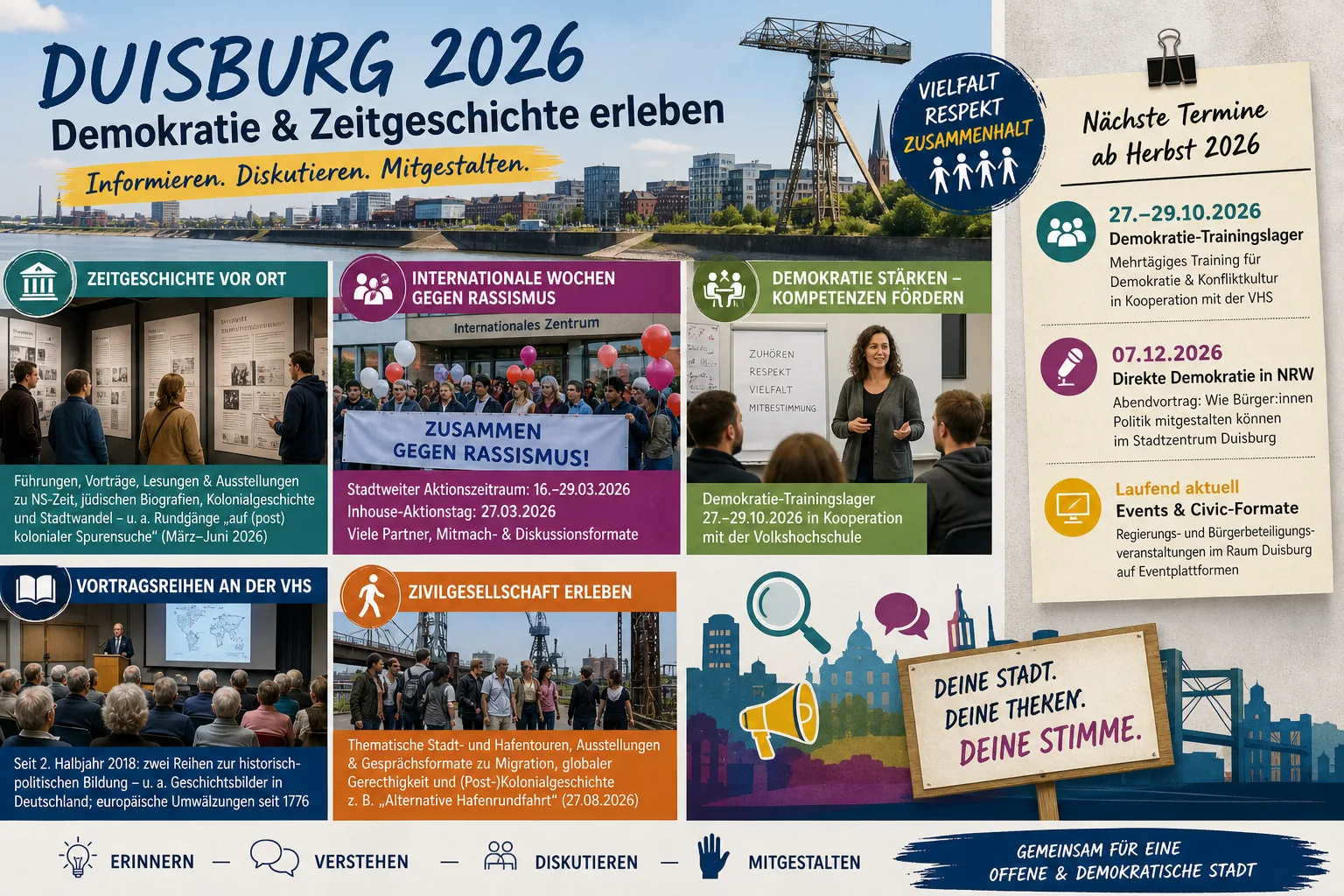
This outlook bundles formats that typically take place in Duisburg in the coming months and in the next annual cycle: city and harbor tours with a contemporary history focus, democracy education workshops, lecture series, and exhibitions with diverse perspectives. All notes are formulated so that you can use them for the next program season.
Contemporary History on Site: Tours, Colonial Traces, Exhibitions
If you are looking for offerings on democracy and contemporary history in Duisburg in the coming months, you will most likely first come across formats that start "on your doorstep": guided tours, thematic walks, and exhibitions. In the future, they will start where urban history and global interconnections become visible—in the urban space, in biographies, and in collections.
For your planning, it is helpful to filter by the following keywords in programs and calendars:
- City tour / City walk (often focusing on remembrance culture, Nazi history, Jewish life, migration)
- (Post-)colonial trace search (e.g., on trade, raw materials, language in the cityscape, debates on monuments and street names)
- Curatorial tours through exhibitions (with discussion elements instead of "frontal tours")
- Accompanying programs such as lectures, readings, or moderated discussions in the context of an exhibition
In terms of content, you can expect a mix in the future: historical classification (facts, sources, contexts), change of perspective (e.g., through voices of those affected, community formats, artistic positions), and the transfer to the present (What does this mean for racism, antisemitism, participation, and local responsibility today?).
International Weeks Against Racism: What to Expect in Duisburg
The International Weeks Against Racism will again serve as a citywide program window in the next cycle, in which initiatives, educational institutions, religious communities, cultural institutions, and schools bundle events. If you want to participate, it is worth looking for calls for participation, invitations, and program overviews in advance.
Which formats are realistically to be expected for the next implementation?
- Discussion rounds on everyday racism, institutional discrimination, and acts of solidarity
- Cultural and remembrance formats (readings, film discussions, performances) with subsequent classification
- Educational offerings for school classes and teams (methods, language, confidence in action)
- Neighborhood actions and encounter formats that are deliberately designed to be low-threshold
A focus that will remain particularly relevant in future programs is the examination of colonial continuities (in cityscapes, narratives, consumer and supply chains) as well as the strengthening of perspectives that are too often overlooked in classic historical narratives—including Black perspectives and voices of people with experiences of racism.
For your visit, this means: These weeks will likely be a good "entry ramp" to combine several formats in a short time—e.g., first an evening discussion, then a workshop, then a tour.
Workshops & Democracy Trainings: Try Out Politics
If you not only want to listen in the future but also want to practice, workshops and democracy trainings in Duisburg will offer the right formats. Unlike lectures, they focus on practical situations, role changes, and concrete options for action—for school, clubs, the workplace, or volunteering.
Typical content you can expect in upcoming courses
- Argumentation trainings against inhumane remarks (with exercises on conversation management, setting boundaries, de-escalation)
- Simulation games on municipal decisions (How are resolutions made? Where can participation begin?)
- Civil courage formats (acting safely, supporting others, assessing situations)
- Media and information literacy (recognizing disinformation, checking sources, conducting debates fairly)
In the next program season, many of these offerings will likely remain interactive: small groups, moderated exercises, and reflection replace long monologues. This increases accessibility—even for people who have had little contact with political education so far.
The transfer is important: Good democracy trainings will not only give you knowledge in the end but also a plan for how you can apply what you have learned in everyday life (e.g., conversation guides, support networks, information on counseling centers).
Civil Society Tours & Alternative Harbor Perspectives
In the coming months, civil society actors in Duisburg will continue to offer formats that deliberately "turn the page" on established city views. This becomes particularly vivid on thematic city and harbor tours that do not stop at architecture and industrial aesthetics but ask about social and global conditions.
What you can look out for on future tours
- Harbor perspectives with a global view: Instead of just explaining logistics, tours will in the future also consider trade routes, raw materials, working conditions, and inequalities.
- Context instead of backdrop: Good tours will explain terms (e.g., colonialism, racialization, remembrance culture) and anchor them at specific locations.
- Polyphony: Look for formats that deliberately include different perspectives—e.g., from migrant communities, research, educational work, or art.
Such offerings will likely help you to read familiar paths in new ways: street names, monuments, trade references, and narratives about "rise" and "prosperity" gain context when power relations and omissions become visible. This is precisely where a democratic added value lies: you practice understanding history as negotiable, justifiable, and responsibility-related—not as decorative scenery.
Lecture Series & Exhibitions: Remembering and Classifying
If you want to systematically deepen your knowledge in the coming program season, lecture series and exhibitions will provide the right structure. Series formats make it possible for terms and lines of conflict to be built up step by step—instead of "working through" everything in one evening.
Topics that will be particularly relevant in future series
- History of democracy: How do democratic institutions emerge, and how are they attacked or protected?
- Remembrance culture: How are guilt, responsibility, victim and perpetrator perspectives negotiated—and what follows from this for current politics?
- Antisemitism & Racism: historical roots, current manifestations, prevention and intervention approaches
- Colonial entanglements: local references, language in urban space, global dependencies, and counter-movements
Exhibitions will often make these topics tangible with documents, objects, media, and artistic works. If you are aiming for sustainable learning, ideally plan for both in the future: an exhibition (for vividness) and a discussion or lecture format (for classification and follow-up questions).
Experience Duisburg: How to Find Your Next Event
So that you don't get stuck in the jungle of offerings in the future, the search works best with a clear process. The following steps are designed so that you can apply them repeatedly over the next few months.
1) Start with the right calendar
- Use the municipal event calendar as well as the pages of major educational institutions (e.g., adult education center) and cultural institutions.
- Additionally, search for project and initiative pages, as tours and discussions are often announced there that do not appear in all standard calendars.
2) Filter with search terms that really fit
- "Democracy", "political education", "civil courage", "argumentation training"
- "Remembrance culture", "Nazi history", "Jewish life", "antisemitism"
- "postcolonial", "colonial traces", "critique of racism", "Black perspectives"
- "City tour", "harbor tour", "city walk", "curator tour"
3) Briefly check before registering (quality check)
- Transparency: Are the goal, process, duration, accessibility notes, and costs clearly stated?
- Competence: Are speakers or cooperation partners named (e.g., educational institutions, museums, specialist offices)?
- Discussion culture: Is there moderation, rules, or notes on how respectful discussion is ensured?
- Reference to sources: Is it clear what statements are based on (e.g., documents, research, eyewitness accounts, curatorial concepts)?
4) Select according to your purpose
- You want to get started quickly: Choose a guided tour or a moderated tour with a Q&A session.
- You want to learn methods: Choose a workshop or training with exercises and transfer material.
- You want to deepen your knowledge: Choose a lecture series plus accompanying exhibition or reading.
If you plan flexibly, you will often find formats in Duisburg in the future that can be combined—e.g., first a tour (location), then a workshop (action), then a lecture (classification). This mix strengthens both democratic competence and historical understanding.