Student & Pupil Events in Duisburg
Student & Pupil Events in Duisburg: Learn, Live, Connect (Preview of Upcoming Dates)
This overview shows you where to reliably find upcoming events in Duisburg for school, campus, and leisure: city calendars, university dates, career orientation, learning locations like the industrial park and city archive, as well as low-threshold youth culture.
What This Guide Is About (and How to Plan With It)
If you are looking in Duisburg for the next suitable event for school, university, or leisure, it pays to have a clear starting point: official calendars and contact points that continuously publish upcoming dates. This guide explains where to find these dates, which formats are typically announced there, and how to quickly filter out what fits your situation (upper school, university, teaching staff, or companion).
Important: Specific date entries change depending on the organizer. Therefore, use the linked calendars as a source for the currently announced and upcoming events.
Central Event Calendar: Your Entry Point to Duisburg's Education and Leisure Program
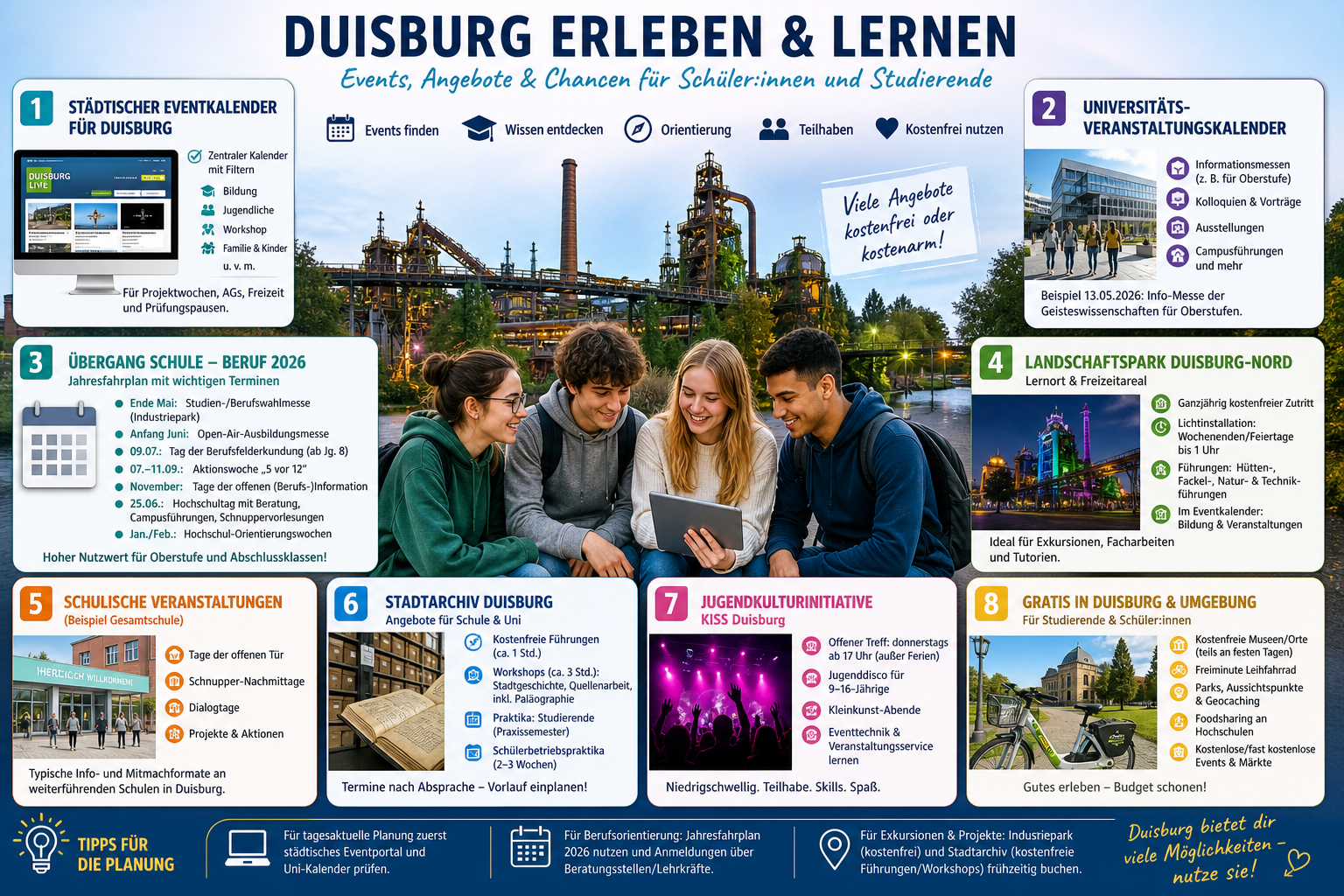
For a quick overview, the official event portal of the City of Duisburg is suitable. There, upcoming entries can usually be filtered by date and category (e.g., education, youth, workshop, family, culture). This way, you can specifically search for formats relevant to school groups, youth offers, or students.
Typical formats that you often find there as upcoming dates include:
- public lectures and discussion rounds (e.g., on urban development, environment, politics)
- creative workshops (e.g., media, theater, urban gardening)
- tours (e.g., museum, harbor, industrial backdrops)
- activities for young people and families, also suitable for clubs or project courses
Planning tip: Set up a routine (e.g., once a week or before the start of holidays) to check the newly announced dates.
University of Duisburg-Essen: Upcoming Campus Dates for Pupils and Students
The University of Duisburg-Essen (Duisburg Campus) publishes its own, continuously updated event notices. There you will find dates particularly relevant for study orientation, science communication, and university life.
For Pupils: Orientation and Insights
If you (or your school) want to gain a realistic impression of studying, orientation formats are especially interesting. Frequently announced are, for example:
- information events on choosing a course of study and degree programs
- taster offers such as lectures or introductions to subject areas
- university public events that welcome external guests
For classes or courses: Check the respective announcement to see if registration is required and if places are limited.
For Students: Looking Beyond Your Own Field
As a student, you can use the university calendar to find upcoming events outside your own degree program—such as lectures, colloquia, exhibitions, or skills and career workshops. This is particularly helpful for:
- finding topics and context for seminar or final papers
- networking with initiatives, departments, or central facilities
- additional qualifications (e.g., presentation, research, project work)
Transition School–Career: What You Find in the Annual Schedule for Your Next Steps
For career and study orientation, upcoming offers in Duisburg are often communicated collectively—especially for grades from middle school onwards. Such overviews help to plan the year early and secure suitable time slots.
In corresponding city overviews and announcements, you typically find:
- career and study orientation fairs
- advisory and matching appointments around training and dual pathways
- action days with insights into professional fields (e.g., explorations, company formats)
- additional dates for switchers and those doubting their studies, if advertised
For schools and teachers, the biggest advantage is: Planning becomes more reliable, as project days, career explorations, and parent communication can be better aligned with upcoming announced dates.
Industrial Park & City Archive: Learning Locations for Upcoming Tours and Workshops
Extracurricular learning locations are especially valuable if you want to connect theory with concrete places. In Duisburg, two contact points are particularly common, which also regularly announce upcoming offers or make them possible on request:
Industrial Park (Industrial Backdrop as Learning and Project Space)
A large industrial park in Duisburg is often used as a place for upcoming tours, thematic walks, and educational formats. For pupils, students, and teachers, it is especially interesting if you:
- plan excursions with a focus on technology, environment, history, or photography
- are looking for places for project work, documentation, or teaching formats outside the classroom
- want to organize low-cost leisure or group projects with an educational connection
If you are planning a tour or group format, check the respective announcement for registration and group size rules.
City Archive: Working with Sources and City History as Workshop Topic
The Duisburg City Archive is a central address for anyone who wants to deepen source work, local history, or research skills in the coming months. Depending on the offer and request, formats such as introductions, thematic workshops, or supervised research are particularly relevant.
For school classes, seminars, and project groups, the city archive is especially worthwhile if you:
- plan a specialist paper, project work, or scientific work with a Duisburg connection
- want to learn how to work with files, photos, maps, and historical documents
- want to practice research and source criticism in a practical way
Since educational archive offers are often prepared in advance, it is advisable to make an early request for planned future dates.
School & Youth Culture: Regular Series as Reliable Dates
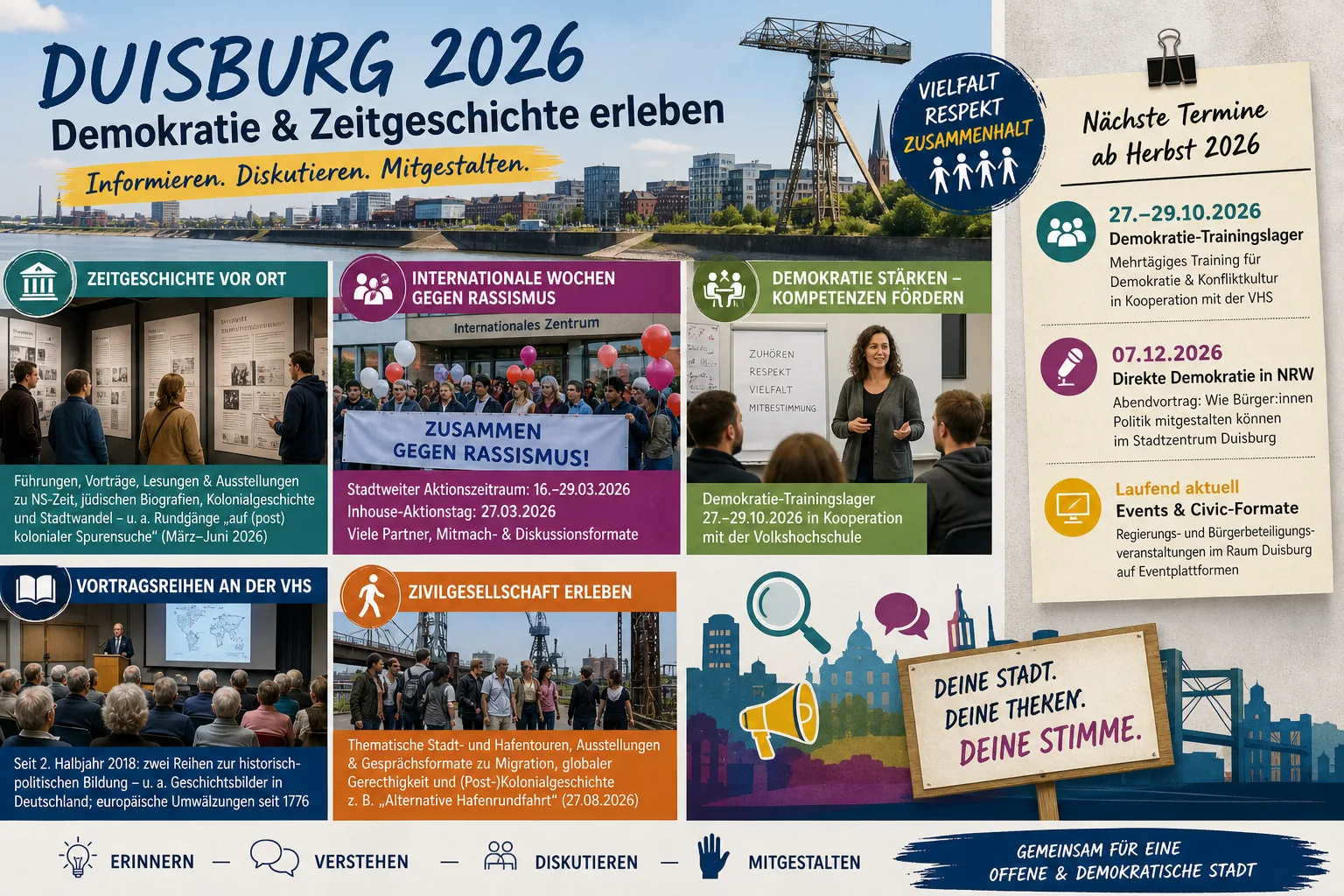
In addition to major events, it is often recurring formats that shape the everyday life of young people and students—such as open days, project presentations, club activities, or youth culture evenings. Such series are particularly plannable for the future, as they are often announced annually or in fixed cycles.
For pupils and families, these can be orientation dates at schools, for example; for student teachers and educational degree programs, school-related series are also a good way to identify upcoming observation or project opportunities—always depending on the published announcements and framework conditions.
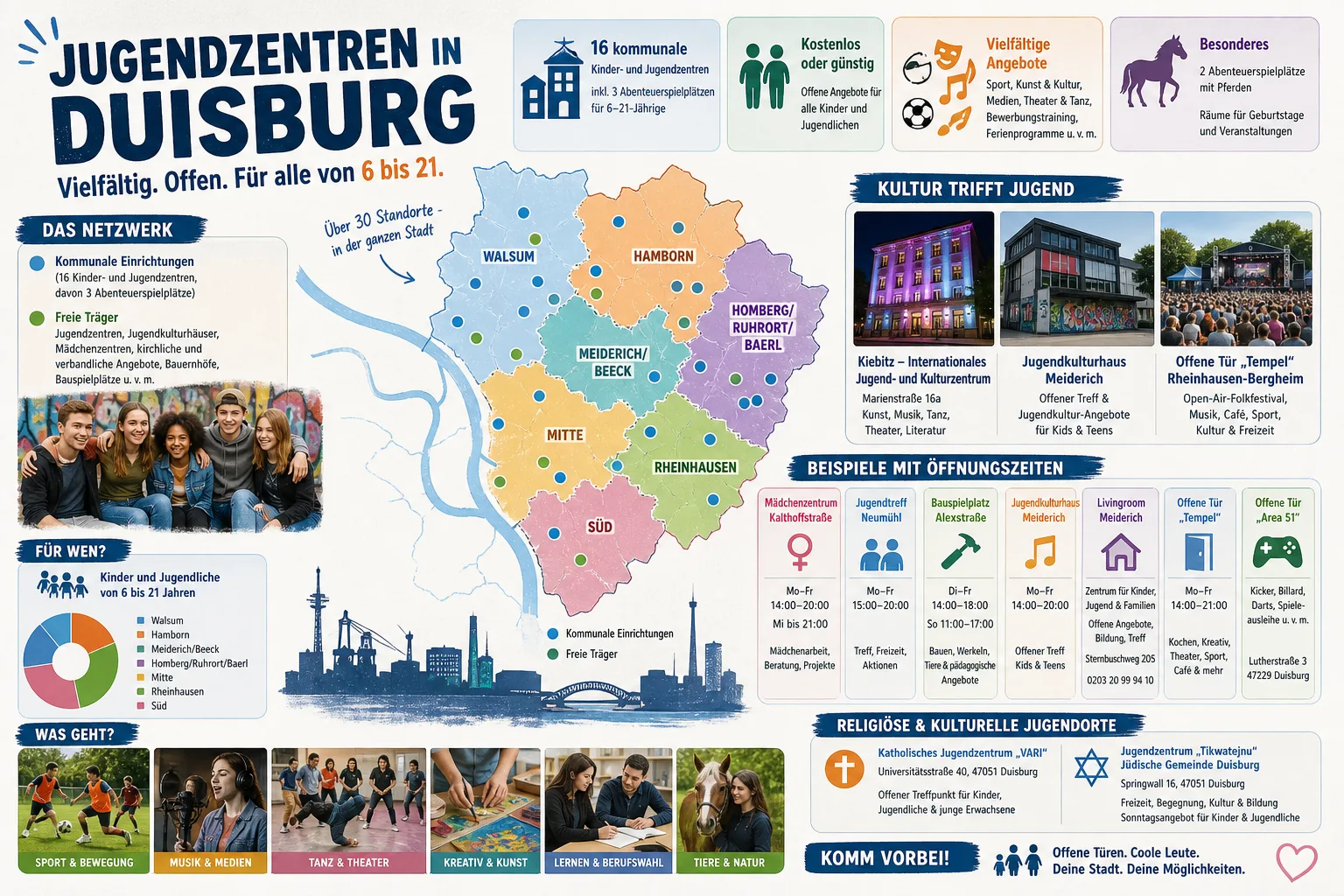
Additionally, in many cities (including Duisburg), there are initiatives where young people help shape cultural formats. When such offers are advertised, they often provide low-threshold access to event organization, technology, or stage experience.
Free Offers & Affordable Leisure Ideas for the Coming Weeks and Months
If the budget is tight, two strategies help: first, free places (parks, freely accessible areas, public learning spaces), second, free or inexpensive upcoming announced events (e.g., small concerts, local exhibitions, public lectures).
Possible starting points you can check for upcoming plans:
- freely accessible places for study groups, photo or media projects (e.g., parks, industrial backdrops)
- free public lectures and discussions (depending on the announcement)
- activities by university groups or neighborhoods, if publicly advertised
- sharing and exchange initiatives (only use if source/rules are clearly published)
Always check the details of the announcement before you go (admission, registration, age limits, accessibility, photo/film permission).
How to Quickly Find Suitable Upcoming Dates (Checklist)
- Clarify your goal: Is it about study orientation, subject input, leisure, practice/networking, or a school project?
- Choose your source: For citywide offers, first check the city event portal; for science and campus, use the university calendar; for orientation, possibly use city overviews for the school–career transition.
- Use filters: Category, target group, date range, district/location, costs, accessibility.
- Check framework conditions: Registration, group size, admission times, participation requirements.
- Secure a Plan B: If dates are fully booked, plan an alternative event or substitute location (e.g., outdoor learning location).