Experience Camping & Vanlife around Duisburg
Camping, Glamping & Vanlife around Duisburg: Planning for Your Next Trip
What does it feel like to wake up in the morning with a view of old blast furnaces – and in the evening of the same day experience the sunset on the Rhine, without needing a hotel? If you are planning a trip to Duisburg in the coming months (or for the next camping season), here you will find a clear, future-oriented guide: Which types of accommodation are likely to work, how to reliably check legal parking spots, and how to avoid conflicts with nature conservation, residents, and local authorities.
Goal: You go home with a realistic plan – including a checklist, alternatives in the surrounding area, and an FAQ for the most common practical questions.
1) Vanlife in Duisburg: How to Plan the Two Classic City Options
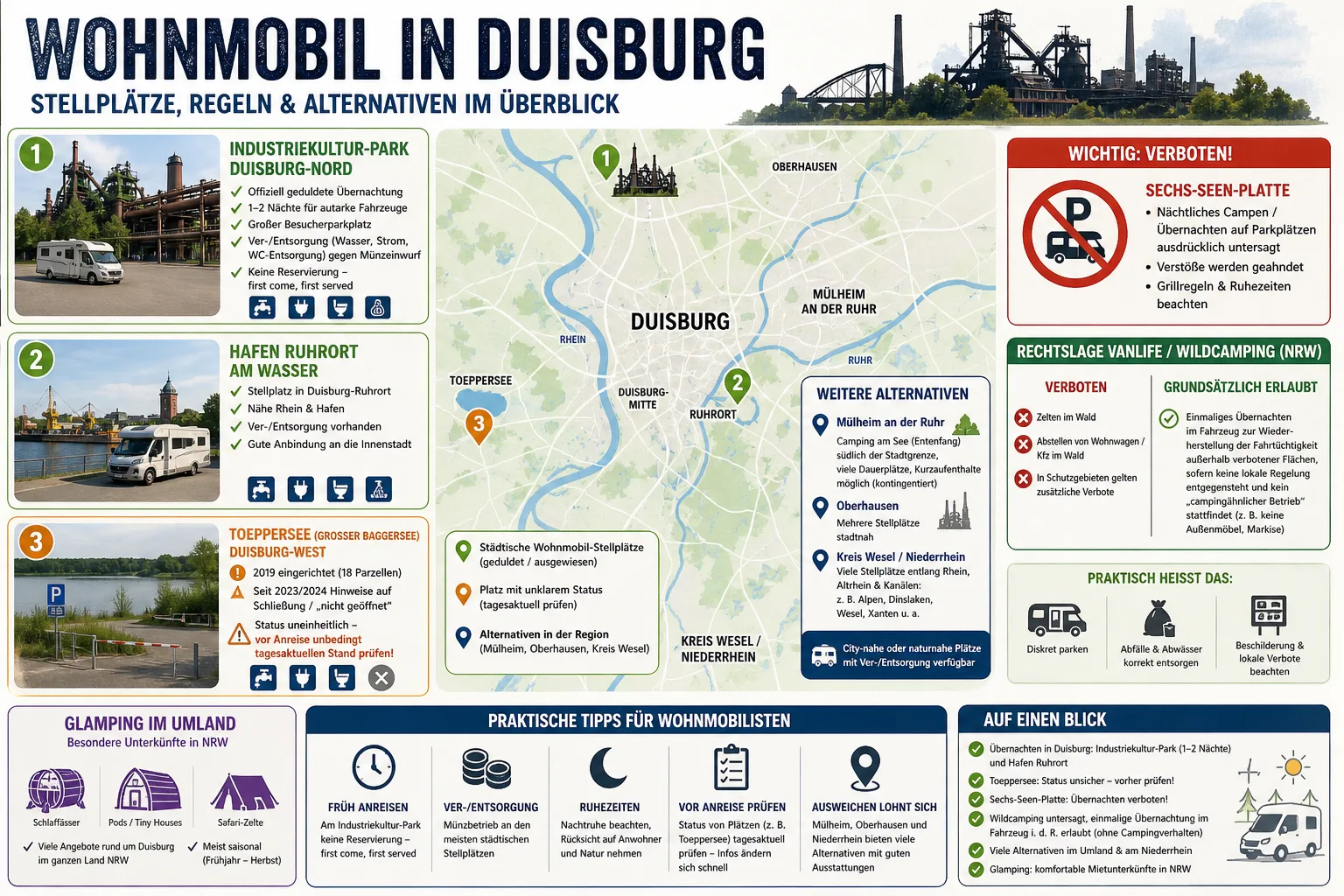
For a Duisburg trip with a campervan or motorhome, you will typically consider two inner-city options: a parking area near a large industrial heritage site in the north of Duisburg and a location in the harbor district of Ruhrort. Both are often used as a base in travel planning because from there you can plan short distances to water, bike paths, gastronomy, and urban highlights.
Industrial Heritage Site in the North: Overnight Only as Explicitly Intended
If you want to stay overnight there, plan so that you strictly follow the locally communicated rules (especially maximum length of stay, permitted vehicle types, and the distinction between "overnight stay in the vehicle" and "camping operation"). For practical purposes, this means for your next trip:
- Arrival time: Plan an early arrival on weekends so you are not dependent on alternative spots.
- Self-sufficiency: Expect to get by without "permanent camping" (no setting up furniture/awning outside, no claims to plots).
- Supply/disposal: Keep in mind that supply and disposal (if available) do not work like on a campsite: time slots, coin or short-term operation, and capacity limits should be considered.
- Check before departure: Read the operator or FAQ notes immediately before your departure, as details (e.g., temporary closures for events or maintenance) can change seasonally.
Ruhrort: Harbor Location as a Starting Point for the Rhine, City, and Bike Tours
If you want to focus your next days more on "water + city," it is best to plan in Ruhrort so that you are traveling on foot or by bike: harbor tours, Rhine promenade, and short distances to public transport/city can then be easily combined. For relaxed future planning, the following applies:
- Plan for noise profile: Near the harbor, it can be livelier than at a classic campsite.
- Stay mobile: Use the parking spot as a starting point for day trips and move nights to the quieter surrounding area if you prioritize relaxation.
- Provisioning: Plan shopping and gastronomy specifically at times when you are out anyway.
2) Surrounding Area Strategy: How to Secure Alternatives Around Duisburg
To ensure your trip works even if inner-city parking spaces are full, it is best to plan from the start with a "surrounding ring": neighboring cities and the Lower Rhine usually offer additional parking spaces, often near bike paths, rivers, or lakes. For the upcoming tour, this approach has proven itself:
- Set 2–3 alternative locations (e.g., one option each towards the Lower Rhine, towards the western Ruhr area, and towards the south).
- Define your minimum profile (e.g., electricity yes/no, water, disposal, public transport connection, dogs, maximum vehicle length).
- Check the current situation on the day of travel (opening, access, seasonal operation, construction sites/events).
This way, Duisburg becomes your day destination – and the overnight stay remains legal, plannable, and low-stress.
3) Lakes, Protected Areas & Parking Lots: What You Should Definitely Plan for Future Nights
If you plan your route along lakes and recreational areas, the following applies especially for upcoming trips: During the day, these destinations are often perfect, but at night, parking lots and waterfront areas are often explicitly not overnight locations. To avoid fines, towing, or conflicts in the future, please plan with these basic rules:
- Signs beat routines: If "camping/overnight stay prohibited" is posted on site, consistently plan alternatives.
- Protected areas are off-limits: In nature or landscape protection areas, additional restrictions usually apply at night – plan only day stays there.
- Forest is not an alternative area: For NRW, you should generally assume that camping and parking vehicles in the forest is not allowed unless explicitly permitted.
- "Restoring driving ability" is not a holiday strategy: Plan emergency sleeping only as an exception (and without camping-like behavior), not as a deliberate travel concept.
Practically, this means for your next Duisburg region tour: Plan lakes and green spaces as day programs (swimming, walking, paddling, cycling) – and reliably plan the night on designated parking or camping sites.
4) Glamping Around Duisburg: Plan Comfort Without Missing Out on Nature
If you (this time or in the future) travel without your own vehicle or simply want more comfort, it is best to plan glamping as you would a holiday accommodation: early, seasonally, and with clear criteria. In the NRW region, depending on the provider, you will typically find options such as:
- Pods, sleeping barrels or lodges near lakes,
- Tiny houses with terrace,
- Safari tents with fixed beds (sometimes with heating option, depending on the seasonal concept).
This rule of thumb helps for your next planning: Choose your glamping base according to connection (car/public transport), and plan Duisburg as a day trip. This way you combine industrial heritage, harbor, and Rhine with a quiet night in the countryside.
5) Checklist for Your Upcoming Trip (Camper, Motorhome, Tent & Glamping)
- 24–48 hours before departure: Check opening, rules, payment method, and possible temporary closures of your target parking spots.
- Define plan B: Set at least two alternative spots in the area (including access route).
- Stay discreet: If you only plan to "overnight in the vehicle" somewhere, consistently avoid camping-like behavior.
- Supply/disposal: Plan a fixed disposal stop (time, capacity, payment method) instead of "it'll work out somewhere".
- Nature conservation & night rest: Plan overnight stays only where they are explicitly intended.
- Weather & event days: Consider that major events, holiday weekends, and severe weather can noticeably increase occupancy.